 Andy Devaney
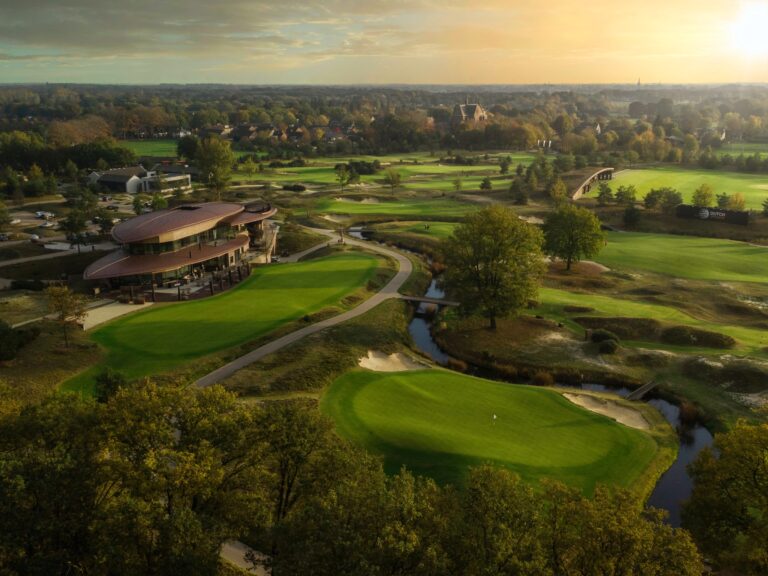
Bernardus is not merely a golf course with a comfortable place to sit afterwards. This Kyle Phillips-designed championship layout near Den Bosch hosted the Dutch Open from 2021 to 2023 and will welcome the Solheim Cup in September 2026. The tournament pedigree supplies the headline, but the better story is how convincingly Bernardus turns one round into a proper golf trip.
Located in Cromvoirt, around 15 minutes from Den Bosch, the course occupies a part of the Netherlands better known for medieval cities, cycling routes and improbably serious pastries than international match play. That may soon change.
The Solheim Cup will place Bernardus before a global audience, exposing every strategic angle, awkward recovery and nerveless putt to the usual forensic examination. Long before the grandstands arrive, however, visiting golfers can experience a venue that already understands the difference between selling a tee time and hosting a golfer.
One is a transaction. The other involves practice balls, a prepared trolley, a sauna and, ideally, nobody asking how many you had on the 14th.
A Kyle Phillips Course With Tournament Credentials
The Bernardus course was designed by Kyle Phillips, whose work tends to favour width, strategy and visual persuasion over the blunt instrument of endless rough.
That philosophy matters for travelling golfers. Championship venues can occasionally mistake difficulty for personality, producing courses that feel less like an examination and more like a disciplinary hearing. The better layouts allow different routes, reward sound positioning and give the player just enough rope to make a complete nuisance of themselves.
Bernardus arrives with credible competitive history. The Dutch Open was staged here on the DP World Tour for three consecutive years between 2021 and 2023, demonstrating the course’s ability to test elite players and accommodate a significant tournament operation.
The next assignment is larger still. In September 2026, Europe and the United States will contest the Solheim Cup at Bernardus. Match play has a habit of revealing a course’s character more vividly than stroke play. Holes become stages. Risks are taken earlier. Putts that would normally be treated with cautious respect are struck firmly towards the back of the cup, occasionally with magnificent consequences and occasionally into the following postcode.
For golfers visiting before or after the event, that history adds texture to the round. A drive is no longer merely a drive. It is a chance to consider where the world’s best will attack, retreat or stare grimly at a bunker while pretending it was always part of the plan.
The Bernardus Day Membership Changes the Rhythm
The Day Membership concept is one of Bernardus’ most persuasive ideas.
Golf travel is often full of small irritations. Bags must be located, tokens purchased, trolleys assembled and practice balls extracted from machines that appear personally offended by foreign bank cards. By the time the golfer reaches the first tee, the opening drive can feel like the final stage of an administrative decathlon.
At Bernardus, golfers are welcomed with prepared trolleys and practice balls. The details are modest, but the effect is not. Arrival feels organised. Practice becomes part of the day rather than a hurried attempt to locate the centre of the clubface six minutes before teeing off.
The membership also includes access to the gym, sauna, heated outdoor swimming pool and tennis court. For the golfer, these facilities turn the round into a fuller day at the club. For a non-playing partner, they provide an alternative to spending four hours pretending that the view from behind the 12th green is endlessly fascinating.
That makes Bernardus particularly suitable for couples and groups with differing levels of golfing devotion. One guest can play the championship course while another uses the leisure facilities or heads into Den Bosch. Everyone can meet afterwards, refreshed, fed and prepared to offer conflicting accounts of how productively the day was spent.
Staying Over Keeps the Golf at the Centre
The Lodge at Bernardus has just eight rooms, lending the accommodation a sense of intimacy that larger golf resorts often struggle to manufacture.
There is no need to leave the property immediately after the round. That matters. Some of the best golf conversations occur long after the scorecard has been abandoned, usually when one player has reconstructed a double bogey as an act of near-heroic resistance.
Bernardus Café provides the natural setting. Open seven days a week, it offers brasserie-style dining and the sort of relaxed post-round atmosphere in which a missed four-footer can be discussed with the seriousness normally reserved for central bank policy.
For a more ambitious evening, Nami by Bernardus offers Michelin-starred dining. Its presence lifts Bernardus above the familiar golf-resort formula of acceptable steak, oversized chips and a wine list selected primarily for its ability to survive prolonged exposure to a storeroom.
Wines from Bernardus Winery in Carmel Valley, California, strengthen the connection between the Dutch golf destination and the Bernardus name overseas. The pairing of championship golf, small-scale accommodation and high-level dining gives the property a clear identity. This is a place for golfers who take the game seriously but do not believe seriousness should continue through every course of dinner.
A Strong Golf Base Without Resort Confinement
Bernardus differs from many established European golf destinations because it does not demand complete surrender to the resort.
The Algarve and Costa del Sol remain obvious choices for reliable golf infrastructure, multiple courses and warmer winter conditions. Their strengths are considerable and well established. Bernardus offers something different: a championship venue with a genuine city close enough to shape the trip.
Den Bosch, officially ’s-Hertogenbosch, is around 15 minutes away. Its compact centre contains medieval streets, independent restaurants, cafés, terraces and cultural attractions. It is close enough for an evening meal after golf, yet substantial enough to justify a day away from the course.
That flexibility is valuable on a three- or four-night break. Golfers can build the itinerary around Bernardus without requiring every waking hour to feature a glove, scorecard or debate about green speed.
The city’s most unusual attraction is the Binnendieze, a network of waterways running beneath buildings and through its oldest quarters. Electric boats take visitors through the channels, offering a view of Den Bosch that is quieter and more atmospheric than the conventional open-top bus.
Art also plays a significant role. The Jheronimus Bosch Art Center explores the legacy of the city’s most famous painter, whose strange creatures and unsettling scenes may look oddly familiar to anyone who has ever joined a fourball on a difficult society day.
Het Noordbrabants Museum covers regional art and history, while Design Museum Den Bosch focuses on contemporary design and visual culture.
Then there is the Bossche Bol, the city’s celebrated cream-filled, chocolate-covered pastry. It is not an obvious piece of performance nutrition, although after 18 holes most golfers will find a way to justify it.
Golf, Recovery and a Change of Scenery
The wider North Brabant landscape gives Bernardus another advantage over self-contained resorts.
Loonse en Drunense Duinen National Park offers woodland, heathland and inland dunes, with routes for walking, cycling and mountain biking. These are useful additions to a golf break, especially for players who have discovered that recovery requires more than sitting in a buggy and announcing that their back is “a bit tight”.
Cycling is deeply embedded in the region, with dedicated routes linking Den Bosch to villages, historic towns and rural landscapes. The relatively gentle terrain makes it possible to add an active day without turning the holiday into an endurance test.
Heusden is a particularly appealing excursion. Its restored ramparts, cobbled streets, galleries and harbour provide a quieter alternative to Den Bosch and an easy half-day outing.
None of this diminishes Bernardus as the reason for travelling. It strengthens it. Golf destinations become more compelling when the course is not required to carry every hour of the visit.
Sabine Riezebos, General Manager of Bernardus, shared: “Many guests first discover Bernardus through golf, but there is so much more to experience during a visit. Den Bosch, the surrounding countryside and the wider North Brabant region offer culture, food, nature and a wonderfully relaxed atmosphere, all within easy reach. The Bernardus Experience is about creating lasting memories throughout the whole stay, whether on the course, around the table, at The Lodge or while exploring the region.”
Why Bernardus Belongs on the Golf-Break Map
Accessibility will help Bernardus convert tournament recognition into golf tourism.
The destination is approximately one hour from Amsterdam and can be reached via Amsterdam Schiphol, Eindhoven and Rotterdam airports. Düsseldorf and Brussels also provide viable gateways for travellers building a wider European itinerary.
That makes Bernardus practical for short breaks from the UK and for longer trips incorporating other destinations in the Netherlands or neighbouring countries.
The Solheim Cup will bring scale, noise and international attention in September 2026. Yet Bernardus does not need the event to manufacture relevance. The course has already staged three Dutch Opens. The hospitality is well developed. The accommodation is deliberately small. The food reaches well beyond clubhouse convention, and Den Bosch provides a genuine second act.
Most importantly, the golf remains the organising principle.
The first tee is why players will arrive. The quality of everything around it is why they may be reluctant to leave.