 Chandni Canan Bauer
The Blue Bay LPGA did not end with a serenely managed procession or one of those polished Sunday strolls where the leader spends four hours looking like she misplaced nothing more serious than a glove. It ended in a scrap.
Mi Hyang Lee, who began the day with the lead and nearly watched it skid into the sea, birdied the 72nd hole to win by one and claim her third LPGA Tour title in a finish that was messy, tense and all the more gripping for it.
She signed for a final-round 73, which is not usually the sort of number framed in gold after a victory, but golf has never had much time for neatness. Lee made five birdies, two bogeys and two double bogeys, hit 7 of 14 fairways, found 11 of 18 greens, and needed 27 putts.
It looked at times like a card assembled during an argument. Yet the closing stretch told a different story. She played the back nine in a bogey-free 33, and when the tournament demanded one last act of nerve, she birdied the 18th.
That was the shot that settled the Blue Bay LPGA, and it was the sort of finish that says more about a player than a clean scoreline ever could.
A Victory Built on Refusal
Lee’s final round had the wobble of a supermarket trolley with one bad wheel. An opening birdie suggested control. Two doubles on the front nine suggested something else entirely. At 4-over for the day, the thing looked to be slipping out of her hands.
It did not.
Instead, she did what experienced professionals do when technique starts blinking and confidence wanders off behind the clubhouse. She stayed in the fight. The birdies returned. The round steadied. The panic receded. By the time she stood on the 18th tee, the tournament had become a test of nerve rather than prettiness.
And she passed it.
This was Lee’s second time converting a 54-hole lead into a victory on the LPGA Tour, the first coming at the 2014 TOTO Japan Classic. That matters. Closing is its own skill in this sport. Plenty can lead after 54 holes. Far fewer can still breathe properly on the last.
Afterwards, Lee said: “Still kind of a little bit shake in my hands, and was first hole make birdie, but like two double front nine and then finish 4-over so was almost give up, but my caddie just kept telling me keep fighting, fighting. So I really fought, just didn’t give up, and then I just got to make a lot of birdie, so I think amazing. Feels amazing, yes.”
There is nothing polished about that quote, which is precisely why it lands. It sounds like the day looked: frantic, emotional and deeply earned.
What the Blue Bay LPGA Win Means
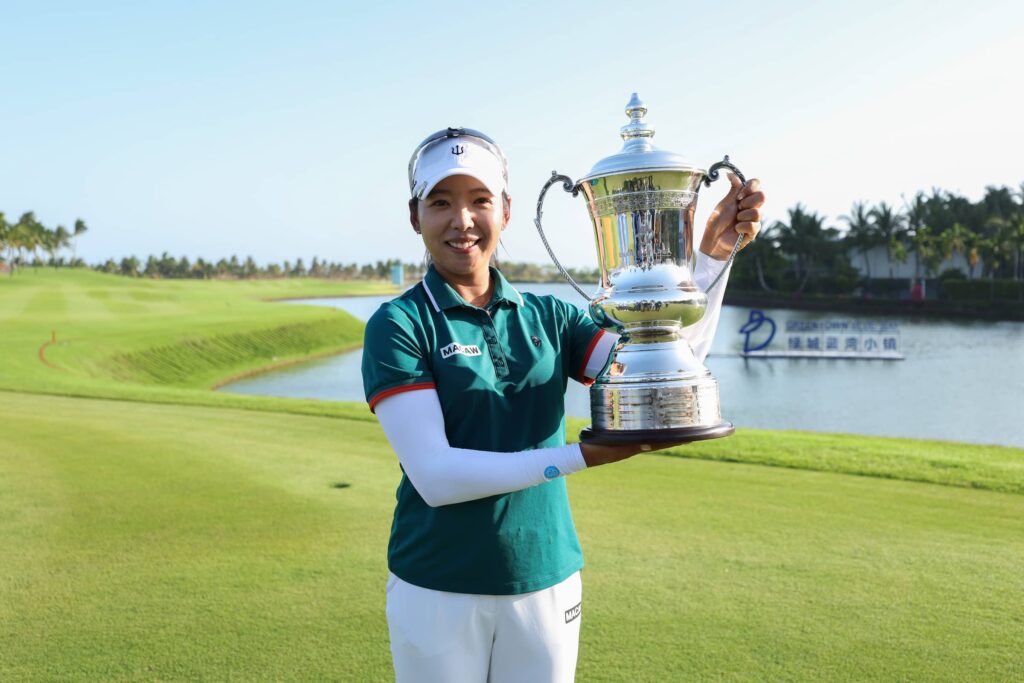
This Blue Bay LPGA victory was Lee’s first LPGA Tour win since the 2017 ISPS HANDA Women’s Scottish Open, ending a wait of 3,143 days between titles. For a player who joined the LPGA Tour in 2012, has now collected three wins, 30 top-10 finishes and more than $6.1 million in career earnings, it was both a return and a reminder.
She is now the fourth different winner in the first four events of the 2026 LPGA Tour season, an early sign that this year may offer about as much predictability as a cat in a bath. She also became the first player from the Republic of Korea to win on the LPGA Tour this season and just the second Korean winner in Blue Bay LPGA history, joining Sei Young Kim.
There are victories that announce arrival. There are others that confirm survival. This one felt like the latter, and that can be every bit as significant.
Lee also moved to No. 4 in the Race to CME Globe standings, passed $400,000 in official season earnings, and added another meaningful chapter to a career that has been steady, durable and, on this occasion, gloriously stubborn.
Weiwei Zhang Pushed Her All the Way
If Lee won the tournament on the final hole, Weiwei Zhang made sure she had to. Zhang finished solo second at 10-under after a closing 69, tied for the low round of the day and one of only 10 under-par rounds on Sunday.
Her card was hardly dull. She mixed five birdies, one eagle and four bogeys, hit 11 of 14 fairways, found 13 of 18 greens and took 30 putts. It was a round with plenty of gears and no shortage of ambition.
For Zhang, the result was significant beyond the obvious disappointment of coming up one shot short. She moved to No. 8 in the Race to CME Globe and finished as the leading player from the People’s Republic of China. It was also the second runner-up finish of her LPGA Tour career, which is another way of saying she is knocking hard enough now that eventually the door should open.
At this Blue Bay LPGA, she gave the home galleries every reason to lean forward.
Auston Kim and Aditi Ashok Add Substance to the Chase
Tied for third at 8-under were Auston Kim and Aditi Ashok, each arriving there by different routes.
Kim closed with a 71, making four birdies and three bogeys, hitting 12 greens in regulation and playing her last six holes in 3-under. She now has two top-three finishes in as many weeks and has climbed to No. 3 in the Race to CME Globe. That is not a hot streak so much as a bright flare. Her season has proper traction.
Ashok carded an even-par 72, with three birdies and three bogeys, and birdied her final hole to secure a share of third. It was her best result since a tie for second at the 2024 JM Eagle Championship presented by Plastpro, and it had the feel of a player putting a marker down rather than merely filling a spot on a leaderboard.
In tournament recaps, it is tempting to focus only on the winner and treat everyone else like furniture. That would undersell what happened here. The Blue Bay LPGA had pressure all over it.
Strong Performances Further Down the Board
Amateur Yujie Liu gave the local crowd another story worth following. The only amateur in the field to make the cut, Liu finished 3-under for the week after a closing 71 and earned a LEAP point with a tie for 12th. In a field full of seasoned professionals, that was no small contribution.
Defending champion Rio Takeda finished tied for fifth after a final-round 73. She made three birdies, two bogeys and a double bogey on Sunday. Takeda already owns part of the tournament’s scoring lore, having posted a 64 in the final round here in 2025, matching the 18-hole tournament record. She did not mount another charge of that sort this week, but her presence again underlined how demanding it is to repeat at this level.
The Numbers Behind the Result
The statistical texture of the Blue Bay LPGA final round told its own story. Lee hit only half the fairways and just over 60 percent of greens, yet still won because she responded when the tournament tilted. Zhang, by contrast, was cleaner tee-to-green, but one shot is a thin line between almost and enough.
That is often the case on Sunday in professional golf. The winner is not always the player who looks best in freeze frame. Sometimes it is the one who survives the most untidy bits without flinching.
Lee’s career record now stands at three LPGA Tour wins and 30 top-10 finishes. She first joined the LPGA Tour in 2012, won the 2012 Epson Classic on the Epson Tour, and captured the Gaelle Truett Epson Tour Rookie of the Year Award that same season. In 2025, she recorded three top-10 finishes and ended the year No. 50 in the Race to the CME Globe, her best season-ending mark since 2019.
So while this win at the Blue Bay LPGA may look on paper like a surprise given her Rolex Ranking of No. 83 entering the week, the broader truth is less dramatic. Good players rarely vanish. They simply go quiet for a while.
A Sunday That Felt Like Real Golf
There was something refreshingly human about the way this tournament finished. No sterile dominance. No robotic procession. Just a player wobbling, regathering herself and finding one last birdie when it was absolutely required.
That is why this Blue Bay LPGA mattered.
Lee did not win with perfection. She won with resilience, timing and a refusal to pack up the tent when the weather turned ugly inside her own round. Those victories tend to travel well because players recognize them and fans trust them. They look real.
And in the end, after all the doubles, all the pressure, all the shifting arithmetic on the leaderboard, Mi Hyang Lee walked off the 18th green with the one thing that matters most: proof that seven long years between wins can disappear with a single putt.