 Andy Devaney
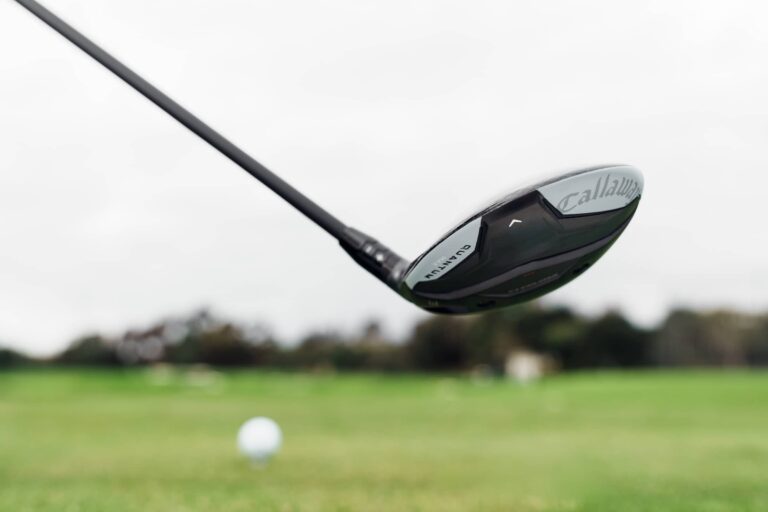
There are two kinds of golf launches: the ones that whisper politely from the pro shop shelf, and the ones that kick the door in, announce themselves, and start rearranging your bag while you’re still tying your shoes. Callaway is going for the latter with the all-new Quantum family—Drivers, Fairway Woods, Irons, and Hybrids—built with a clear message: this is meant to be a genuine step-change for golfers who’d quite like the ball to do what they asked, rather than what it fancied.
That’s the sort of line you read and immediately think, “Right then—show me where the magic is hidden.” And if you start anywhere, start with the irons, because that’s where most golfers live: in the daily grind of approach shots, thin strikes, heavy strikes, and the eternal search for a repeatable launch window that doesn’t require divine intervention.
Quantum Irons: speed, launch, and forgiveness with a grown-up shape

The Quantum Irons are engineered to deliver exceptional speed, high launch, consistent carry and forgiving performance across the face. The irons are underpinned by Callaway’s Modern 360 Undercut cavity that’s designed to deliver these fast ball speeds and high launch in a refined game-improvement shaping. This advanced two-piece design provides perimeter weighting and a fully exposed undercut for added flex where golfers need it most.
In plain terms, Callaway is chasing the holy trinity: faster ball speed (so your “good swing” actually gets rewarded), higher launch (so you can hold greens without needing a backboard), and consistency (so your 7-iron doesn’t occasionally impersonate a 9-iron). The headline tech here is that Modern 360 Undercut cavity—an architecture built to help the face do more of the work, particularly when contact drifts away from the center of the clubface, which is… let’s call it “common.”
That “two-piece design” plus perimeter weighting is the engineering version of a safety net. It’s there for the days when your tempo’s off, your feet are too quick, or you’ve decided to “just swing easy” and then immediately swing like you’re chopping wood.
The Tri-Sole idea: better turf interaction from long irons to wedges

The Progressive Tri-Sole Design in Quantum Irons promotes cleaner, more consistent contact across the set, with a re-engineered sole geometry that adapts from long irons to wedges for smooth turf interaction and efficient speed retention — even on heavy strikes. This lineup is available in Max and Max OS (super game-improvement) offerings.
If you’ve ever taken a heroic divot that started somewhere near your ball and ended somewhere near Edinburgh, you already understand why sole design matters. A progressive sole that changes through the set is a subtle, underappreciated performance lever—especially for everyday golfers whose low point control can be more “seasonal” than “repeatable.”
Callaway’s pitch is straightforward: cleaner turf interaction, more consistent strike, and less speed lost when you catch it heavy. In other words, it’s designed to reduce the penalty for being human.
Max vs Max OS: who are these Quantum irons for?

Callaway is offering Quantum irons in Max and Max OS configurations, with Max OS sitting in the “super game-improvement” end of the pool.
- Quantum Max is likely the broadest fit—players who want help with launch and forgiveness but still prefer a shape that doesn’t look like it was borrowed from a garden spade.
- Quantum Max OS is for golfers who want the most built-in assistance: higher launch, more stability, more “please keep this on the planet.”
Either way, the story is consistent: Callaway wants Quantum to be playable for a wide range of handicaps, not just the golfers who compress the ball like they’re paid per dimple.
Release dates: when Quantum hits screens and shelves
If you’re the sort who likes to “research responsibly” (or, alternatively, stare at launch imagery until your current clubs develop a complex), here’s the timeline:
- Retail: 30/01/2026
That gives golfers a clean runway: announcement, attention, then availability—no months-long limbo where you’re asked to fall in love with something you can’t actually buy.
Pricing: US and UK/EU RRP details
Below are the launch prices as provided for the Quantum irons line-up, including per-club and set options in the US, plus UK/EU RRPs.
US Pricing
- Max: Steel – $164/stick, $1149.99 per 7-piece set. Graphite – $178 per stick, 1249.99 per 7-piece set.
- Max OS: Steel – $164/stick, $1149.99 per 7-piece set. Graphite – $178 per stick, 1249.99 per 7-piece set.
- Max Fast: $192/stick. $1349.99 per 7-piece set.
UK / EU RRP
- Max / Max OS per stick: 167 GPB | 200 EURIR | 186 EUR | 186 CHF | 2000 SEK | 1333 DKK | 2083 NOK | 183 EURFI
Note: RRP the same for both steel and graphite shafts.
Note: Max Fast Irons are US only.
For UK and European golfers, the key practical note is the RRP parity between steel and graphite in the Max/Max OS offerings—useful if you’re weighing feel, launch, and vibration management without being nudged by a price step.
Where Quantum fits in the bigger Callaway picture
The clever part of this Callaway Quantum launch is the breadth: Drivers, Fairway Woods, Irons, and Hybrids under one family name. That matters because golfers don’t buy “a technology,” they buy a confidence loop. If the irons do what they promise—speed, launch, forgiveness, consistency—then the rest of the Quantum range benefits from the halo effect.
And make no mistake: this is aimed squarely at the largest group in golf—the people who want better results without needing a swing rebuild, a second job, and an appointment with a sports psychologist.