 Andy Devaney
Jill Thornhill has been named the latest recipient of the Gerald Micklem Award, a fitting salute to one of English golf’s great lifers: a champion on the scorecard, a servant of the game in committee rooms, and a quiet force behind generations of amateur talent.
Golf has a habit of measuring greatness in silverware, and Thornhill has enough of that to make a mantelpiece nervous. But this award is about more than trophies. It recognises a lifetime spent improving the game, particularly women’s golf, junior pathways and the amateur structures that so often do the heavy lifting long before television cameras show up.
Born on 18 August 1942, Thornhill began her golfing life in the late 1950s at Purley Downs Golf Club in Surrey. The talent did not take long to announce itself. By 1962, she had won her first Surrey County Championship. She would win that title 15 times in total, an astonishing record that still stands.
A Champion Before She Became A Builder
Thornhill’s playing CV reads like the sort of document that should come with its own steward and velvet rope.
She won the British Ladies’ Amateur in 1983, added the English Ladies’ Championship in 1986, and had finished runner-up in that event in 1974. She was also the leading amateur in the 1985 British Open.
Then there is the Curtis Cup record, which sparkles rather nicely. Thornhill competed in three Curtis Cups, winning two, including Great Britain and Ireland’s first victory on American soil. Personally, she lost just twice and claimed 8.5 points, which is not so much a contribution as a controlled demolition with a scorecard.
She later captained the Curtis Cup side in 1990, having already represented England at nine Home Internationals, played in the European Ladies Team Championship in 1985, and represented Great Britain and Ireland in the Vagliano Trophy four times before captaining the team in 1989.
On the county scene, she helped Surrey win eight County Championships. Add in the Avia Lady Golfer of the Year Award in 1983, three Hampshire Rose titles, three Astor Salver wins, the 1971 Newmark International, the 1983 Welsh Open Stroke Play, the 1986 New Zealand Foursomes and the 1993 British Senior title, and you get the picture.
Not a career. A weather system.
The Administrative Engine Behind The Elegance
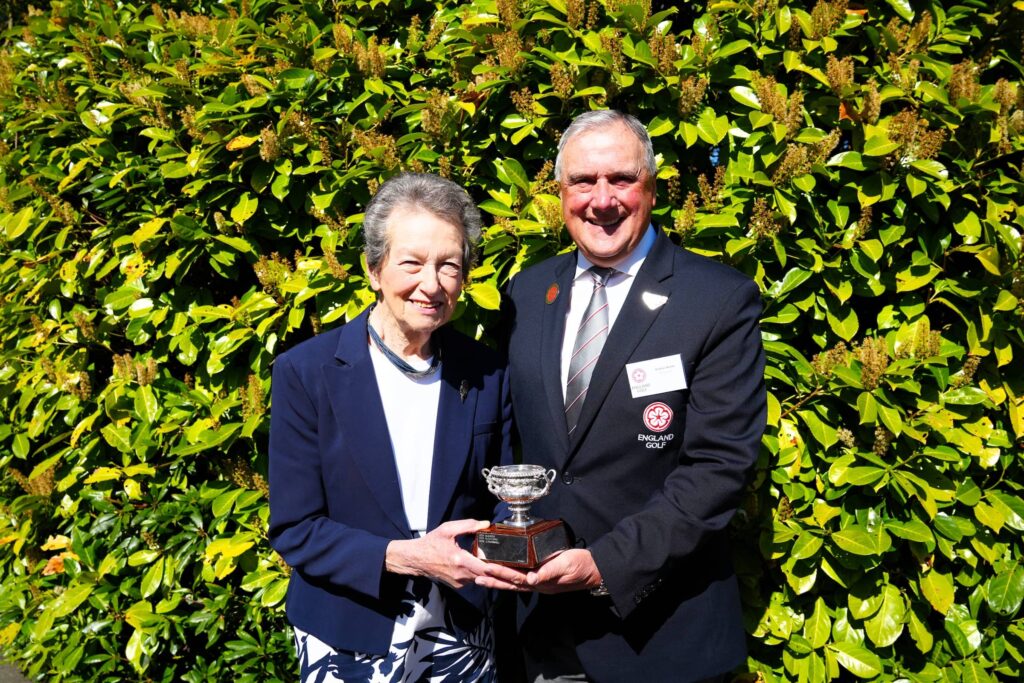
Yet the Gerald Micklem Award does not simply nod at someone who could play. It recognises those who give selflessly to golf, and that is where Thornhill’s story widens from personal achievement into proper legacy.
Over more than 30 years, she has served voluntarily at club, county and national level. Her administrative career included work with the South Eastern Division of the English Ladies’ Golf Association in the 1980s, followed by roles on the national ELGA Board, where she became Chairman in 1991.
She later represented England on the Ladies’ Golf Union for four years, chairing the Training Committee and bringing hard-earned competitive knowledge into the machinery of development.
That matters. Golf needs great players, yes. But it also needs people who understand how young players are found, supported, challenged and kept in the game. Thornhill has been one of those people: not waving from the balcony, but turning up, listening, organising and making the pathway less mysterious.
Surrey, Juniors And The Next Wave
Few places have felt Thornhill’s influence more deeply than Surrey.
She captained the county team in 1985 and 1986, then served as President from 2013 to 2015. Her presence across events, meetings and junior sessions helped set the tone for a thriving junior programme that has produced serious talent, including Lottie Woad.
Her work in the County Academy Programme strengthened opportunities for girls aged 8–15, giving players of different abilities a route into structured coaching and competition. In an era when women’s golf still fights too often for attention, that sort of groundwork is not decorative. It is essential plumbing.
Now President of Walton Heath Golf Club, Thornhill continues to champion junior golf. Her influence reaches into the current England setup too, with Annabel and Emily Peaford among the young players now representing their country. She has also supported players moving towards the professional ranks, including Annabel Dimmock.
There is a lovely symmetry in all that. Thornhill came through amateur golf, conquered much of it, then spent decades making sure the next generation had firmer ground beneath their spikes.
Still Playing, Still Relevant
At 83, Thornhill remains an active golfer and still plays off a Handicap Index® of 12.6. That detail feels important. This is not a figure from a sepia-toned photograph being wheeled out for polite applause. Thornhill is still part of the game’s living rhythm.
Upon receiving the award, Jill said:
“It’s a huge honour. I remember all the wonderful people I have worked with on the various committees who have helped us achieve some fantastic things.
“I think the most enjoyable part has been seeing the youngsters come through and the smiles on their faces, and watching them grow up and progress was wonderful.
“I’d like to see the importance of amateur golf playing a big role in their progress to turning professional. Amateur golf provides the grounding for every aspect of their future career.
“I’d also like to see better recognition and media coverage of women’s golf to help profile the game.”
Why The Gerald Micklem Award Fits
The Gerald Micklem Award celebrates people who have given deeply and consistently to golf. In Thornhill’s case, the word “contribution” almost feels under-clubbed.
She has been an elite amateur, a county stalwart, an England and Great Britain and Ireland representative, a captain, a chair, a president, a mentor and a visible advocate for girls’ and women’s golf.
More importantly, she has understood something the game sometimes forgets: amateur golf is not a waiting room for professionalism. It is where character is formed, competitive habits are built, friendships are made, and future champions first learn how to lose without combusting and win without floating off into the shrubbery.
That Thornhill wants greater recognition and media coverage for women’s golf says plenty. Even after decades of service, her instinct is still to push the game forward.
The Gerald Micklem Award is therefore not just a decoration for a distinguished past. It is a reminder of what golf relies on at its best: champions who stay, serve and make the game bigger than themselves. Jill Thornhill has done exactly that.