 Andy Devaney
LIV Golf has always preferred the front foot, the big entrance and the sort of disruption that arrives wearing expensive shoes. But even by its own noisy standards, this week feels different. Executives being summoned to New York. Rumours rattling around social media like loose change in a tumble dryer. A shuttered media centre in Mexico. And somewhere in the middle of it all, a league once built to shake the game now finds itself being asked whether it can steady itself.
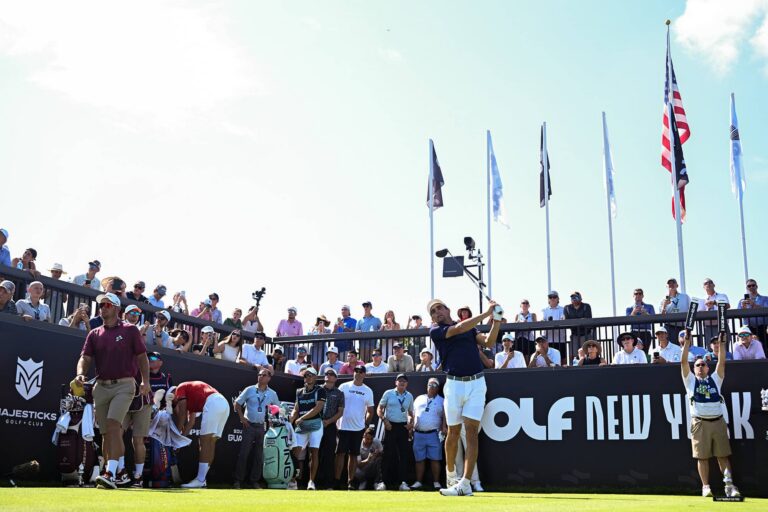
That is the intrigue hanging over the Saudi-backed circuit ahead of its latest event in Mexico City, where the chatter off the course has become every bit as loud as anything likely to happen on it.
According to reporting first detailed by The Daily Telegraph, LIV’s senior figures were absent from Club de Golf Chapultepec on Tuesday because they were travelling to Manhattan for what has been described as an emergency meeting ahead of a potentially “seismic” announcement.
In a sport that can turn a weather delay into a constitutional crisis, that sort of language does not exactly calm the room.
Why this LIV Golf meeting matters
LIV Golf was launched in 2021 by Saudi Arabia’s Public Investment Fund as a direct challenger to the PGA Tour, and it did not arrive quietly. Massive guarantees, shotgun starts, team franchises, a shorter format and a deliberate rejection of golf’s old order gave it the feel of a breakaway tour with a flamethrower in one hand and a cheque book in the other.
For a while, that was enough.
Big names crossed over. Bryson DeChambeau, Jon Rahm and Brooks Koepka became part of the circuit’s star power. The sums involved were eye-watering, the politics were bruising and the sport’s civil war dragged on long enough to make everyone look a bit tired.
Now the tone has shifted.
Recent reports of Brooks Koepka and Patrick Reed leaving to return to the established tours for the 2026 season have naturally intensified scrutiny. When recognisable names start heading for the exit, people stop talking about revolution and start talking about viability.
That is why a closed-door meeting in New York suddenly feels like more than a diary clash.
Mexico, Manhattan and mounting noise
The optics, it must be said, are not ideal.
For the first time in LIV Golf’s four-year history, the media centre was closed on Tuesday as journalists gathered for the $30 million event in Mexico. Claims later surfaced that a power board was not working, which may be perfectly true, but in tense moments even innocent explanations tend to arrive with muddy boots.
Meanwhile, social media did what social media does best: sprinted toward the loudest possible conclusion.
Rumours of a shutdown began to swirl, with one prominent golf account even claiming LIV was on the brink of collapse. That may prove to be nonsense, but the point is not whether the whispers are accurate. The point is that the vacuum exists at all. In modern sport, silence is not neutral. Silence is a petri dish.
And yet, among players, there appears to be no immediate sense of panic.
After speaking to several LIV golfers, The Telegraph reported that the prevailing feeling was one of business as usual. One player, though, admitted there was at least a theory doing the rounds, saying: “I’ll be honest. None of the players have heard anything. It’s hopefully a merger. Everyone gathers at Augusta don’t they?”
That quote lands with a familiar thud, because golf has been circling merger talk for what feels like half a century, though in reality it has been since the 2023 framework agreement between PIF and the PGA Tour. That deal was announced with much fanfare and has since produced more drift than destination.
Merger talk refuses to die
The idea of a deal has never really gone away because it makes too much sense not to haunt the conversation.
LIV Golf has money, profile and a roster of major champions. The traditional tours still have legacy, ranking infrastructure and week-to-week credibility. Put simply, both sides possess something the other still lacks. That is why every unexplained meeting, every Augusta handshake and every executive sighting becomes fresh fuel for speculation.
There has also been chatter about LIV and the DP World Tour entering discussions, although sources on that side were reportedly adamant that this latest upheaval had nothing to do with Wentworth.
So the sport waits, as it has done repeatedly, for a breakthrough that may yet turn out to be another mirage shimmering on hot tarmac.
South Africa showed promise, but the bigger picture is harder to ignore
The awkward thing about LIV Golf is that it can still stage a compelling event.
Last month’s tournament in South Africa was widely regarded as one of its most successful weeks. Big galleries turned up. Bryson DeChambeau won. The atmosphere looked lively rather than manufactured, which is no small thing in a format still trying to prove it can create genuine sporting texture rather than just expensive spectacle.
There were also signs of institutional progress, with LIV finally gaining recognition from the Official World Golf Ranking boards, a development that suggested the circuit might at last be moving from insurgency toward legitimacy.
On paper, that sounds like momentum.
In practice, the questions remain stubborn.
Television audiences have continued to disappoint, and for all the swagger of the product, that matters. A tour can survive bad headlines longer than it can survive indifference. Viewership is the coldest judge in the room, and it has not exactly wrapped LIV in a warm embrace.
Then there is the matter of competitive traction. At the Masters, England’s Tyrrell Hatton, tied third, was the only LIV player inside the top 10. DeChambeau, arguably the league’s most bankable attraction, missed the cut. That does not amount to a crisis on its own, but it does dull the argument that LIV’s stars are consistently dictating the biggest championships.
PIF’s strategy adds another layer
The timing of all this is not accidental.
The development comes as PIF approved funding for its strategy for the next four years. The statement, as provided, read: “The 2026-2030 Strategy represents a natural progression from a phase of growth and expansion to a new phase of achieving sustainable value, maximizing impact, increasing investment efficiency, and implementing the highest standards of governance, transparency, and institutional excellence.”
That is corporate language, naturally, and corporate language tends to make even dramatic ideas sound like a filing cabinet. But the important phrase in there is “sustainable value”.
That is the sort of wording people use when they are moving from splash to scrutiny. From expansion to evaluation. From launching the circus to checking whether the tents are profitable.
It does not automatically mean retrenchment, merger or structural change. But it does suggest LIV Golf is entering a phase in which performance will be judged less by noise and more by durability.
What comes next for LIV Golf?
That is the question now hanging over Manhattan.
If the announcement proves substantial, it could mark the most important moment for LIV Golf since its formation. A merger pathway, a strategic reset, an investment shift, a partnership model or a governance overhaul would all carry enormous implications not only for the league, but for the fractured shape of elite men’s golf.
If it turns out to be less dramatic than advertised, then LIV will once again have to deal with the problem that has stalked it almost from the start: the gap between spectacle and certainty.
The league is not short of money, names or ambition. What it still craves is settled purpose.
For now, the players are in Mexico, the executives are in New York and the rest of golf is peering through the keyhole. LIV Golf was built to force the sport into a new era. The question now is whether this week finally clarifies what that era is supposed to look like.