 Andy Devaney
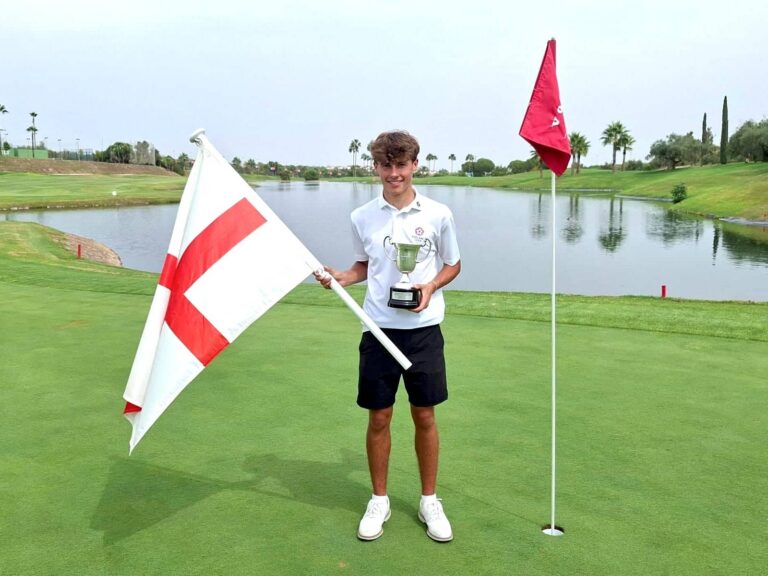
The McEvoy Trophy ended in the sort of delicious chaos that makes junior elite golf so compelling: a crowded leaderboard, a handful of lads swinging like they had ice water in their veins, and George Whitehead rolling in a winning birdie on the 18th as though this sort of thing happened to him every Thursday. It does not, which made it all the more impressive.
At Copt Heath Golf Club in Warwickshire, Whitehead of Hillside Golf Club won by a single shot after a final day that wriggled and twisted from one contender to the next. By the time the dust settled, he had edged Thomas Hartshorne, George Cooper and Alex Boyes in a finish as tight as a new pair of golf shoes.
This was no sleepy procession. The McEvoy Trophy, played over 72 holes in just two days, asked the field to sprint and think at the same time. Whitehead did both. He produced a sublime eagle on the 15th, conjured a superb par save on the 16th, then holed a 20-footer for birdie on the last to win it outright. That is not merely tidy golf. That is championship golf.
A leaderboard that refused to sit still
The event began at a gallop and rarely paused for breath.
Hartshorne and Aaron Moody set the early pace after the opening round, sharing the lead with matching fireworks of their own. Hartshorne’s 65 included an eagle and seven birdies, while Moody’s effort featured an eagle and six birdies. Whitehead and Boyes sat just one back, already close enough to smell trouble.
Then Boyes lit the touch paper.
His second-round 68 backed up an opening 66 and gave him a five-shot lead after the first day, with Moody his nearest pursuer. In most tournaments, that sort of advantage buys a player a bit of peace. In the McEvoy Trophy, it buys you an interesting seat at the front of a very fast-moving bus.
By Thursday morning, Cooper had surged with a bogey-free 67, Hartshorne added a 69, and they were the only two players in the field to break 70 in that round. Suddenly the whole thing was compressed again. The top five were huddled together, the crowd had started to sense a proper finish, and every fairway began to feel narrower.
Whitehead’s charge when it mattered most
What separated Whitehead in the end was not only the scoring but the timing.
Two eagles and three birdies in the final round gave him just enough to get over the line, but the score alone does not fully explain it. The key moments came when the tournament was wobbling in every direction and somebody had to take hold of it.
Whitehead did exactly that on the 15th. His eagle there was the jolt of energy a contender dreams about and every rival dreads. One hole later came the sort of par that often decides championships quietly while everyone is busy admiring the louder stuff. Then, with the arithmetic clear and the nerves humming, he poured in a 20-foot birdie putt at the 18th to win.
That final putt was the full stop on a round of nerve and nerve alone. More than 200 spectators were treated to a finish worthy of the occasion, and Whitehead, by his own admission, handled a new level of scrutiny with notable calm.
After winning, Whitehead said:
“It’s a privilege to win – there are so many great players who have played this event like Marco Penge. I didn’t expect to win coming into this week so it’s very special.
“It was a really solid couple of days from tee to green and putting. I made three eagles which I was surprised at, I’m so happy with how everything went.
“The eagle on 15 in the final round – a 15-footer left-to-right up the hill – that gave me some momentum. When I was on 18, I knew I needed birdie to win or force a play-off and it was a good 20-footer for the win.
“I’m happy that all the England team did well. To beat all of them was good, and with all the crowd too. I’ve never really had that before, it was quite special and I felt like I controlled my nerves so I was happy with that.
“I’ve got Fairhaven Trophy next up in a couple of weeks so I’ll be going into that to try and win.”
England’s pathway looks frighteningly healthy
The wider significance of this McEvoy Trophy was almost as striking as the finish itself.
England Golf had five Boys’ Squad players in the field and all five finished inside the top seven. That is not depth by accident. That is a performance pathway doing exactly what it is supposed to do. In fact, the top 10 players at Copt Heath, and 18 of the top 20, came from National or Regional Squads.
For England Golf, that is a rather loud endorsement of the system.
Whitehead may have taken the silverware, but he was hardly operating in isolation. Hartshorne was excellent, Cooper surged into contention impressively, Boyes had controlled large stretches of the tournament, and Moody helped set the early tone. This was not one player sneaking through a weak field. It was one player surviving a very strong one.
Low numbers everywhere you looked
There was other serious scoring around the course too.
Scott Antoun of Wildernesse produced the round of the tournament with a blistering 63 in the final round, eight under par and the lowest lap of the week. Alfie Turner of Trentham, another England Golf youngster, signed for a 66 to finish only three shots behind Whitehead.
That mattered because it showed just how little room there was for anyone to blink. The McEvoy Trophy was not merely won with birdies. It had to be defended from all sides.
What this win means next
Junior golf has a habit of revealing itself in flashes: a shot under pressure, a calm walk to the next tee, a putt holed when second place is still a fine outcome but not the one you want. Whitehead gave Copt Heath all of that.
The victory puts his name on one of the more respected titles in elite boys’ amateur golf and, more importantly, suggests he owns the sort of temperament that travels well. The Fairhaven Trophy is next, and he will arrive there with a fresh layer of belief and a rather useful reminder that when the door cracked open this week, he kicked it clean off the hinges.
The McEvoy Trophy has seen plenty of gifted players come through it. George Whitehead now joins that conversation, and he did it the hard way: one shot better than the rest, one holed putt on the last, and not much fuss beyond the scorecard. In golf, that is usually the best kind of statement.