 Andy Devaney
The PXG Hot Rod ZT arrives with a simple promise wrapped in a very modern idea: keep the face stable, keep the stroke repeatable, and stop asking your hands to perform emergency steering corrections at the worst possible time—three feet from glory, with your mates suddenly remembering how to blink.
Zero-torque design has been creeping from niche fascination to mainstream curiosity because it targets a common gremlin: the face that wants to wander open or shut when your stroke gets even slightly human. PXG’s angle is clear—engineer the wandering out of the equation, then dress it up in a confidence-building mallet shape that looks like it means business.
What “zero torque” is really trying to fix
Putters don’t miss putts. People do. But they often miss in predictable ways—starting the ball a fraction left or right because the face wasn’t square at impact. The Hot Rod ZT is built around a geometry trick with a practical goal: reduce the twisting forces that nudge the face off line.
PXG places the center of gravity just below the shaft axis, which is a tidy way of saying the head is less eager to rotate when you move it. Less rotation means less face manipulation required. In theory, that translates to tighter start lines, steadier contact, and a stroke that feels like it’s running on rails rather than opinions.
First impressions: looks, setup, and the “this feels steady” factor

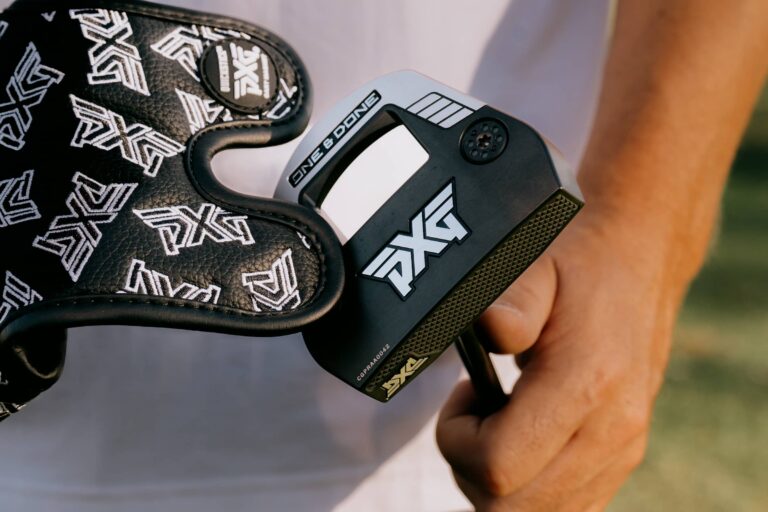
At address, the Hot Rod ZT leans into a high-MOI mallet profile that frames the ball neatly. It’s designed to look stable—because golfers are easy to spook and putting is mostly psychology with a side order of physics.
Two alignment options help you choose your preferred visual cue: SL2 with an elongated sightline, or SL1 with a clean line from the face and a blank back cavity. If you’re the sort who putts best when your eyes feel “quiet,” that choice matters more than most marketing departments admit.
PXG’s own design engineer puts the intent plainly: “Every detail of Hot Rod ZT was shaped around confidence, both visually and through impact,” said Matt Andrews, PXG Design Engineer.
“From the way the mallet frames the ball to the sound and feel off the face, we focused on creating a putter that looks stable, feels stable, and performs exactly the way players expect when it matters most.”
Materials and weighting: why this mallet is built like a tuning fork

The head is precision-milled from 6061 aluminium, and that matters because lightweight aluminium gives designers freedom: you can redistribute mass where it’s actually useful rather than where it happens to end up. PXG pairs that with concealed high-density tungsten and four interchangeable sole weights to increase stability and forgiveness.
The adjustable head weight range—340g to 410g—isn’t a gimmick if you care about tempo. Some golfers like a lighter, more “free” stroke. Others want heft that smooths out jabby tendencies. Being able to tune head weight can affect speed control, dispersion on mishits, and even your confidence on short putts (because nothing says fear like decelerating into impact).
Face tech: roll, sound, and the “insert feel” without the insert

PXG uses its Pyramid Milled Face Pattern, built with an aggressive pyramid geometry meant to interact more consistently with ball dimples. The practical target is more consistent roll—less skidding, fewer surprises, more putts that start behaving like they’ve read the script.
PXG also claims a sound profile many players associate with inserts—softer—while keeping the feedback of a fully milled face. That combination is attractive to golfers who want feel without the mushy “did I hit it?” moment that some inserts can create, especially on faster greens.
The forward press story: loft that “plays” differently
The Hot Rod ZT includes an onset hosel with an integrated forward press. It’s engineered with 6 degrees of measured loft, but PXG says it plays like a traditional 3-degree putter. The intent is consistent launch—getting the ball into a predictable roll window across different strokes and different hands-at-address tendencies.
For golfers who naturally press their hands forward, this can help avoid de-lofting the putter into low-launch, high-skid putts. For golfers who don’t, it’s a reminder to get fit—because built-in forward press can be brilliant for one player and awkward for another.
On-green performance: stability, forgiveness, and dispersion
In real-world terms, the PXG Hot Rod ZT is chasing three outcomes:
- Face stability: fewer unintended opens/closes through the stroke, especially under pressure.
- Forgiveness: better results when contact drifts away from the sweet spot—useful for distance control and start line consistency.
- Dispersion control: tighter grouping on where the ball actually starts, which is the first domino in the putting chain.
High-MOI mallets typically shine on mishits, and zero-torque concepts tend to help players who fight face rotation—whether that’s a push on short putts or a pull when the hands get too involved. If your miss pattern is “I made a good stroke and the face still did something,” you’re the target audience.
Who is this best for?
Best fit:
- Golfers who struggle with face rotation and inconsistent start lines
- Players who prefer a mallet look and want stability at address
- Those who like to fine-tune head weight to match tempo and feel
- Mid- to high-handicappers wanting forgiveness, and low-handicappers wanting repeatability under pressure
Potentially not for:
- Players devoted to a traditional blade look
- Golfers who dislike center-shafted visuals or built-in forward press
- Anyone who already putts best with lots of toe-hang and a strong arcing stroke preference (fit can still work, but it’s not the obvious bullseye)
Strengths and weaknesses
Strengths
- Strong stability concept: CG placement and center-shaft design aimed at reducing twisting
- High-MOI mallet forgiveness with meaningful weighting adjustability (340g–410g)
- Face milling designed for consistent roll plus a softer sound profile
- Two alignment options to match different eyes
Weaknesses
- Zero-torque and center-shaft aesthetics can be polarising at address
- Integrated forward press won’t suit every setup preference
- Performance gains depend heavily on fit—loft, lie, head weight, and stroke style need to agree
How it stacks up against the zero-torque crowd
Zero-torque putting is no longer a lonely outpost. The category includes established specialists and big-brand entries that all aim at the same thing: making it easier to return the face square.
PXG’s differentiators here are the adjustable head weight range, the 6061 aluminum + tungsten mass strategy, and the company’s emphasis on a milled-face feel with insert-like sound. The broader competitors may offer different balance philosophies, alignment schemes, or shapes—so it’s less about “best” and more about which one your stroke accepts without argument.
Verdict: a serious tool for golfers who want less steering
The PXG Hot Rod ZT is a modern mallet designed for golfers who are tired of negotiating with their putter face mid-stroke. If your best putts feel like the result of calm mechanics rather than last-second rescue missions, this is the type of design that can move the needle—especially when you dial in head weight and alignment to match your eye.
PXG is also smart to frame this as a confidence project, not just a physics project. Because putting doesn’t happen in a lab. It happens when your heart rate is doing interval training and the hole suddenly looks like it’s auditioning for a magic trick.
The Hot Rod ZT is available now in right- and left-handed models via PXG and fitting locations—where, frankly, it belongs. Zero-torque putters can be transformative, but only when the fit is right. In the wrong hands, even the most stable face in the world can’t fix a stroke that’s arguing with itself.