 Andy Devaney
Alison Lee, the professional golfer and Golf Saudi ambassador, has become one of the clearest voices in the build-up to the 2026 PIF London Championship, which returns to Centurion Club in Hertfordshire from 6–9 August as part of the Ladies European Tour and PIF Global Series. Her message is considerably more interesting than the usual tournament fanfare: women’s golf needs serious investment, but its players still measure progress in contention, pressure and trophies.
There is no shortage of grand language surrounding the development of women’s professional golf. Growth, transformation and opportunity are routinely sent marching into press conferences like a row of obedient corporate soldiers.
Lee’s perspective is rather more grounded. Investment matters because players can feel its consequences: stronger fields, wider international representation and tournaments carrying enough financial weight to command attention.
The PIF Global Series has placed a combined $15 million prize purse across five events. The figure is significant, but the more revealing detail is how that money changes the competitive environment around it.
“To grow the game, you need investment, and they believe in us,” says Lee. “It’s meaningful. You feel the investment, the care, the intention behind it. That kind of support makes a difference.”
That support is not an abstract talking point for players trying to build sustainable careers in an unforgiving individual sport. Golfers do not receive a weekly wage for turning up with a tidy backswing and a brave expression. Bigger prize funds can attract deeper fields, reward performance more convincingly and give tournaments a stature that extends beyond the ropes.
Centurion Club Takes Centre Stage
The PIF London Championship will return to Centurion Club for a sixth consecutive year from 6–9 August 2026.
The Hertfordshire event has become the established centrepiece of the Series, bringing the international field to an elite English venue at a useful point in the summer sporting calendar. Familiarity helps. So does continuity. Tournaments acquire identity over time, not through a collection of temporary signs erected beside the first tee.
For Lee, the more important consequence of the increased prize fund is the breadth and intensity of the competition it attracts.
“You see so many more girls from different countries coming to compete because the prize fund has gone up,” Lee notes. “It’s a huge win for professional sports, and in particular, a huge win for women’s professional golf.”
That international pull is central to the Series’ relevance. A global competition earns its description through the players it attracts, not through the number of flags printed on promotional material.
The arrival of golfers from different countries also raises standards. More players with genuine ambitions to win inevitably means fewer comfortable afternoons. Professional golf is especially democratic in that regard: everyone receives the same small target and roughly four hours in which to discover how unreasonable the game can be.
Motherhood Changes the Context, Not the Ambition
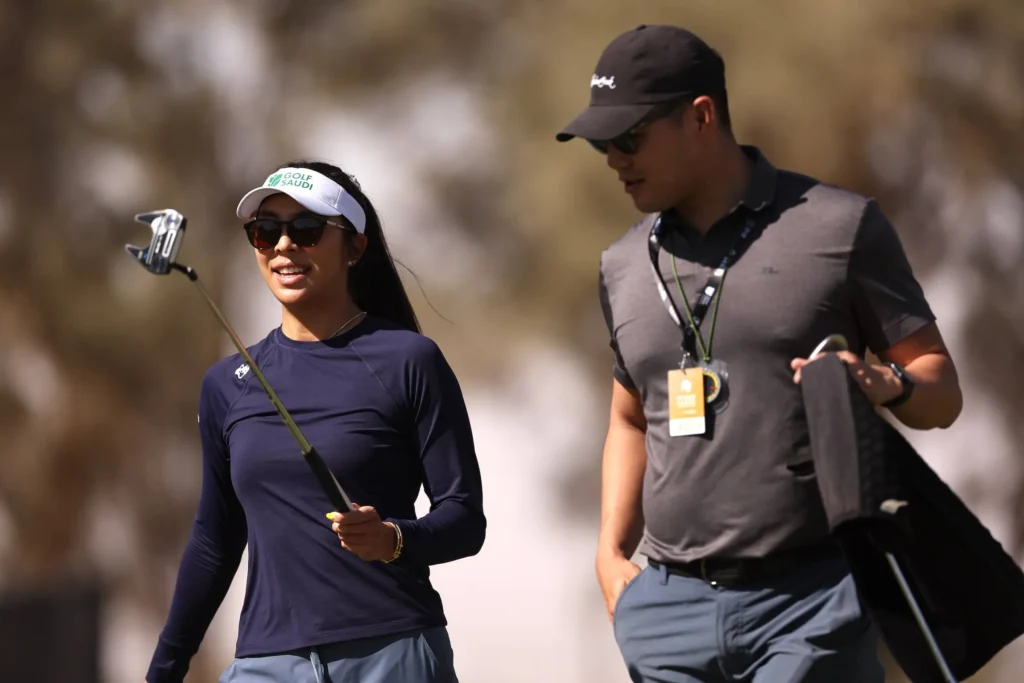
Lee’s return to golf following the birth of her son, Levi, gives her involvement a more personal dimension.
The physical and psychological demands of returning to elite competition after childbirth are not softened by a player’s previous achievements or reputation. Tournament golf remains impatient. The leaderboard does not offer bonus strokes for interrupted sleep, altered routines or the logistical complications of combining competition with parenthood.
Lee is not presenting the process as an exercise in heroic perfection. Her advice is more practical and considerably more humane.
“Give yourself grace,” Lee reflects. “To be a great athlete, sometimes you have to be selfish, and that’s okay. Take breaks, ask for help. It makes you a better mum too.”
There is refreshing honesty in that assessment. Elite athletes are trained to regard total commitment as a virtue, yet parenthood rarely respects training schedules, travel itineraries or carefully plotted performance plans.
Lee’s acceptance that ambition sometimes requires help is not a retreat from competitive seriousness. It is part of the machinery required to sustain it.
The destination has not changed, either.
“I don’t want to just make cuts, I want to contend.”
That is the line around which Lee’s return should be judged. Making cuts would represent respectable progress, particularly after time away from tournament golf. She is not interested in returning merely to populate the lower half of a leaderboard.
Contention is a more demanding standard. It requires more than recovering sufficient form to survive two rounds. It demands the ability to remain technically controlled and mentally coherent while the tournament tightens around its leading players.
Investment Must Create Better Competition
The PIF Global Series sits at the intersection of sporting ambition and commercial investment.
Golf Saudi and the Public Investment Fund are attempting to create more than a collection of well-funded tournament weeks. The broader stated ambition is to build a pipeline around the sport, using elite events to encourage participation and establish visible routes towards professional competition.
That intention should be assessed through outcomes rather than slogans.
The useful questions are whether the events continue to attract stronger international fields, whether players view them as important competitive opportunities and whether their influence reaches beyond the professionals already inside the ropes.
Lee’s comments suggest that the larger prize funds are already affecting player behaviour. More golfers are prepared to travel and compete because the potential reward now better reflects the commitment required.
Prize money alone cannot solve every structural challenge facing women’s sport. It can, however, establish seriousness quickly. It tells athletes that their performance carries value and tells audiences that the competition deserves sustained attention.
The significance is particularly clear in golf, where individual players carry much of the financial risk associated with travel, preparation and competition.
Women’s Golf No Longer Needs Modest Ambitions
Golf has spent years attempting to shake off the caricature of a slow, insular pastime preserved for ageing members and suspiciously well-ironed trousers.
The modern professional game is international, athletic and increasingly competitive for the attention of younger audiences. Women’s golf is not separate from that evolution. It is one of its strongest expressions.
The PIF Global Series is contributing by increasing the financial stakes and bringing players from different countries into the same competitive arena. The PIF London Championship offers a visible stage on which that strategy can be examined rather than simply announced.
Lee provides the human counterpoint to all the talk of prize funds and global expansion. Her career is now being shaped by the practical demands of motherhood, the patience required during a return and an ambition that has survived both perfectly well.
There is grace in her approach, but no shortage of steel.
As Centurion Club prepares to host the tournament for a sixth consecutive year, the most compelling measure of progress will not be the size of the claims made around it. It will be the quality of the competition played inside the ropes.
Lee has already set her own standard. She is not coming back simply to appear on a start sheet or scrape through to the weekend. She wants to contend.
That is how an expanding sport ultimately proves its worth: not by asking to be admired for growing, but by giving its best players a stage large enough to be fiercely ambitious.