 Chandni Canan Bauer
The U.S. Women’s Open has reached that splendidly uncomfortable stage where the scoreboard stops being a courtesy and starts acting like a customs officer.
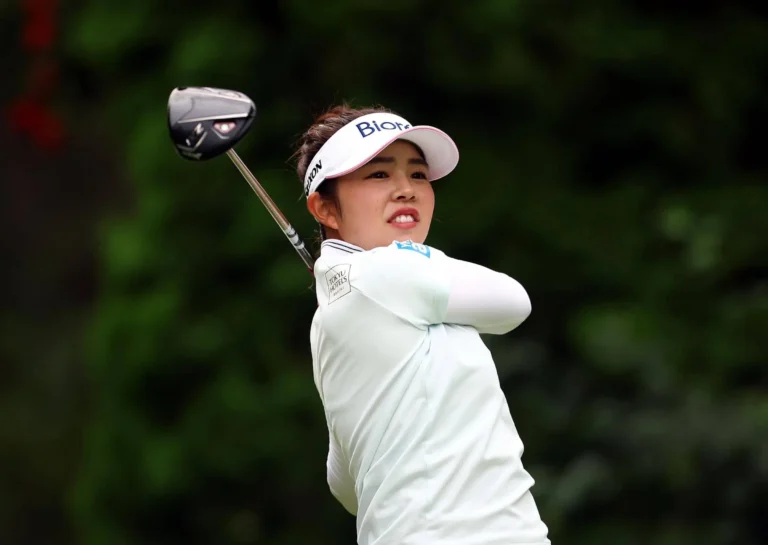
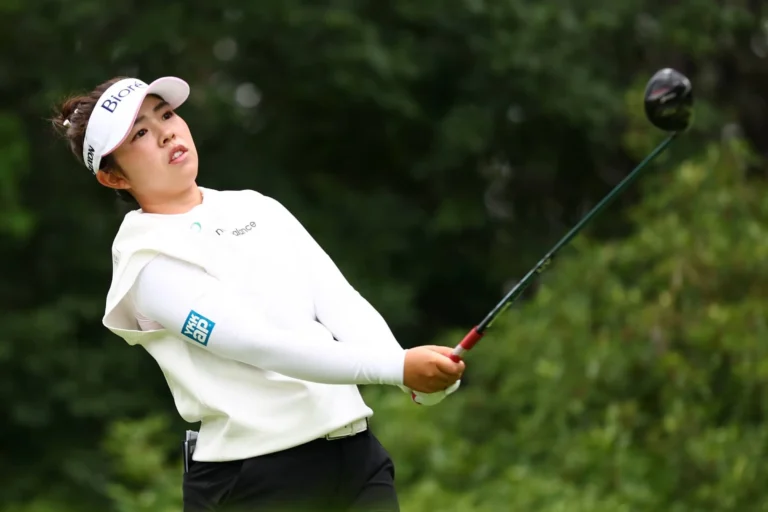
After Friday’s second round, Alison Lee and Ruoning Yin sit together at four-under par, with 68 players surviving the cut at +4 or better and a sizeable collection of major champions, hopefuls and hard-luck stories heading for the exit.
Lee And Yin Set The Pace
At the top, there is a pleasing contrast.
Lee, ranked No. 145 in the Rolex Rankings, shot a three-under 68 on Friday to earn her first post-round lead in a major championship. It is also a considerable improvement on her previous best position after two rounds at the U.S. Women’s Open, which was T18 in 2021.
Yin, world No. 4, was more serene than spectacular, signing for a two-under 69. Crucially, it was one of only three bogey-free rounds recorded through the first two rounds of the 2026 U.S. Women’s Open presented by Ally, alongside Minjee Lee in round one and Casandra Alexander in round two.
That is the sort of detail that does not shout from the leaderboard but matters enormously by Sunday evening.
Lee and Yin are two of just three players to record two under-par rounds through the first two rounds, joining Alexander, who opened with matching 70s. In a championship built to expose impatience, that steadiness is not decoration. It is ammunition.
Alison Lee’s Old Dream Finds Fresh Urgency
Lee’s position is especially intriguing because the one thing missing from her LPGA Tour career remains the one thing now hovering most tantalisingly in front of her.
She has 26 career top-10 finishes, $4.6 million in official career earnings and four runner-up finishes on the LPGA Tour. She has represented the United States in the Solheim Cup in 2015 and 2024. She has been close enough to victory to smell the varnish on the trophy cabinet, but has not yet won on the LPGA Tour.
Since 2020, three players have claimed their first LPGA Tour victory at the U.S. Women’s Open: Allisen Corpuz in 2023, Yuka Saso in 2021 and A Lim Kim in 2020. It is a brutal place to get off the mark, admittedly, a bit like choosing a thunderstorm for your first driving lesson. But history says it can be done.
Asked about what keeps her competing, and whether her motivation has changed over time, Lee gave a revealing answer.
“Realistically, I thought a few years ago when I became a mom, I wouldn’t want to come back and play. I thought it would be too difficult. I would say, just before having Levi, I played amazing. I had one of the best runs I’ve had in a really long time. I was really close to making the Olympics, playing on the Solheim Cup team.
I think that really gave me that spark again, and that was kind of — having that success really showed me like, hey, I can still have a chance to win out here because I still have yet to win on the LPGA Tour.
That’s been my biggest goal since turning pro. Like I feel like I had so much success in junior golf. I had a lot of success in college golf. Then when I came on Tour, I came close so many times, and I still haven’t been able to do that. So I told myself, okay, I’m going to have Levi.
I’m just going to do everything I can, just tell myself absolutely no regrets looking back and just try really hard for this next probably year to maybe two years to just play the best golf I can because realistically I feel like I’ve thought about my future a lot, and moving forward I do want more kids. I want a bigger family. I think, if I were to have another baby,
I think it would be ten times more difficult to try and come back and play. So I’ve really told myself like, hey, this next year, 2026-2027, I’m just going to do everything I can to possibly — I possibly can to play the best golf I can and say that I have no regrets.
So that’s kind of like a comforting feeling but also putting a little bit of pressure on myself. But I feel like I’m in a good head space now because I’ve truly accepted that.”
That is not corporate athlete-speak. That is a player measuring ambition against family, time, pressure and possibility. It gives her week a sharper edge than a mere number beside her name.
Ruoning Yin Looks Like A Major Champion Again
Yin, meanwhile, needs no introduction to major championship nerve. She won the KPMG Women’s PGA Championship in 2023 and is one of two players from the People’s Republic of China to win a major championship.
Her U.S. Women’s Open record is quietly excellent. This is her fifth start in the championship, she has never missed the cut, and her best finish is T4 in 2025. She has now shot even par or better in each of her last five rounds at the U.S. Women’s Open.
In 2026, Yin has made ten cuts in 11 starts, collected four top-10 finishes and arrived with two runner-up finishes among her previous three starts. That is not form. That is a warning label.
Asked how winning the KPMG Women’s PGA Championship changed her life, Yin was concise and clear.
“Quite a bit. Quite a bit. Because I think winning on the LPGA Tour is difficult, and winning a major is even more difficult. Winning at Baltusrol definitely boosted my confidence, and I just want to get another one.”
No confetti cannon required. Just ambition, neatly folded and placed in the yardage book.
Nelly Korda Sends A Friday Flare
The leaders did not have the stage entirely to themselves. Rolex Rankings No. 1 Nelly Korda produced the best round of the field through two rounds, a 67 that reminded everyone that she remains a deeply inconvenient presence for anyone with plans to win the championship.
It was the sixth time Korda has shot the outright low round of the day at a major championship. She also recorded a 32 on her front nine in round two, her second-lowest nine-hole score at the U.S. Women’s Open.
That sort of round changes the temperature of a championship. It does not guarantee anything, but it does tend to make everyone above her glance over a shoulder.
The Cut Line Was Not Sentimental
The U.S. Women’s Open cut line settled at +4 or better, and it was not in a forgiving mood.
Lauren Coughlin, at T9, made her first cut at the championship in her third appearance, at 33 years old. Xiyu Janet Lin, an LPGA Mom, made the cut in her first event back since having her son and sits T17. Karis Davidson, the last player to get into the field, is also T17, which is precisely the kind of late-entry mischief golf occasionally throws into a major.
Defending champion Maja Stark is T22. Melanie Green, also T22, is the only 2026 LPGA Tour rookie to make the cut.
The Romero sisters both made the weekend, with Kiara at T22 and Kaleiya at T45. Five amateurs also survived: Kiara Romero, Aphrodite Deng, Maria Jose Marin, Farah O’Keefe and Asterisk Talley. Each amateur who made the cut will receive one point in the LPGA Elite Amateur Pathway. A finish in the top 25 and ties could add another LEAP point.
That is a significant subplot. Major championships are not just about who wins on Sunday. They are also about who learns, who accelerates, and who leaves with proof that the next level is no longer theoretical.
Big Names Miss Out
Cut day also carried a rather unsentimental guest list of departures.
Lydia Ko, an LPGA Hall of Fame member, missed at T69. Megha Ganne, the 2025 U.S. Women’s Amateur champion making her first professional start, also finished T69.
Past champions Jeongeun Lee6, Michelle Wie West, Sung Hyun Park, Brittany Lang and Yuka Saso all missed the weekend. Madelene Sagstrom, playing almost seven months pregnant, finished T130. Hailee Cooper, who was T7 in 2025 in only her second LPGA Tour start, finished 156th.
There is no romance in a major championship cut line. It simply arrives, checks the arithmetic, and closes the door.
In Gee Chun Remains Very Much In The Hunt
In Gee Chun sits T3 at three-under, just one stroke behind Lee and Yin. In a championship where the scoring records remain forbidding — Helen Alfredsson’s 63 for 18 holes in 1994, Alfredsson’s 132 for 36 holes in the same year, and Minjee Lee’s 200 and 271 marks from 2022 for 54 and 72 holes — staying close is its own skill.
Chun’s motivation remains rooted in resilience, reinvention and the life that golf has given her.
“I think I never expect to come to the USA for LPGA, but after I won in 2015, my life was changed, everything. Now I’m here, and I have new friends out here. Sometimes it’s hard to be here and be alone because my family and friends are still in Korea, but I already told you like after I work with my new swing and then I got the confidence.
That’s a good motivation to keep playing out here. I feel never have like I’m too old. So I think I’m in a good mood, and I trust my team and they help me, and my fans still cheering me. Everything just make me more willing to keep playing out here.”
There is something admirable in that. Golf is often presented as a scorecard with shoes on, but careers are rarely so tidy. Chun’s words carry the weight of distance, adaptation and a stubborn appetite for the fight.
A Leaderboard With Proper Teeth
The leaderboard now has shape. Lee has the emotional current, the unfinished business and the chance to turn years of near-misses into something permanent. Yin has the major pedigree, the form line and the chilling calm of a player who already knows how the biggest weeks feel.
Korda has momentum. Chun has proximity. The amateurs have a foothold. The weekend has all the ingredients required to become awkward, dramatic and thoroughly watchable.
At the U.S. Women’s Open, nobody is handed anything. The championship makes players come and collect it, usually with trembling hands and a pulse rate that would worry a cardiologist.
Lee and Yin have earned the view from the top. Now comes the unpleasant business of staying there.