 Andy Devaney
There is a point in most golfers’ relationship with technology when enthusiasm collides with irritation. The promise is always seductive enough: better data, smarter decisions, lower scores. The reality, too often, involves tags, syncing, batteries, phone placement and the creeping suspicion that your gadget is demanding more attention than your backswing. Arccos Air enters that conversation with a rather more sensible idea. Put it in your pocket, play your round, and let the technology do its work quietly.
That is what makes this launch interesting. Not because golf suddenly needs another smart device, but because Arccos appears to have identified the one thing many players actually want from golf tech: less interference.
Arccos Air is designed to deliver AI-powered shot tracking without screw-in sensors, without carrying a phone in your pocket, and without turning the round into a digital admin exercise.
For a category that has often mistaken complexity for sophistication, that is a meaningful shift.
What is Arccos Air?

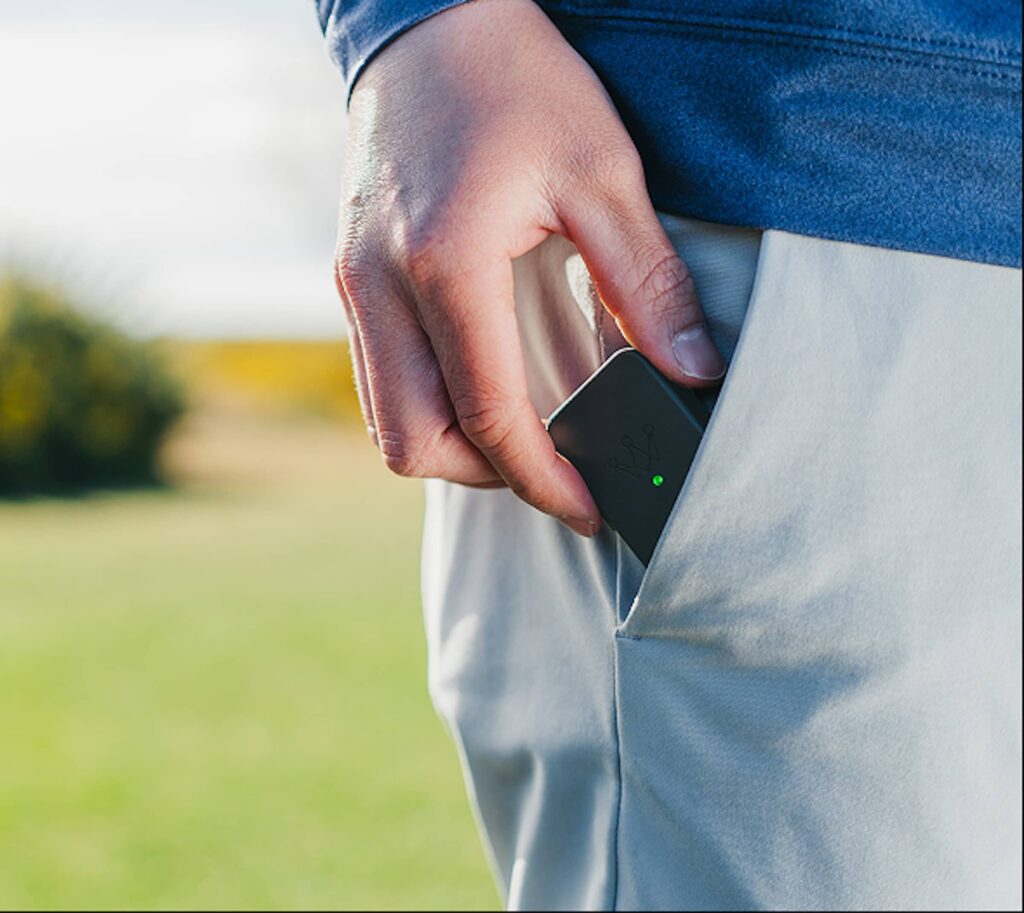
Arccos Air is a wearable shot-tracking device, roughly the size of an AirPods case, designed to sit in a golfer’s pocket during a round. Using a combination of gyroscope and accelerometer technology, along with onboard GPS, it automatically detects swings and maps shot locations throughout the course of play.
In simple terms, it is trying to remove the friction between playing golf and understanding golf.
That is an important distinction. Plenty of golfers are interested in performance data. Far fewer want the process of collecting it to feel like assembling flat-pack furniture in the rain.
Arccos Air is built around the idea that shot tracking should happen in the background, leaving the golfer free to get on with the far more pressing matter of trying not to carve a 5-iron into the nearest postcode.
Why Arccos Air matters

The real strength of Arccos Air is not that it gathers information. Lots of devices can do that. The value lies in how invisibly it aims to operate.
Golfers want to know why they score the way they do. They want to understand whether the damage is being done off the tee, into greens, around the green or on it.
They want proof, not vague post-round folklore about “not quite having it today.” What they do not want is a system so fiddly that it becomes another obstacle between intention and performance.
That is the problem Arccos Air is trying to solve.
“Arccos Air removes the biggest barrier golfers have had to understanding their game,” said Sal Syed, CEO and Co-founder of Arccos Golf. “Now, you don’t have to manage sensors or think about technology. You just play. And when the round is over, you know exactly where you gained strokes, where you lost them, and what to work on next. That kind of clarity leads to smarter decisions and ultimately lower scores.”
It is a strong summary of the product’s appeal. Golfers have never been short of data. They have been short of low-friction data that actually leads somewhere useful.
The technology behind Arccos Air

Under the hood, Arccos Air is leaning heavily on the scale of the company’s existing data infrastructure. Arccos says its AI models have been trained on 4 trillion data points from 1.5 billion golf shots, while the wider Arccos ecosystem has tracked 25 million rounds.
Those are serious numbers, and they matter because automatic shot detection only becomes valuable if it is accurate enough to be trusted. The system effectively has three jobs.
- First, it must identify when a real shot has occurred.
- Second, it must pinpoint where that shot was played from.
- Third, it must turn that information into something practical and performance-led.
That final part is what separates proper golf analytics from digital wallpaper. Through the Arccos app, golfers can review strokes gained data, benchmarking analysis and performance trends to see where shots are actually being lost.
It is not generic coaching language or a vague pat on the back. It is supposed to reveal whether your approach play is leaking strokes, whether your putting is undoing decent ball-striking, or whether your driving is quietly putting you in bad places all day.
Real-world benefits for golfers
The feature list sounds technical. The benefits are more straightforward.
The first is convenience. Arccos Air removes much of the mental clutter associated with traditional shot-tracking systems. There are no club sensors to manage and no need to keep your phone on your person throughout the round. For many golfers, that alone will be the difference between using performance tech occasionally and actually sticking with it.
The second is sharper performance analysis. Strokes gained remains one of the clearest ways to assess scoring patterns because it exposes what is really happening beneath the scorecard. Golfers are often poor judges of their own game.
One bad tee shot can hijack the memory of an otherwise decent driving day. One missed three-footer can convince a player they putted terribly when the real damage came from sloppy wedge play. Arccos Air is built to provide the evidence.
The third is better practice efficiency. If the data is reliable, golfers can practise with intent rather than habit. That matters. There is a world of difference between a range session shaped by real weaknesses and one spent thumping balls in the general direction of hope.
Arccos also claims its members lower their handicaps by 25 percent in their first year on average and hit approach shots 14.9 feet closer to the pin. Those are attention-grabbing figures, though naturally they depend on the golfer’s starting point, playing frequency and willingness to actually use the feedback rather than simply admire it over a post-round coffee.
Tour-level endorsement and why it fits
“Arccos Air is incredibly accurate and easy to use,” said Matt Fitzpatrick, Major Champion and Arccos Tour Ambassador. “You just put it in your pocket and play, and the insights you get afterward show exactly how your game is performing. That same strategy has been transformational for me and helped me win a major.”
Tour player backing is hardly rare in golf technology, but in this case the endorsement makes sense. Fitzpatrick’s rise has been built not just on talent, but on process, planning and attention to detail. Arccos has long positioned itself around strokes gained and strategic decision-making, so the alignment feels credible.
That does not mean Arccos Air turns weekend golfers into major champions. If only the game were that charitable. What it can do, at least in theory, is make decision-making smarter. And smarter decisions, made often enough, tend to mean fewer wasted shots and fewer avoidable disasters.
Who Arccos Air is best suited to
Arccos Air will appeal most strongly to golfers who are serious about improvement but weary of cumbersome technology.
The first group is the committed improver. These are players actively trying to lower a handicap and willing to use data to guide that process. For them, AI shot tracking and strokes gained feedback are not gimmicks; they are tools.
The second is the tech-curious golfer who dislikes clutter. This is probably the clearest target audience. Many golfers like gadgets until the gadgets begin dictating behaviour. Arccos Air promises the upside of shot tracking without the ritual.
The third is the existing Arccos user who wants a more flexible setup. Because Arccos Air can work alone or alongside Arccos Smart Sensors, it adds another layer to the brand’s broader ecosystem.
It may be less compelling for the occasional golfer who plays sporadically and has little interest in post-round analysis. If you are perfectly content not knowing why you shot 94, this may feel slightly excessive.
Strengths and weaknesses
Strengths
The biggest strength is convenience. Sensor-free tracking is a meaningful evolution in a category where setup friction has often limited long-term use. Arccos Air also benefits from the maturity of the wider Arccos platform, which already offers strokes gained analytics, AI Strategy and Green Maps across more than 9,000 courses.
There is also a sense that this product solves a real golfer problem rather than a theoretical one. It is not trying to dazzle with complexity. It is trying to make useful information easier to access.
Weaknesses
The obvious question is accuracy over time and in all conditions. Golf is not played in laboratory neatness. There are half-swings, punch-outs, awkward lies, practice motions, tap-ins and all manner of odd moments that can confuse automated systems. Buyers will want to know how reliably Arccos Air handles the messy reality of an actual round.
Price is another factor. At $349.99, even with a first-year Game Tracking subscription included and valued at $199.99, this sits firmly in premium territory. It is not outrageous by golf tech standards, but it is still a meaningful purchase.
And finally, some golfers simply do not want this much information. Arccos Air may be less intrusive than rival systems, but it still belongs to the world of performance analytics. Not every golfer wants that world in their pocket.
How it compares with the competition
The golf tech market is now crowded with tools promising insight, simplicity or both. Traditional Arccos Smart Sensors still offer a benchmark for club-level shot tracking, but they require physical setup.
- Shot Scope has built a loyal audience through watch-led GPS and stat tracking.
- Garmin remains strong for players already embedded in its wearable ecosystem.
- Rangefinders and launch monitors serve different purposes, but they all sit somewhere on the same broad spectrum of golf information tools.
What makes Arccos Air distinct is that it is competing not just on data, but on ease of data collection. That is a smart angle. Many golfers already know they want insight. What they do not want is another layer of faff.
There is also strategic logic in the wider Arccos ecosystem. With the recent Arccos Smart Laser Rangefinder delivering “Plays Like” distances based on slope and real-time weather, the brand is building a connected decision-making environment before, during and after the shot. Arccos Air fits neatly into that bigger picture.
Is Arccos Air worth it?
For the right golfer, 100% it’s a yes.
If you are serious about improvement, like evidence more than guesswork, and want your golf technology to be helpful rather than needy, Arccos Air makes a compelling case. It addresses a genuine issue in the market and packages sophisticated analytics in a way that appears refreshingly unobtrusive.
If you are instinctive by nature, uninterested in post-round data and broadly happy to leave your golfing flaws unexamined, the value is less clear.
Still, there is something refreshingly sensible about Arccos Air. Too much golf technology has been created by people who seem to admire technology more than golfers. This device, at least on the face of it, seems to understand that the best systems are the ones that do not demand to be centre stage.
Love Live Golf Magazine verdict
Arccos Air is one of the most intelligent golf tech launches in recent memory because it addresses the right problem. Not whether golfers need more information, but whether that information can be gathered without turning the round into a software tutorial.
That gives it real appeal. The sensor-free design feels modern, the AI golf tracking proposition is strong, and the link into Arccos’s wider analytics platform gives the product substance rather than novelty. The premium price means performance and accuracy will be scrutinised closely, and rightly so.
But on first inspection, Arccos Air looks like the sort of golf technology many players have wanted for years: discreet, useful and smart enough to help without behaving like it deserves its own tee time.