 Andy Devaney
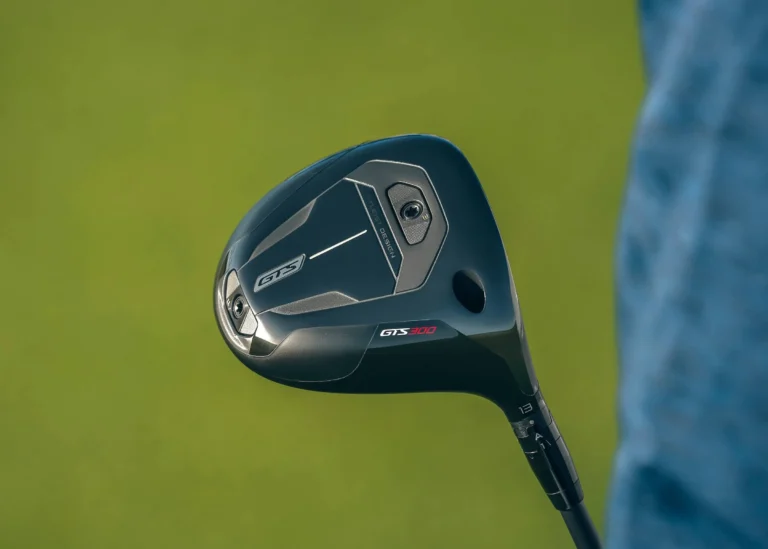
Titleist has rolled another polished piece of metalwood engineering onto the PGA TOUR, with the new GTS300 mini driver making its tour debut this week ahead of a full consumer launch in July.
It arrives as the latest member of the GTS metalwoods family, joining the already tour-tested GTS2, GTS3 and GTS4 drivers, which have wasted little time finding their way into some very serious golf bags.
For a company that has owned the top spot as the most played driver on the PGA TOUR for the last seven seasons and counting, this is not a casual dabble in the “mini driver” space. Titleist does not tend to enter a category with a shrug and a sandwich. It usually arrives with a launch monitor, a player testing bay and a fairly ruthless understanding of what elite golfers are actually asking for.
A Mini Driver With Tour-Level Intent
The GTS300 has not been presented as a novelty club or a weekend warrior’s rescue mission off the tee. It is being introduced as part of the same high-performance Titleist GTS metalwoods family already earning validation across worldwide professional tours.
That matters.
Mini drivers occupy an intriguing middle ground in the modern bag. They are not quite full-blooded drivers, and they are not fairway woods either. Used properly, they can offer a powerful alternative from the tee for players who want a touch more control, a different launch window, tighter dispersion, or a club that behaves itself when the full driver starts acting like it has eaten too much airport sushi.
The Titleist GTS300 appears to be built for exactly that conversation: controlled power, tour-calibre stability, and another option for players who want distance without feeling as though they have handed the steering wheel to a caffeinated Labrador.
Tour Validation Has Arrived Quickly
The wider GTS driver family has already made a considerable impression.
Since the GTS2, GTS3 and GTS4 drivers were introduced in late March at the Texas Children’s Houston Open, more than 50 players on the PGA TOUR have put one into play.
That is not a marketing footnote. That is a serious adoption curve.
Among those switching into GTS is Jordan Spieth, who put the GTS2 9.0 into the bag and was one of five players who moved into GTS at last week’s Cadillac Championship. Spieth is not the sort of player who casually swaps equipment because someone passed him a shiny new headcover and a biscuit. His game is built on feel, windows, shot shaping and that restless search for control under pressure.
When players at that level move, it usually means the numbers are behaving and the club is doing what the eye, ear and hands demand.
Built With Input From Cameron Young And Justin Thomas
The GTS300 has also been shaped by direct player feedback, with Cameron Young and Justin Thomas involved in testing and influencing the final design.
That is an important detail because both players stress equipment in different but useful ways.
Young brings enormous speed and a fierce need for stability through impact. Thomas, meanwhile, is a shot-maker with a forensic sense of launch, spin, face control and ball flight. If a club can survive that kind of scrutiny, it has probably endured more interrogation than a lost golf ball in a committee room.
Titleist’s continued collaboration with elite players suggests the GTS300 has been refined not merely to look sharp on a launch stand, but to earn trust when the course narrows, the wind freshens and the fairway suddenly appears to be the width of a hotel bathmat.
First Impressions: What Golfers Should Expect
Without full consumer testing data yet available, the early read on the Titleist GTS300 is clear enough: this is likely to appeal to golfers who want an alternative tee club with more authority than a fairway wood and more control than a standard driver.
The mini driver category is usually about finding a practical compromise. You want distance, but not chaos. You want ball speed, but not a two-way miss that requires a search party and a mild apology.
The GTS300 should appeal to players who like the idea of a shorter, more controllable tee option while still wanting driver-like confidence behind the ball. In real-world terms, that can mean tighter dispersion, more predictable launch, better performance on positional holes and a useful weapon when the full driver feels a touch too hot to handle.
Who Is The Titleist GTS300 Best For?
The Titleist GTS300 mini driver is unlikely to be a one-size-fits-all club. Very little in the top end of the bag ever is.
It should make most sense for:
- Mid-to-low handicap golfers who want a reliable second tee option.
- Better players who like to shape shots and control trajectory.
- Fast swingers who want stability without always reaching for a full-sized driver.
- Golfers who struggle with driver dispersion but do not want to give up too much distance.
- Players who use a strong 3-wood from the tee and want something more powerful and purpose-built.
For higher-handicap players, the appeal will depend on forgiveness, loft options, shaft fit and how confidently the club sits behind the ball. A mini driver can be brilliant in the right hands, but it does not automatically solve a faulty delivery. No club does, despite what the internet occasionally whispers after midnight.
Strengths And Weaknesses
Strengths
The biggest strength of the Titleist GTS300 is its positioning. It gives golfers another decision-making tool at the top of the bag, especially on courses where accuracy and controlled distance matter more than simply attempting to vaporise the golf ball.
It also benefits from the credibility of the wider GTS family, which has already been accepted quickly by more than 50 PGA TOUR players. That kind of tour uptake suggests the performance story is not just theoretical.
Player-influenced design is another major plus. With Cameron Young and Justin Thomas helping guide the final model, Titleist has clearly built this around real-world tour demands rather than showroom theatre.
Weaknesses
The obvious limitation is category fit. A mini driver is not essential for every golfer. Some players will be better served by a forgiving standard driver, while others may prefer the versatility of a fairway wood they can hit from both tee and turf.
There is also the usual fitting caveat. A club like the GTS300 needs to be properly dialled in. Loft, shaft, ball flight and gapping will matter enormously. Get it right, and it could become a favourite. Get it wrong, and it becomes an expensive conversation piece.
How It Compares In The Mini Driver Market
Compared with traditional fairway woods, the Titleist GTS300 should offer more tee-box authority and a stronger visual bridge towards a driver. Compared with a full-sized driver, it should theoretically provide a more controlled, compact option when accuracy becomes the priority.
Against rival mini drivers, Titleist’s advantage is its tour validation and fitting ecosystem. The brand’s metalwoods are already deeply embedded across the professional game, and the rapid uptake of GTS2, GTS3 and GTS4 reinforces that trust.
Where competitors may lean heavily into raw distance or retro-inspired shaping, Titleist’s pitch is likely to centre on precision, stability, launch control and the kind of measured performance that suits players who prefer their equipment to behave like a trained professional rather than a circus act with a titanium face.
Verdict: A Serious Club For Serious Tee Shots
The Titleist GTS300 mini driver looks like a timely addition to a metalwoods family already gaining serious traction on tour.
Its appeal will not be universal, and that is rather the point. This is not a club for everyone. It is a club for golfers who know exactly why they need one: tighter tee-shot control, dependable ball flight, useful distance, and another option when the driver feels excessive but a fairway wood feels underpowered.
With Titleist continuing to lead driver usage on the PGA TOUR and the wider GTS family already finding rapid acceptance among elite players, the GTS300 arrives with more than a hint of credibility.
Come July, everyday golfers will get their turn. And for those who like the idea of putting a little order into the wild west at the top of the bag, this mini driver may prove to be a rather large development.