 Andy Devaney
Garmin has released its latest Trends in Golf Data Report, and for anyone who still thinks modern golf is all slow play, stiff backs and middle-aged men debating wedge bounce in the pro shop, the numbers tell a rather livelier story.
The game is getting younger. Golfers are improving. Practice is becoming more data-led. And, in perhaps the greatest plot twist since someone first decided white trousers were appropriate sporting attire, more golfers are taking strength and mobility seriously.
Drawn from insights in the Garmin Golf™ app, the report highlights global trends among Garmin golfers in 2025, showing increased participation, better player performance across nearly every shot category and a clear rise in off-course fitness activity.
For Love Live Golf readers, this is not just a gadget story. It is a snapshot of where the game is heading.
Young Golfers Are Arriving In Numbers

The headline finding is the surge in younger players.
According to Garmin, the number of golfers under the age of 20 increased by 76% in 2025. Golfers aged 20-29 also rose sharply, growing by 53%.
That is significant. Golf has spent years trying to loosen its collar and convince younger players that it is not simply a sport for retirees, boardrooms and people who own too many quarter-zips.
This data suggests the game is finding fresh momentum with a generation that expects sport to be measurable, shareable and instantly trackable.
For younger golfers, performance data is not intimidating. It is part of the language. They already track runs, workouts, sleep, calories, recovery and heart rate. Adding fairways hit, shot distances and score trends feels natural rather than nerdy.
Golf, at last, may have found a way to speak fluent Gen Z without putting a skateboard in a bunker.
Scores Are Coming Down

The most striking performance figure in the report is that six months after registering a Garmin launch monitor, users saw an average score improvement of 4.4 strokes.
In club golf terms, that is not a footnote. That is the difference between quietly enjoying your post-round drink and spending 40 minutes explaining why the 8 at the 14th was “actually a good bogey in context.”
Of course, a launch monitor does not swing the club for you. It will not fix your tempo, cure your slice or stop you attempting a heroic 3-wood from wet rough when a wedge back to the fairway is begging for common sense.
But it does provide something many amateurs desperately need: evidence.
Golfers are brilliant at believing their own mythology. They remember the one drive that flew 285 yards downwind and quietly forget the usual 221-yard heel cut into semi-rough. Data trims the nonsense. It shows carry distance, launch, direction, patterns and progress.
That kind of honesty can sting, but it can also save shots.
The Fairway Statistic Every Golfer Will Recognise
Garmin golfers hit the fairway 37% of the time in 2025.
Before anyone winces, there is some useful context. The average for PGA TOUR® professionals in 2025 was 59%.
So, no, the club golfer is not uniquely cursed. The game is simply hard. Even the best players in the world miss a lot of fairways, although they do tend to miss into places where recovery does not involve nettles, a dog walker and a provisional ball.
The report also found that Garmin golfers saw their biggest improvement off the tee in 2025.
That matters because the tee shot is where many scorecards begin to sweat. Golfers do not need to hit every drive like Rory McIlroy trying to frighten the atmosphere. They need to keep the ball in play, reduce the catastrophic miss and give themselves a second shot that does not require legal advice.
Better information can help with that. Knowing tendencies, distances and dispersion patterns makes course management less emotional and more strategic.
The Median Handicap Tells A Real-World Story
The median handicap for Garmin golfers was 14 during the 2025 golf season.
Players in the United States and Canada recorded slightly lower median handicaps at 12. Australia came in at 14, while France, Sweden and the United Kingdom were at 15.
That puts the report firmly in everyday golf territory.
This is not just elite-level insight for scratch players with launch monitors in the garage and a working knowledge of spin loft. It reflects the middle of the game: golfers who can play, golfers who can improve, and golfers who still occasionally turn a routine par five into a short documentary on poor decision-making.
For UK golfers, a median handicap of 15 feels especially believable. Between soft fairways, wet winters and a climate that treats April as a practical joke, progress is rarely straightforward.
Fitness Is Becoming Part Of Better Golf
Another important trend sits away from the scorecard.
Garmin golfers recorded 49% more yoga activities and 45% more strength training activities in 2025.
That is a quietly important shift. Golfers have long obsessed over shafts, balls, grips and shoes while ignoring the rather crucial machine holding the club.
Now, more players appear to understand that flexibility, mobility and strength are not just gym-floor vanity. They influence rotation, balance, speed, stability and injury resistance.
A better body does not guarantee a better swing, but a restricted, tired or unstable body can make improvement far harder than it needs to be.
The modern golfer is beginning to realise that the game is not only played from the wrists down. It is played through the hips, trunk, shoulders, legs and, on bad days, whatever part of the soul survives a three-putt.
Garmin’s Place In The Modern Golf Bag
The wider Garmin golf range now covers much of the playing and practice journey.
For junior golfers, the Approach® J1 has been introduced as the brand’s first GPS watch purpose-built to help young players learn the game, play with confidence and track their performance.
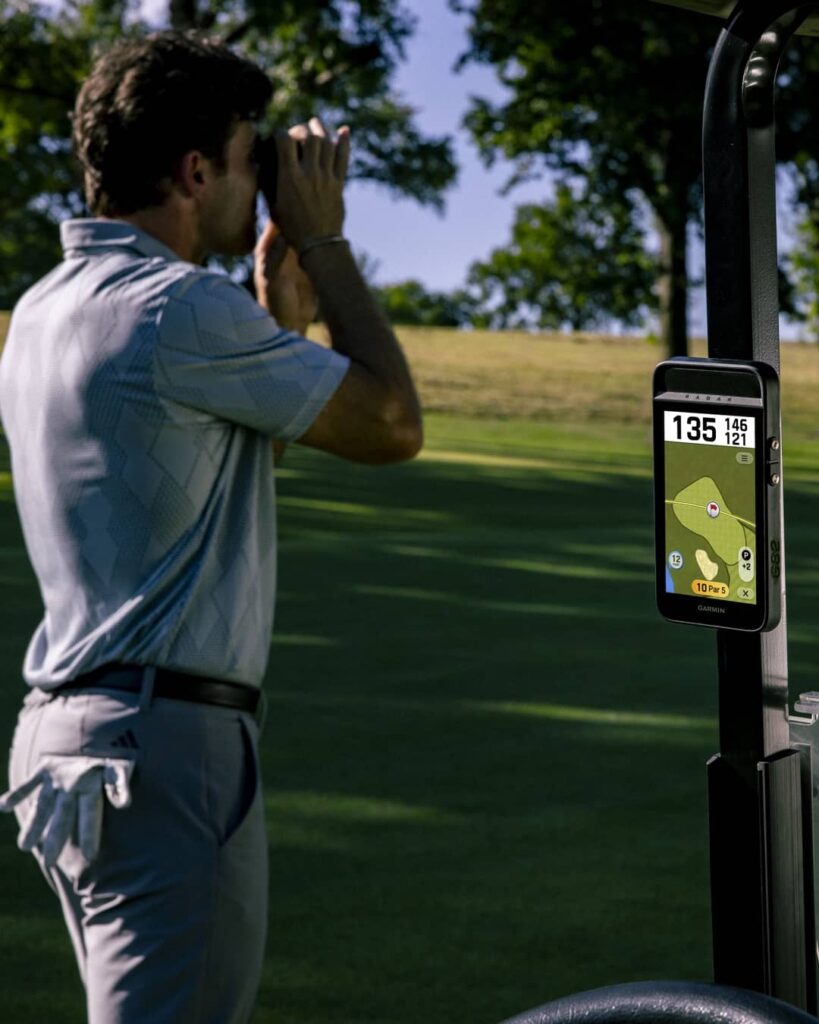
For range work and on-course support, the Approach G82 combines portable launch monitor features with GPS handheld functionality.
For those who want year-round practice, the Approach R50 and Approach R10 launch monitors and golf simulators offer ways to work on performance at home, on the range or through simulated rounds.
The Approach S70 GPS golf watch sits at the premium end, combining course tools with fitness features, while the Approach Z82 GPS laser range finder measures shot distances up to 450 yards to within 10 inches of the flag.
There is also the Garmin Golf membership, which adds features such as Green Contour Data, enhanced aerial imagery and premium CourseView maps.
But the key point is not that golfers now have more technology to choose from. It is that this technology is increasingly shaping how they learn, practise and make decisions.
Golf Is Becoming Less Guessy
For generations, golf improvement was built on instinct, lessons, feel and a fair amount of self-delusion.
That is still part of the charm. Nobody wants the game turned into a spreadsheet with bunkers.
But the Garmin report shows that golfers are becoming more comfortable with measurable progress. They are tracking scores, understanding distances, identifying weak spots and linking physical fitness to on-course performance.
That does not make golf easy. Nothing does.
A perfect yardage can still produce a dreadful swing. A beautifully planned tee shot can still be sabotaged by a clubface arriving open enough to host a village fete. Data gives you better information, not immunity from being human.
Still, better information is valuable.
It helps golfers practise with purpose. It helps juniors learn faster. It helps mid-handicappers stop guessing. And it helps the game itself move toward a more modern, accessible future.
What This Means For The Game
The real story in Garmin’s 2025 data is not simply that golfers are using more devices.
It is that the game is changing around the way people now live.
Younger players want feedback. Recreational golfers want progress. Fitness-conscious players want to understand how their bodies affect performance. And clubs, coaches and brands are all operating in a world where golf is no longer just about turning up, hitting balls and hoping for the best.
The sport is still gloriously maddening. It still has the ability to make a reasonable person say things to a golf ball that would trouble a priest.
But it is becoming smarter.
And if Garmin’s data is any indication, the next generation of golfers will not just be younger. They will be better informed, more active and far less willing to accept that a bad round was simply “one of those days.”
Golf will always keep a few secrets. That is why we love it, curse it and come back again.
But the modern player now has more ways than ever to find the answers.
To view even more of their insights, check out their latest blog post here: