Staff Writer
TaylorMade has decided that the sensible part of the golf ball market no longer needs to dress like an accountant. With the arrival of the 2026 Tour Response family, the company has given one of its most accessible urethane balls a meaningful technical nudge, added fresh visual options to the Stripe model, and doubled down on the idea that decent golfers — and the ones still trying to become one — deserve more than hand-me-down technology.
That is the pitch, anyway. And unlike some launch-season fanfare, this one has a bit of meat on it.
The new Tour Response and Tour Response Stripe land with TaylorMade’s newly introduced microcoating technology, a more precise finishing process designed to keep the ball flying as intended, while the Stripe version now comes in Clear and Mint colourways for golfers who like alignment help without feeling as though they are putting with a traffic cone.
Tour Response will be available from April 16 at TaylorMadeGolf.co.uk and authorised TaylorMade retailers, priced at £37.99 per dozen. Tour Response Stripe comes in at £39.99 per dozen.
TaylorMade targets the sweet spot in the market

The premium golf ball shelf has become a crowded old street fight. At one end, you have the flagship tour models with their tour-level price tags and firmer, faster profiles. At the other, there are softer distance balls built for straightness and durability but often short on finesse around the greens.
TaylorMade’s Tour Response has long tried to sit in the sensible middle: softer than the tour balls, more playable for a wider range of handicaps, but still wrapped in the sort of urethane cover that better players want when the scoring clubs come out. That remains the basic appeal here.
This is not a ball aimed only at scratch players who flight wedges through a keyhole. It is aimed at golfers who want real greenside spin, stable flight, and a softer overall feel, without having to swing like Rory McIlroy or pay flagship-ball money every time one disappears into a pond.
The big story is microcoating

The headline change in the 2026 TaylorMade Tour Response is microcoating, a precision-engineered coating process the brand says reduces the tiny inconsistencies that can occur when paint is applied to a ball’s surface.
That may sound like the sort of thing only an engineer could love, but the practical point is simple enough. If the finish on the ball is more uniform, the aerodynamic performance should be more consistent. Less unwanted variation means the ball is more likely to do what it is supposed to do, particularly on full shots where stability, distance consistency and left-to-right dispersion matter most.
In plain English, TaylorMade is trying to make the ball fly cleaner and repeat better.
And in this category, that matters. The golfer buying Tour Response is often not looking for absolute maximum speed at all costs. More often, they are looking for predictability. They want the driver to behave, the irons to hold their line, and the wedges to feel as though they came from the same family rather than three different households.
What it should feel like on the course
On first impression, the recipe is clearly geared toward golfers who prefer a softer sensation at impact without sacrificing too much speed. The Speed Wrapped Core and SpeedMantle layer are doing the heavy lifting there, with TaylorMade chasing a blend of ball speed off the tee and improved touch into the greens.
That usually translates to a ball that feels more agreeable off the putter face and short irons than a firmer tour model, while still retaining enough snap from the driver to avoid feeling sluggish. It is the kind of setup that suits a broad middle of the market: low and mid handicappers who want more control, and higher handicappers who are beginning to care less about surviving the round and more about shaping one.
The 100% cast urethane cover is an important detail too. Urethane is still the dividing line for many serious golfers. It is what gives this ball proper bite on approach shots and more control around the greens, rather than the skidding, slightly indifferent behaviour you can get from firmer ionomer-covered options.
Stripe gets a visual tune-up
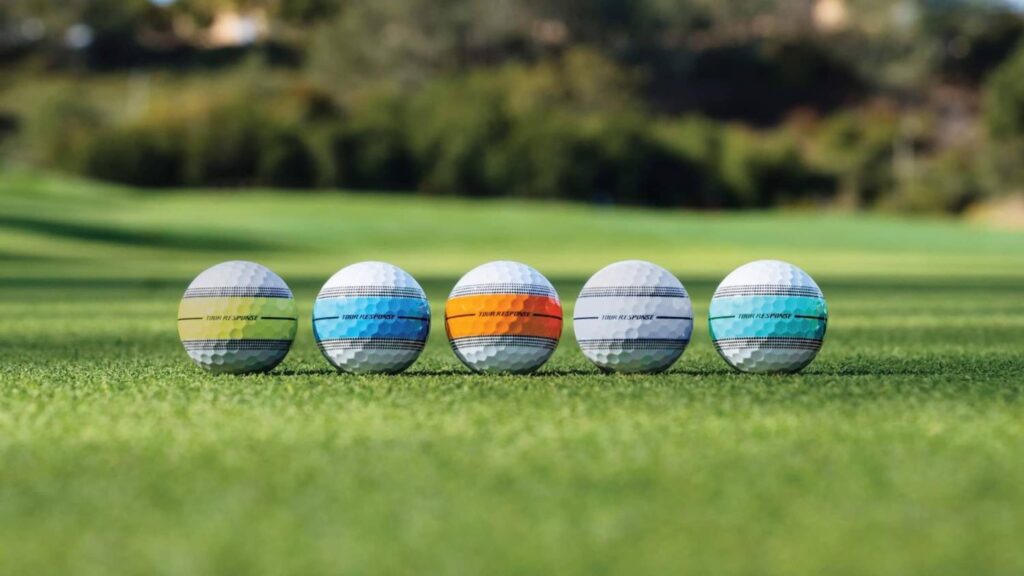
TaylorMade has been clever with Stripe. Some alignment aids on golf balls look useful in theory and exhausting in practice. The Tour Response Stripe has always been one of the more functional efforts because the band is obvious without becoming a neon lecture.
Now it comes in Clear and Mint.
Clear is the quieter of the two, designed for golfers who want alignment help without a loud colour block dominating the look of the ball. Mint is softer on the eye than brighter alternatives, but still distinct enough to improve visibility and ball tracking.
Both retain the 360° ClearPath Alignment feature, which remains one of the strongest selling points of the Stripe line. For golfers who struggle with aim on the greens, or simply like a cleaner reference point off the tee, this is more than decoration. It is practical help.
“The Tour Response continues to represent our commitment to being at the forefront of cutting-edge golf ball technology and design accessible to players at every skill level.
Microcoating brings a new level of precision to this ball, ensuring golfers experience the full benefits of the Tour Response ball’s Tour technology and 100% cast urethane cover on the course. The all-new Tour Response incorporates Tour technologies in a soft, low-compression golf ball to provide real performance benefits and genuine choice for all golfers.” – Mike Fox, Sr. Category Director
Strengths and weaknesses
The strengths are fairly clear.
TaylorMade has built a ball that should appeal to golfers who want tour-style cover performance without the sharper feel or higher compression of a top-end tour ball. The softer profile should make it friendlier for a wider handicap range, while microcoating gives the launch a genuinely fresh technical angle rather than just a cosmetic repaint.
The Stripe options also broaden the appeal. Golfers who value alignment assistance now have two more polished-looking choices, especially the Clear version, which should suit players who want visual guidance without too much fuss.
The weakness, if there is one, is that Tour Response still lives in a competitive middle tier where every brand is promising some version of “tour performance for more players.” It has to prove that the microcoating advantage is noticeable where it counts: on-course dispersion, repeatability and flight consistency.
Golfers chasing the absolute highest ball speed or the firmest response may still drift toward flagship tour models. And traditionalists who dislike alignment bands will ignore Stripe entirely, no matter how neatly dressed it is.
Who is this TaylorMade ball best for?
This looks best suited to golfers in the broad band from improving mid-handicappers through to strong club players who want soft feel, useful spin and dependable flight without moving into the most demanding end of the tour-ball spectrum.
It should also suit players who value short-game control but do not want a ball that feels overly firm off the putter. For golfers who like help with setup and start lines, Tour Response Stripe is the obvious choice.
If you are a very high-speed player who wants maximum firmness and the most aggressive tour-level flight profile, TaylorMade’s flagship offerings will still sit above this. But for a large section of the playing public, Tour Response may be the more sensible companion.
How it stacks up
In market terms, TaylorMade is squarely in the premium-value urethane conversation here. This is the part of the category where golfers want genuine performance gains, not just a cheaper box and a nice logo.
What helps TaylorMade is that the Tour Response story is easy to understand. Softer compression. Urethane cover. Stable flight. Real alignment technology. A more precise finish. That is a coherent package, and more coherent than some golf ball launches that read as though five departments fought over the same whiteboard.
Verdict
The 2026 TaylorMade Tour Response family looks like a smart, measured upgrade rather than a desperate reinvention. The addition of microcoating gives TaylorMade a credible performance story centred on consistency, while the underlying recipe still leans into what made Tour Response appealing in the first place: soft feel, usable speed and proper greenside control.
The new Stripe colourways are a nice touch, but the real substance lies in the attempt to tighten dispersion and preserve intended flight through better manufacturing precision. If that promise holds up on the course, TaylorMade will have strengthened one of the most sensible balls in its stable.
Not every golfer needs a tour ball built like a racehorse with a temper problem. Many just need one that behaves itself, feels good, and does not go wandering when the swing already has enough bad ideas of its own. On paper at least, TaylorMade seems to understand that rather well.