 Andy Devaney
There is something faintly old-fashioned about the traditional driving range: a bucket of balls, a strip of rubber matting and the vague hope that whatever just happened with your seven iron was progress. GolfPod wants to drag that experience into the modern age, compress it into a surprisingly small footprint and, in the process, make golf possible in places where it once looked about as likely as fly-fishing in a car park.
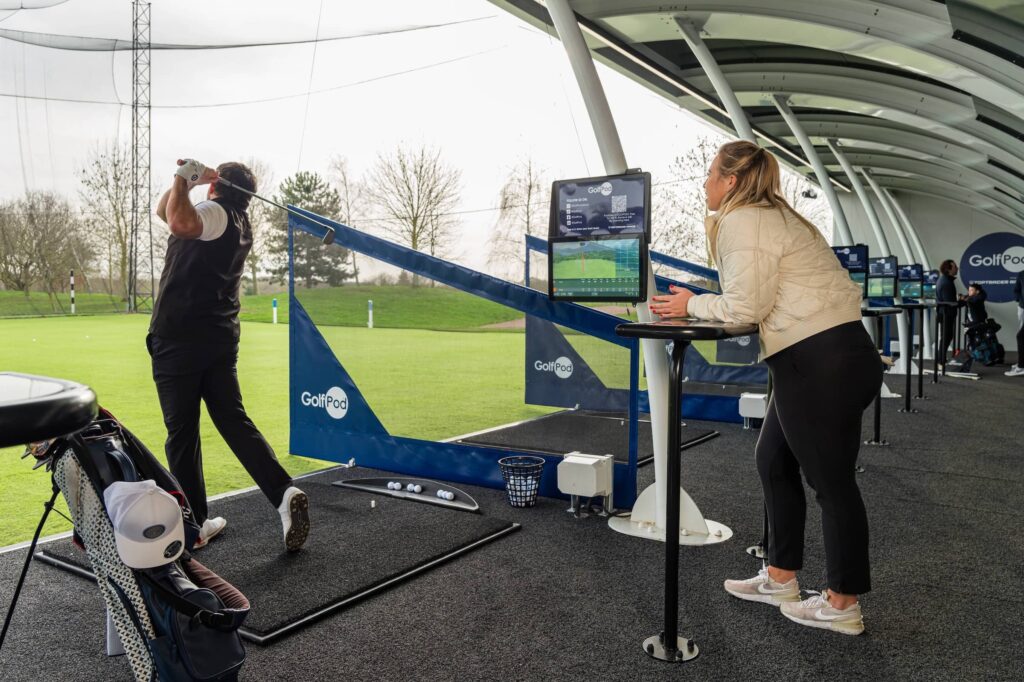
Opening at Cranham Golf Course in Upminster on Monday, March 9, GolfPod arrives as a compact, technology-led driving range concept with ambitions well beyond one corner of Essex.
This is not merely another place to hit balls until your hands sting. It is a modular, Toptracer-powered model built to turn underused land into something commercially sharp and, for golfers, far more entertaining than the average range session.
A compact range with expansive ambitions
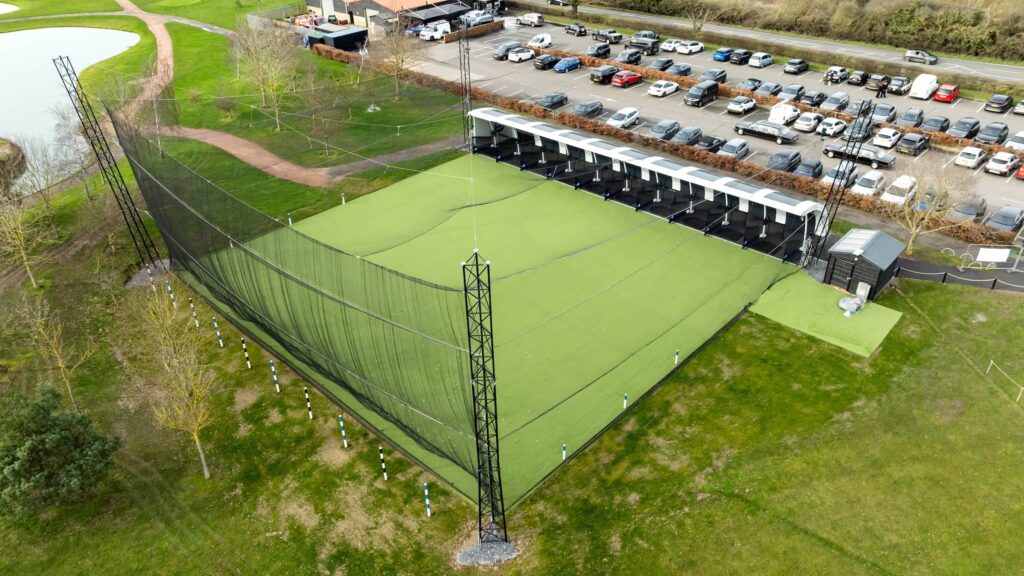
What sets GolfPod apart is the scale of it. Or rather, the lack of it. The concept has been designed to fit within a 40-by-40 metre footprint, which in golf terms is almost comically modest. Yet that modesty is the point.
Land is precious, particularly in built-up areas, and GolfPod is effectively making a case that the future of participation may not depend on vast acreage and sprawling infrastructure. Instead, it may hinge on whether the game can be squeezed intelligently into smaller, more accessible corners of towns, leisure centres and existing golf facilities.
That is where GolfPod looks clever rather than gimmicky. It is not pretending to replace a full course, nor even the romance of a proper day out golfing. It is solving a more modern problem: how to make practice, play and entry-level golf easier to access in the places people actually are.
What GolfPod offers players
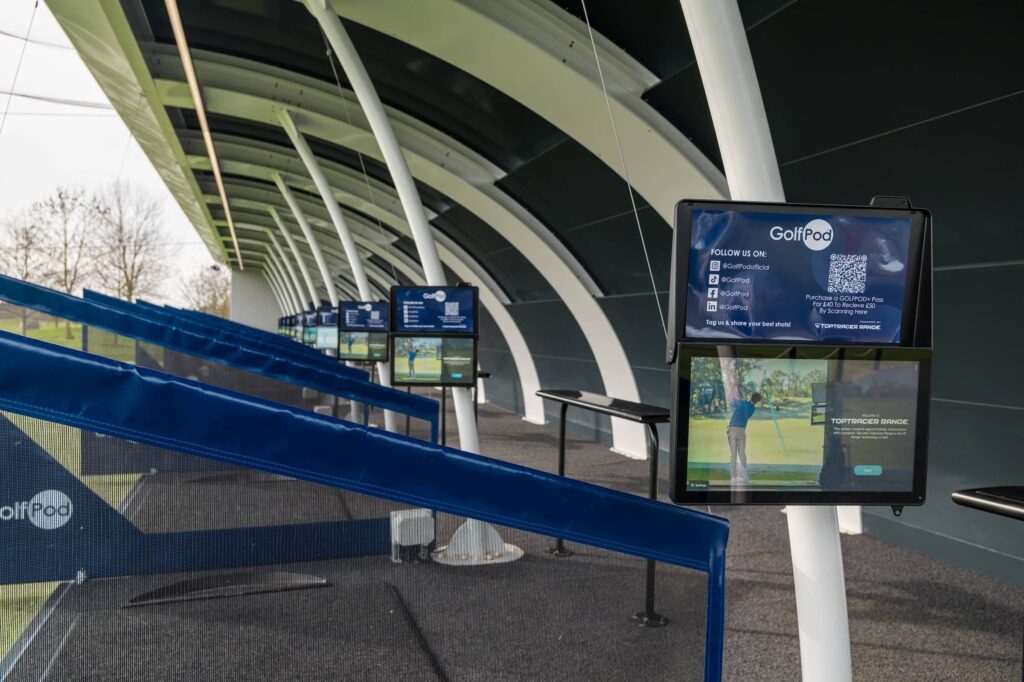
At the centre of the GolfPod model is Toptracer, the range technology that has become golf’s equivalent of instant replay, coaching aid and video game all rolled into one neat, addictive package. Every bay comes fully equipped with Toptracer capabilities, giving players immediate data on distance, speed, launch angle and accuracy, while also allowing them to compete with friends and play virtual versions of famous courses.
That matters because technology in golf only earns its keep when it turns numbers into something useful. In this case, the benefits are obvious enough. Better players get data and feedback.
Casual players get games and entertainment. Beginners get a reason to keep swinging because the experience feels less like solitary labour and more like interactive sport.
Each GolfPod site includes fully covered bays, automated ball collection systems, integrated lighting for longer opening hours and Toptracer-powered gameplay throughout. In practical terms, that means convenience, weather protection and a range session that feels slick rather than makeshift.
The real-world strengths of the concept
The strongest thing about GolfPod is not just the technology. It is the packaging of it.
Toptracer is already well established, but GolfPod applies it in a format that appears more flexible than the traditional driving range model. The compact design opens the door for sites that would previously have been dismissed as too small, too awkward or simply not worth the trouble.
For golfers, that should mean more access points, more convenience and less of the usual friction. For operators, it means the possibility of extending playing hours, encouraging repeat visits and creating stronger secondary spend through food, drink, coaching or memberships.
That commercial logic is difficult to ignore. Golf has spent years talking earnestly about growth. GolfPod looks like one of those rare concepts that may actually help deliver it in a measurable, scalable way.
Where GolfPod may face its limits
No concept is bulletproof, and GolfPod is no exception.
Its obvious strength, compactness, also defines its ceiling. This is an experience built around range practice, entertainment and light social competition. It is not a substitute for course golf, nor is it likely to satisfy players who crave the wider practice environment of larger facilities with short-game areas, teaching academies and expansive outfields.
There is also the inevitable challenge of novelty. Technology-led golf experiences can attract attention quickly, but sustained success depends on whether players return once the initial curiosity fades. That is where service, atmosphere, pricing and site quality will matter every bit as much as the tech itself.
Still, these are manageable issues rather than fatal flaws. GolfPod does not need to be everything. It merely needs to be very good at what it is.
A model built for modern golf growth
Shortly after the Cranham launch, GolfPod will open a second location at Basildon Sporting Village, a move that says plenty about the brand’s thinking. By stepping into a non-traditional golf setting, it is testing the idea that golf can sit comfortably alongside mainstream leisure rather than always requiring its own dedicated kingdom of turf and trolleys.
That may be the most interesting part of the entire GolfPod proposition. It is not simply shrinking the driving range. It is repositioning golf as something modular, transportable and more compatible with modern habits.
Mike Stone, managing director of GolfPod, put it plainly: “GolfPod brings the game to places and people in a way that might not have been possible in the past. With our ability to offer a state-of-the-art range experience within a limited amount of space, we believe golf can be played almost anywhere now.”
That line, crucially, does not feel like wishful marketing fluff. Given the economics of land use and the growing appetite for tech-enabled social golf, it feels more like a realistic reading of where the market is heading.
Why Toptracer matters
GolfPod would not be nearly as persuasive without the Toptracer element. The technology has already proved its worth across more than 1,450 ranges in 38 countries and has been visible at some of the biggest events in the sport, including The Open, AIG Women’s Open, PGA Championship and TGL presented by SoFi.
That pedigree lends the concept immediate credibility. Golfers know the system. Operators trust it. Casual users tend to enjoy it within minutes.
Scott Blevins, general manager and chairman at Toptracer, said: “The GolfPod concept marks an exciting evolution in how Toptracer technology can be deployed in the U.K. Its modular and repeatable format is a unique vessel to grow our community of golfers.”
There is a corporate tidiness to that quote, but the substance holds. A repeatable format is exactly what gives GolfPod its punch. If the rollout lands as planned, with at least five UK locations and one additional European site slated for 2026, this could become a template rather than a one-off curiosity.
Verdict: small footprint, serious potential
GolfPod is best understood not as a reinvention of golf, but as a smart reworking of one of its most accessible entry points. It takes the familiar idea of the driving range and updates it for a world that values efficiency, entertainment and convenience almost as much as tradition.
Its strengths are clear: compact design, proven Toptracer technology, flexible deployment and broad appeal to both committed golfers and people who would not normally set foot in a conventional golf facility. Its weakness is equally clear: it remains a range concept, not a complete golf ecosystem.
But that may be precisely why GolfPod has a chance. It knows what it is. It solves a genuine problem. And in a sport that has often struggled to meet people where they live, work and spend their free time, that alone makes it worth watching.
Golf has never exactly been accused of thinking small. In GolfPod’s case, thinking small might turn out to be the smartest move it has made in years.