 Andy Devaney
There are private clubs that lean on history like an old chap leaning on a barstool, and then there is Sara Bay Country Club, which seems to wear its past rather better than most. Now, as the celebrated Florida club marks its centennial year, it is stepping into the next chapter with a multi-million-dollar clubhouse renovation designed to sharpen the member experience without sanding away the place’s soul.
Completion is expected in early 2027, and the ambition is plain enough: keep the bones, respect the view, and make the whole thing feel alive again. That sounds simple until you remember that Sara Bay is not some shiny newcomer with a valet stand and a mission statement. It is one of the more storied names in American golf, a Donald Ross design with deep roots, a famous old match in its ledger, and the sort of setting that makes lesser clubs look as though they were built by accountants.
A Florida Golf Clubhouse With Real Character
The exterior is staying put, and that is wise. Too many renovations mistake surgery for vandalism. Sara Bay’s 1920s Spanish Renaissance-style clubhouse remains one of its great assets, sitting atop a pine-covered knoll chosen by Ross so it could survey the first tee and the final green with a kind of serene authority.
Buff stucco walls, a red-tile roof, palm-fringed terraces, broad French doors — it has the soft, sun-washed glamour of old Florida without any need to shout about it. In a state full of polished luxury golf properties, Sara Bay has something rarer: atmosphere that feels earned.
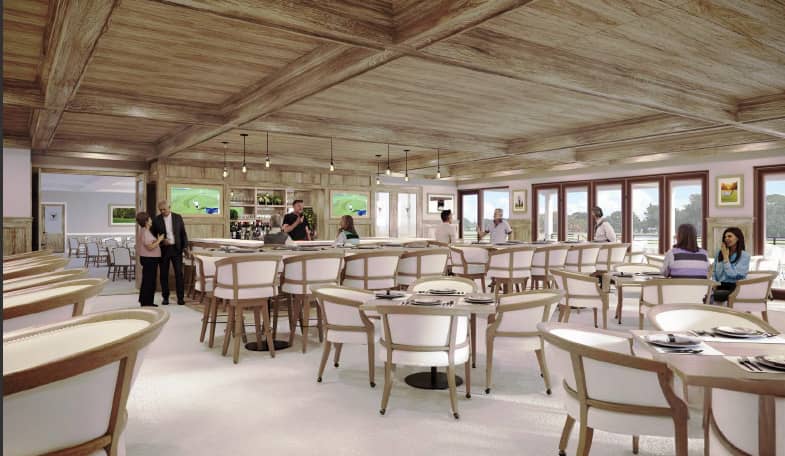
The new work will focus on the interior, where the dining room and bar are being reimagined as a more central and social gathering point. Outdoor dining areas are being expanded, open-air spaces will be elevated, and the grill room and bar are being reshaped to feel more refined without becoming precious. Locker rooms and the boardroom are also being updated, while a new multi-use dining and card room is intended to strengthen that essential private-club ingredient: members actually wanting to linger.
That matters. A great club is never just about the course. It is about the half-light after a round, the exchange at the bar, the quiet traffic of stories and scorecards, the sense that the place belongs to the people inside it.
Honouring Donald Ross Without Living in the Past
Sara Bay figures prominently in American golf history, and not in the empty, brochure-fed sense of the phrase. The course opened in 1926 and has long been regarded as one of the finest Donald Ross layouts in the country.
Recent work overseen by architect Kris Spence restored the greens, surrounds and angles of play Ross originally intended before a century of alteration softened the strategy. That restoration matters because Ross courses are often misunderstood. People see elegance and miss the slyness. The best of them are beautifully mannered and faintly ruthless.
Sara Bay’s roll call helps explain why it still carries weight. In 1926, it hosted the famous “Match of the Century” between Walter Hagen and Bobby Jones. Later came the PGA Senior Championships in 1940 and 1941, the LPGA Sarasota Open from 1952 to 1954, and the Symetra Sara Bay Classic from 2012 to 2017. This is not history pinned to a wall. It is history that has actually happened on the turf.
A Renovation Built Around How People Live Now
The smartest part of this renovation may be that it is not pretending members in 2026 want the same things they did in 1926. They want comfort, flexibility, flow, and a clubhouse that works as well after the round as the golf course does during it.
John Spiess, General Manager, put it like this: “We are thrilled to bring our members and prospective members an exciting new chapter in Sara Bay history with these exceptional renovations and facility upgrades,” said John Spiess, General Manager.
“What’s exciting is that the project is intentional and on trend with what today’s private club members want most. Our Board of Directors surveyed the membership to prioritize the scope of the renovations. Sara Bay is going to be an even more attractive second home with an inviting elegance that brings pride and enjoyment to the members.”
That phrase — second home — does much of the heavy lifting here. The modern private golf club is no longer judged only by conditioning, pace of play, or whether the soup arrives hot. It is judged by whether members feel drawn back when they are not holding a seven-iron. Sara Bay appears to understand that perfectly well.
History Hall, Hospitality and a Sense of Place
One of the more appealing details is the addition of a history hall off the main entrance, complete with display cases for memorabilia and artefacts from more than 100 years of service to the game and the region. That could have been handled as a token gesture. Instead, it sounds like a deliberate attempt to let the club’s past greet people at the door rather than sit quietly in storage.
And that is where Sara Bay separates itself from many upscale golf destinations. Plenty of elite clubs can offer fine dining, outdoor terraces and handsome locker rooms. Fewer can pair that with genuine lineage, a restored Ross course, and an architectural identity that still feels tied to its landscape.
In that respect, Sara Bay belongs in the conversation with the sort of clubs golfers speak about with a different tone in their voice. Not because it is louder or flashier, but because it has restraint. The land, the light, the old clubhouse, the view across the first and eighteenth — it all feels composed rather than manufactured.
On Florida’s Gulf Coast, where lifestyle often gets sold with a heavy hand, Sara Bay’s appeal lies in something subtler. It offers warmth without kitsch, prestige without stiffness, and a sense of occasion that does not require a trumpet section.
Why Sara Bay Country Club Still Matters
Centennials can be dangerous things. Clubs start congratulating themselves, polishing silver, and speaking in reverent tones as though history alone ought to do the work. Sara Bay Country Club seems to be taking the more sensible route. Celebrate the century, yes, but keep moving.
Perry Pogany, President of the Board of Directors, Sara Bay Country Club, said: “We are committed to enhancing our facility for our vibrant membership to enjoy for many years to come,” said Perry Pogany, President of the Board of Directors, Sara Bay Country Club. “These renovations are a testament to our members’ support and dedication, ensuring a lasting legacy for future generations.”
That is the point, really. The best clubs do not preserve themselves in amber. They keep their character, then improve the places where people actually live, gather and remember.
By the time the work is done in early 2027, Sara Bay should still look like itself from the outside — which is exactly as it should be. But inside, it aims to feel sharper, more social and more in tune with modern club life. For a historic Donald Ross venue entering its second century, that is not merely sensible. It is the difference between being admired and being loved.
And in golf, as in architecture, the places that endure are usually the ones that know the difference.