 Andy Devaney
There are golf clubs that host big events, and then there is Sentosa Golf Club, which appears to be collecting them like a man who has discovered a cupboard full of silverware and no intention of stopping.
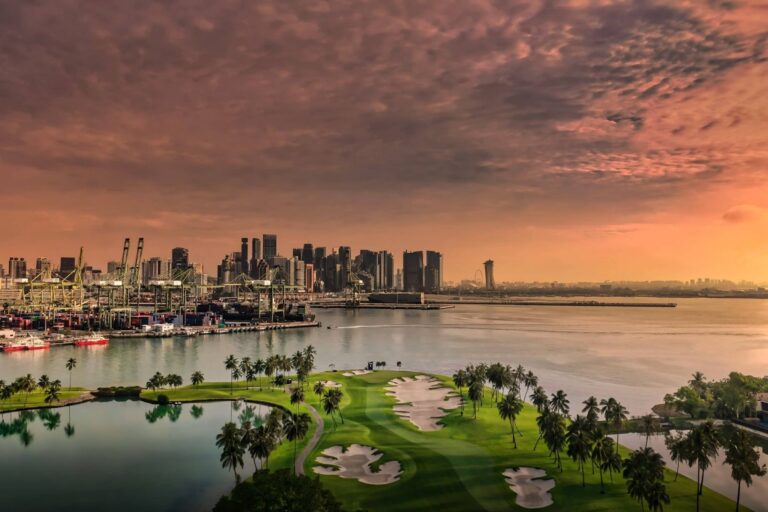
From 23–26 April, the Singapore Open returns to The Serapong, giving the venue its third elite tournament in the space of just eight weeks and underlining what many in the game already know: this place is no decorative backdrop. It is one of world golf’s proper stages.
That is no small boast in a sport drowning in luxury scenery and polished promises. Yet Sentosa has earned it the hard way, by producing championship conditions under pressure and doing so repeatedly.
The club has already had a busy spell by any measure. Hannah Green lifted the HSBC Women’s World Championship trophy here. Then Bryson DeChambeau arrived and won Aramco LIV Golf Singapore in a play-off on The Serapong, adding another layer of drama to a course that does not lack personality.
Now comes the 54th edition of the Singapore Open, back after a four-year absence and returning to the venue that has become its spiritual home.
A championship that knows its way around Sentosa
The Singapore Open and Sentosa Golf Club have history. Serious history.
Sentosa first hosted the championship in 2006 and has since staged 14 editions, crowning 11 different winners. Adam Scott won three times during the Barclays Singapore Open era, which is the sort of record that tends to suggest a player either loves the place or has worked out where the magic is hidden. Since 1961, the tournament itself has welcomed champions of real pedigree, including Major winners Ángel Cabrera and Sergio García.
That matters, because this is not merely another date on the schedule. It is an event with heritage, now plugged firmly into the modern machinery of professional golf.
The Singapore Open forms part of The International Series, the elevated run of events on the Asian Tour co-sanctioned by LIV Golf and the Asian Tour. Singapore is the second of eight confirmed stops on the 2026 calendar, and there is more than a title at stake. The top two players in the season-long Rankings will earn LIV Golf League cards for 2027.
As if that were not enough, The R&A has confirmed that the Singapore Open will also offer two direct qualification places for The 154th Open after being added to The Open Qualifying Series. That gives the week another edge entirely. A man can arrive chasing a trophy and leave with a passport stamped for one of the game’s greatest examinations.
Why The Serapong keeps earning applause
A great tournament venue has to do more than look sharp in television pictures. It must ask questions of the best players in the world and keep asking them until Sunday afternoon.
The Serapong appears to do exactly that.
Lee Westwood said: “The greens are some of, if not the best, I’ve ever seen, certainly in Asia but anywhere, really.”
That is praise from a man who has played just about everywhere a golf bag can be carried.
Bryson DeChambeau was equally effusive after his recent victory, saying: “The best I’ve seen it in the past few years being here. Greens are some of the fastest I’ve ever seen in my entire life, which I love.”
There is no mistaking what players value here. The surfaces are true, quick and exacting. They reward nerve and punish indecision, which is really all a serious championship course is supposed to do.
Sergio García, who won the 2018 Singapore Open, has long been an admirer too. “It is a golf course that obviously if you play well, you can score in,” he said. Returning for Aramco LIV Golf Singapore, he added that “This course has been so good throughout the years that it really hasn’t needed any much tinkering.”
Jon Rahm joined the chorus during the same week, describing the surfaces as “very, very good” and “rolling great,” which is the golfing equivalent of a Michelin inspector quietly nodding over dessert.
Three tournaments in eight weeks is no accident
Hosting one major professional event is a challenge. Hosting three in a condensed stretch without the place falling apart at the edges is something else entirely.
That feat says as much about the people behind Sentosa Golf Club as it does about the course itself.
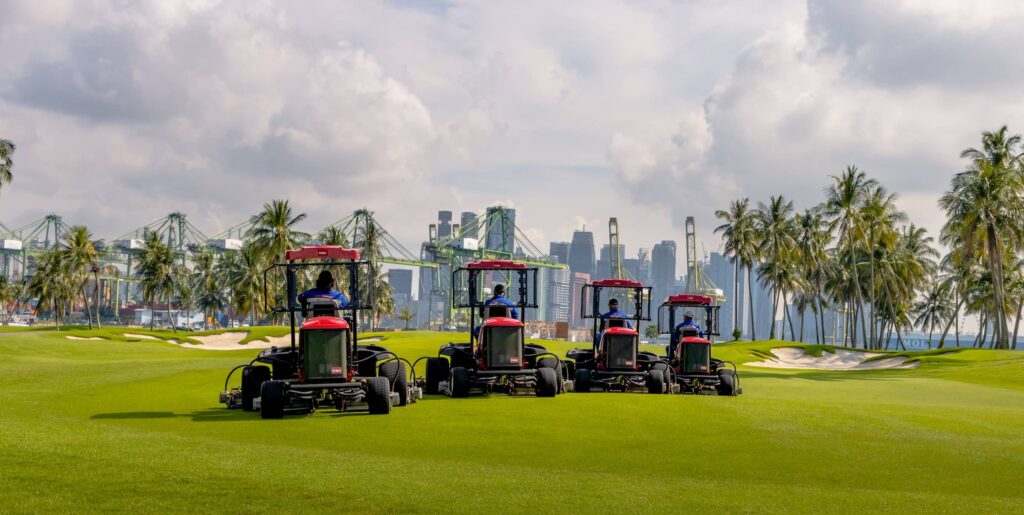
The club’s agronomy and operations teams have been responsible for preparing and maintaining The Serapong to elite standards, while keeping playability, presentation and consistency intact under tournament stress. In a game where everyone notices the tiniest blemish and complains about it at length, that is no minor achievement.
Andrew Johnston, General Manager and Director of Agronomy at Sentosa Golf Club, said: “Welcoming the Singapore Open back to Sentosa is a real honour, and we take that responsibility seriously. With three championships in a short window, it takes a coordinated effort across agronomy and operations to keep standards where they need to be.
Our focus is on doing the basics well every day and delivering consistent, tournament-ready conditions 365 days a year, so the course provides a fair, true test for everyone in the field.”
That quote tells you plenty. No chest-thumping. No grandstanding. Just the unglamorous truth of elite tournament golf: do the basics brilliantly, every day, and everything else has a chance.
Championship golf with a modern conscience
There is another reason Sentosa Golf Club stands apart, and it speaks to where the game is heading rather than where it has been.
In 2020, Sentosa became the first golf club in the world to sign the UN Sports for Climate Action Initiative. That is not a decorative badge pinned on for corporate effect. It signals a deliberate attempt to prove that first-class championship conditioning and environmental responsibility do not have to sit in opposite corners of the room glaring at one another.
Too often, golf talks about sustainability as though it were an awkward relative. Sentosa has taken a more practical view, combining modern agronomy with environmental measures while still producing the kind of surfaces elite players rave about.
That, frankly, is more impressive than another slogan on a media wall.
What the Singapore Open now represents
The return of the Singapore Open to Sentosa Golf Club is not just a pleasant revival of a familiar event. It is a reminder of where influence in world golf now gathers.
This tournament sits at the intersection of heritage, international relevance and modern opportunity. It carries the history of a national Open, the pressure of International Series points, the lure of LIV Golf progression and now the added prize of direct routes into The Open. That is quite a stew.
And it unfolds at a venue that players trust.
That may be the most important thing of all. In modern professional golf, where schedules shift, alliances blur and everyone seems to be arguing about something, a course that consistently delivers a fair and exacting championship test has real currency.
Sentosa Golf Club has become that kind of place.
By the time the Singapore Open begins, the club will not need to make a case for itself. The evidence is already there in the winners, the praise, the pressure and the polish. All it has to do is what it has been doing all season: present The Serapong in immaculate condition and let the golf speak.
And if recent weeks are any guide, it will speak quite loudly.