 Andy Devaney
Shot Scope has looked at the launch monitor market, taken a long pull of air, and done something refreshingly practical: built a device that appears to focus on what most golfers actually need, not what a tour van physicist might scribble on a whiteboard.
The new LM1 arrives at $199.99, comes with no subscription fees, and aims to make data-driven practice feel less like a lab experiment and more like, well, golf.
That matters because the average club golfer does not need a machine that can calculate the rotational mood of a seven-iron. What they need is clear feedback, dependable numbers, and a reason to believe the last half-hour on the range was about more than scuffing balls into a pale sky.
The LM1 is Shot Scope’s latest move toward a joined-up ecosystem that links practice to performance. In plain English, it wants to help golfers understand what happens on the range and then connect that to what happens when the card is in the hand and the knees start whispering dreadful things on the 17th tee.
A launch monitor that keeps its promises narrow
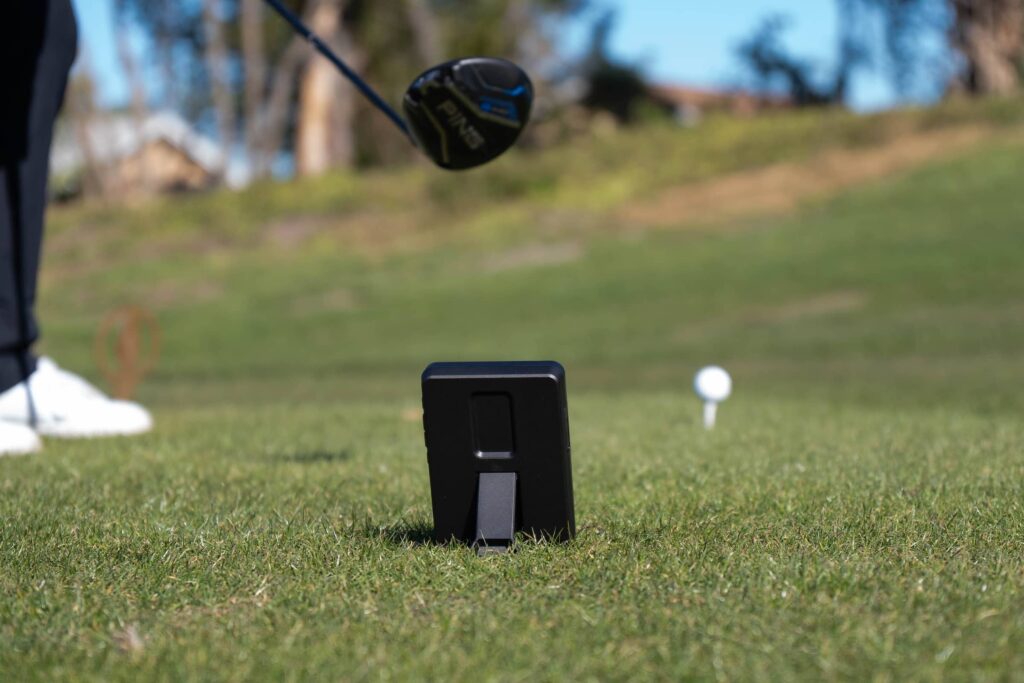
There is a certain wisdom in restraint, and the LM1 seems to understand that. Rather than trying to be all things to all golfers, Shot Scope has built this portable launch monitor around five core metrics: club speed, ball speed, smash factor, carry distance, and total distance.
Those are not throwaway numbers. They tell a golfer whether they are generating speed, whether they are striking the ball efficiently, and whether a change in swing or equipment is actually helping rather than merely feeling heroic for three swings before descending into chaos.
Powered by Doppler radar technology, the LM1 is designed to strip out noise and present usable information fast. That is the key to the whole proposition. Golf technology is at its best when it clarifies. At its worst, it turns a range session into a hostage negotiation with your own swing.
What the LM1 should feel like in the real world
From a first-impressions standpoint, the Shot Scope LM1 sounds as though it has been designed for golfers who want quick answers rather than a technical sermon. It is compact, lightweight, and fitted with a bright 3.5-inch colour display that should make it easy enough to read without squinting like a man trying to identify a fishing boat on the horizon.
Setup is deliberately simple. Place it roughly five feet behind the hitting area, power it on, select a club, and get to work. Indoors or outdoors, that sort of ease matters. A launch monitor that takes too long to set up tends to end up living in a cupboard, alongside old training aids and good intentions.
The five-hour battery life also gives the LM1 a practical edge for golfers who want extended range sessions, home practice, or the occasional on-course use. In that sense, Shot Scope is not selling fantasy. It is selling convenience, continuity, and a better-informed version of the same golfer.
Why these numbers matter more than a thousand swing thoughts
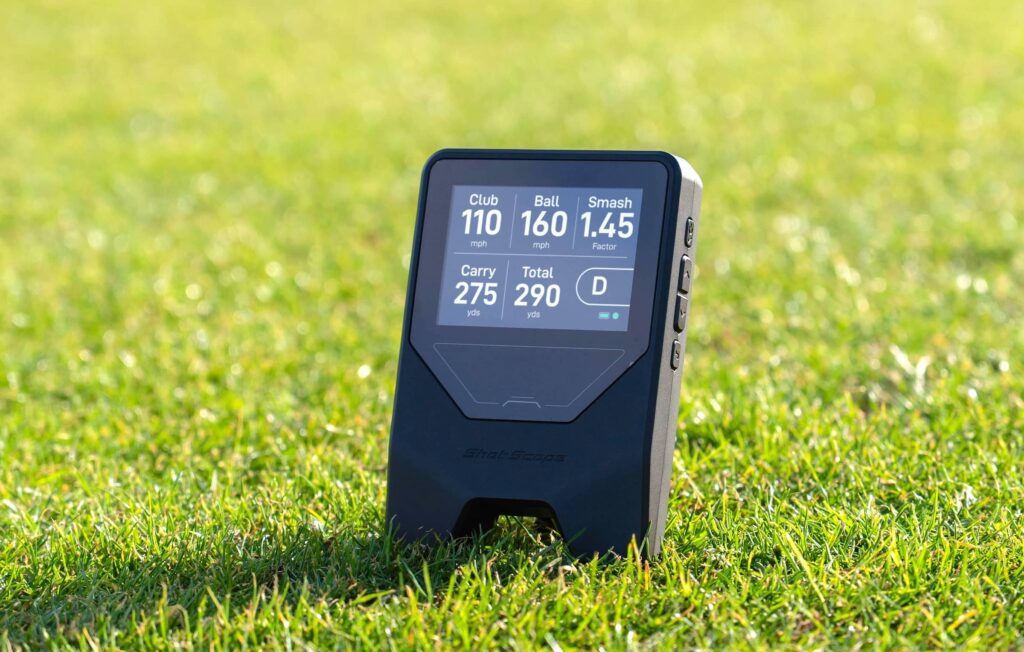
Club speed tells you how fast the tool is moving. Ball speed tells you what the strike actually produced. Smash factor helps reveal whether you are catching it flush or merely making a great noise. Carry distance is your truth. Total distance is what the ball does after truth hits the ground and starts rolling.
That combination gives Shot Scope a very clear lane. The LM1 is not pretending to be a simulator-heavy, tour-grade analysis hub stuffed with spin axis breakdowns and deeper ball-flight modelling. It is built to answer the sort of questions ordinary golfers ask every day.
Am I actually gaining distance?
Did that new driver shaft help?
Why does one seven-iron fly 155 and the next one 141 with all the elegance of a wounded pigeon?
For that golfer, the LM1’s data set looks well chosen rather than incomplete.
Where Shot Scope fits in a crowded launch monitor market
This is where the LM1 becomes interesting. Portable launch monitors tend to split into two camps: the seriously expensive units loaded with advanced data, and the cheaper devices that tempt you in before asking for a subscription, extra software, or a tolerance for frustration.
Shot Scope appears to be planting the LM1 in the sensible middle ground. It is not chasing the premium simulator end of the market. Nor is it relying on jargon to disguise limitations. Instead, it is pitching trusted core data, a straightforward user experience, and a price that makes experimentation feel possible.
Against better-known rivals in the portable launch monitor category, the LM1’s biggest advantage is obvious: accessibility. The price is lower than many established competitors, and the lack of ongoing fees removes one of the great modern irritations in sports tech, namely buying a product only to discover it behaves like a needy flatmate.
The trade-off is equally clear. Golfers who want deeper data points such as spin profiles, shot shape detail, or fitting-level analysis may find the LM1 deliberately modest. But that is not necessarily a flaw. It may simply mean Shot Scope knows exactly which golfer it is talking to.
What Shot Scope Will Tell You
David Hunter, CEO of Shot Scope, said: “The launch of LM1 marks a major step forward in our mission to give every golfer access to technology and products that genuinely help them play better.” said David Hunter, CEO of Shot Scope.
“By combining powerful data with an easy-to-use design, LM1 delivers the accuracy and insight golfers expect, at a price point that opens the door for more golfers to benefit from true performance data. It’s an exciting milestone for us and for the future of accessible golf technology.”
Who is the Shot Scope LM1 really for?
The ideal LM1 golfer is not difficult to picture.
This is a product for the improving amateur, the mid-handicap player trying to make practice more purposeful, the lower-handicap golfer who wants quick gapping and speed feedback, and the budget-conscious player who has long fancied a launch monitor but not the bill that often comes with one.
It should also appeal to golfers working on equipment changes. If you are testing a new fairway wood, trying to sharpen wedge distance control, or simply curious whether your “faster swing” is producing anything beyond back strain, the LM1 looks like a useful companion.
For elite players, coaches, or serious fitters, it may be more of a support tool than a full command centre. But that is fine. Not every golf gadget needs to wear a lab coat.
Strengths and weaknesses
Strengths
The Shot Scope LM1’s strongest hand is clarity. It offers the numbers most golfers can actually understand and use. The no-subscription model is a genuine plus, not a marketing afterthought. Its portable design, simple setup, indoor and outdoor versatility, and app syncing all add up to a product that appears easy to live with.
There is also strength in the wider Shot Scope ecosystem. Golfers already using the brand’s watches, rangefinders, or performance-tracking tools may find the LM1 a natural fit, particularly if they like the idea of linking practice sessions with broader game analysis.
Weaknesses
The obvious limitation is depth. Golfers who crave advanced launch conditions and detailed ball-flight diagnostics may find the LM1 too stripped back. It is also entering a competitive category where trust is everything, so consistent real-world accuracy will be the deciding factor in how widely it catches on.
And while affordability is a major asset, this is still a product that must prove it can do more than look clever on a spec sheet. In launch monitor territory, credibility is earned one shot at a time.
Shot Scope’s broader play is bigger than one device
The LM1 is not arriving in isolation. It joins a wider Shot Scope line-up that already covers GPS handhelds, laser rangefinders, GPS watches, and performance tracking. That matters because the company is no longer just selling individual gadgets. It is building a golf technology environment where practice, decision-making, and on-course performance can feed into one another.
For golfers, this offers a more complete picture of the game. For Shot Scope, it sharpens the brand identity. This is not a random product expansion. It is a deliberate attempt to own more of the journey from warm-up bucket to medal round.
Verdict: smart, focused and likely to find an audience
The Shot Scope LM1 does not seem interested in showing off, and that may be its greatest strength. In a category that often confuses more than it helps, this launch monitor looks built around the fundamentals that move scores in the right direction: better contact, better distance awareness, and more productive practice.
It will not replace high-end analysis tools for golfers chasing every last decimal point. But that is not the point. The point is that Shot Scope appears to have made a launch monitor for the rest of the golfing world, those players who want trustworthy feedback without needing a degree in aerodynamics or a second mortgage.
If the LM1 delivers on its promise of accuracy and ease, Shot Scope may have found a very attractive spot in the market indeed: affordable enough to tempt, useful enough to matter, and simple enough to keep golfers coming back for another session instead of another excuse.