 Robert Theodorson
The TGL schedule can be a funny thing: some nights it’s a neat little hit of golf theatre, and other nights it’s a full-length stress test with floodlights. New York Golf Club got the latter at the SoFi Center—two matches in one night, against two teams with very different moods and the same ruthless aim: points, playoffs, and a little daylight between themselves and trouble.
New York faced The Bay Golf Club first (Wyndham Clark, Shane Lowry, Ludvig Aberg), then Boston Common Golf (Keegan Bradley, Hideki Matsuyama, Adam Scott). By the end, New York had the sort of evening that makes you check your shoes for concrete.
A doubleheader with real consequences
This was not exhibition golf dressed up in techno-glow. The Bay arrived needing momentum and oxygen in the standings, and they played like a team that could see the trapdoor opening. Boston arrived with the chance to make a statement—and, more importantly, make the postseason official.
The through-line for New York was simple: the margins were thin, and the penalties were not.
Match 1: The Bay 5, New York 3 — quick start, cooler finish
Two weeks after earning its first win of Season 2 with an 11-5 victory over Los Angeles Golf Club, The Bay Golf Club kept the engine running by defeating New York Golf Club, 5-3. BAY earned its second consecutive victory to move to 2-2-0 and stay alive in the playoff race. A loss would have made the playoffs unlikely.
If you’ve watched enough TGL, you know the early holes can feel like a barometer. The Bay treated the opening stretch like a cash machine.
BAY again got off to a quick start with three points over the first three holes. The strong start in Triples was led by Lowry:
No. 1 (Flex) – Birdie from 11’6” (Won hole)
No. 2 (Sterling) – Approach from 238 yds to 10’10” (Won hole when NY declined Hammer)
No. 3 (Cenote) – Tee shot to 11’2” (Won hole when Åberg made birdie)
That’s the kind of opening that makes the other bench start doing mental arithmetic. New York did respond, and the match tightened, but The Bay kept finding enough steadiness—especially when it mattered.
As the match continued, Lowry’s helped BAY maintain its lead:
No. 9 (Bay Breaker) – Par from 4’1”(Tied hole to maintain a 3-2 lead through Triples)
No. 12 (Set In Stone) – Par from 5’8” (Tied hole to maintain a 3-3 tie)
And while Lowry steadied the wheel, Aberg supplied the horsepower—birdie early, a new long-drive mark later, and the kind of approach that makes conceded birdies feel inevitable:
Åberg made birdie from 11’6” on No. 1 to give BAY a 1-0 lead, set a new long-drive record on No. 4 (Big Apple) with his 338-yard tee shot and helped BAY retake the lead on No. 13 (Alpine) when he hit his approach to 11’7” for a conceded birdie.
New York’s best moments came in flashes—particularly via Fowler, who kept the match breathing with a handful of quality shots:
No. 4 (Big Apple) – Third shot to 17” for a conceded birdie (Won Hole)
No. 8 (Stinger) – Second shot to 10’7” for a conceded birdie (Won Hole)
No. 9 (Bay Breaker) – Par from 9’2” (Tied Hole)
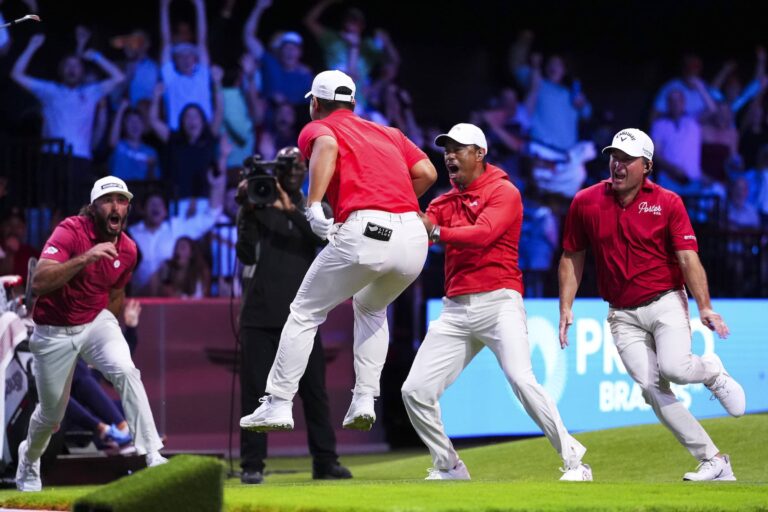
Then came the sort of rules-and-rhythm moment that only modern golf can deliver at speed. With the match tied 3-3, BAY threw the Hammer and momentarily took the lead when NY declined. However, the Hammer was returned to BAY when TGL’s rules committee determined Schauffele had already addressed his ball in the bunker when the Hammer was thrown.
It didn’t just reset points; it reset pulse rates. From there, The Bay did what bubble teams have to do: survive the wobble and finish.
With the score returned to 3-3, Schauffele left his third shot in the bunker and BAY went on to take a 4-3 advantage to the final two holes.
Clark, despite some rough edges—th Clark, who hit into the penalty area on No. 8 (Stinger) and No. 11 (Cut the Sails)—still had a late highlight when it was needed:
added a late highlight for his team on the par-3 14 hole (The Last Toll) when he hit his tee shot to 7’10”. After NY declined the Hammer, BAY scored the final points of the night for a 5-3 advantage.
In the regular season finale on March 3, BAY will face Jupiter Links Golf Club as it attempts to secure its second trip to the playoffs.
Match 2: Boston 9, New York 2 — a playoff clincher with bite
One night after losing to Atlanta Drive GC for its first defeat of Season 2, Boston Common Golf returned to SoFi Center and secured its place in the playoffs with an inspired 9-2 victory over New York Golf Club. With the victory, BOS improves to 3-1-0 and joins ATL as the two teams with three wins and the two teams currently in the postseason.
If The Bay’s win was about staying alive, Boston’s was about arriving—loudly. The win also continues a reversal from last year when the Ballfrogs went winless with a 0-4-1 record and was one of two teams to not advance past the regular season. There’s nothing subtle about a team flipping that narrative in public.
Tuesday marked the Season 2 debut for both Adam Scott and Hideki Matsuyama, and Scott’s night had the shape of a proper sporting story—early frustration, then control.
After Scott missed two putts inside 10 feet on No. 1 (Cut the Sails) and No. 4 (Storrowed), he bounced back with a 2-00 performance in Singles against Cameron Young and multiple key moments during the rest of the match:
No. 7 (Cenote) – Set closest-to-the-pin record at 3’10” (Won Hole with Matsuyama birdie)
No. 8 (Bluebonnet) – Made birdie from 11’0” (Won Hole)
No. 13 (Stinger) – Hit 303-yard tee shot and made birdie from 5’6” (Won Hole)
New York’s night, meanwhile, turned on a brutal stretch where holes didn’t just slip—they fell through the fingers.
After leading 2-1 through the first five holes, NY lost the next five consecutive holes on Nos. 6-10, including two due to penalties:
No. 6 (Loot on the Line) – Fowler hit tee shot into the penalty area
No. 9 (Big Apple) – Young hit second shot into the penalty area
That’s where TGL can feel less like a slow-burn round and more like a run of bad bounces in a pinball machine—except the machine is counting points, and the points are counting you.
Down four points with three holes to play, NY threw the Hammer on the tee on No. 13 (Stinger) to try to cut the deficit in half. After both Scott and Young hit tee shots over 300 yards into the fairway, they both hit approaches to 5’6”. With a miss by Young, Scott’s birdie added two more points for BOS to take an insurmountable 8-2 lead.
The closing details were just salt in the wound:
Beau Welling Design’s Caverns made its second appearance as the closing hole on No. 15. Fowler hit into the penalty area off the tee and Bradley hit the green in two and made birdie from 14’3” to finalize the seven-point victory.
The numbers behind Boston’s edge
Boston aren’t sneaking into anything—they’re driving their way there.
On Sunday Mar. 1, BOS will play its final match of the regular season against Jupiter Links Golf Club. BOS and JUP rank No. 2 (71.7%) and No. 1 (73.3%) in Greens In Regulation, respectively.
And Boston’s power profile reads like a launch monitor flex:
Boston Common leads TGL in several driving categories including:
Avg. Driving Distance – 326.6 yards
Avg. Driver Ball Speed – 180.0 mph
Avg. Driver Swing Speed – 123.6 mph
Driving Accuracy – 75.0%
BOS has three players ranked in the top 4 in TGL in Driving Accuracy
Michael Thorbjornsen – 77.8%
Keegan Bradley – 75%
Rory McIlroy – 75%
Then there’s the part that breaks spirits: the long putts that don’t behave like long putts.
BOS ranks No. 1 in both Medium- and Long-Distance Putting Efficiency.
Putts 10-30 feet – 40.0%
Putts 30+ feet – 16.7%
What it means for the playoff picture
The Bay’s 5-3 win keeps their postseason hopes alive and sets up a defining regular-season finale against Jupiter Links Golf Club on March 3.
Boston, with the 9-2 thumping, have already punched the ticket—and now get to treat the final regular-season match as a chance to sharpen the blade rather than find it.
New York, after a one-night double dose of SoFi Center reality, are left needing answers that don’t fit neatly on a scoreboard. In TGL, you don’t just lose holes—you lose time. And on nights like this, time is the one thing the standings never give back.