 Andy Devaney
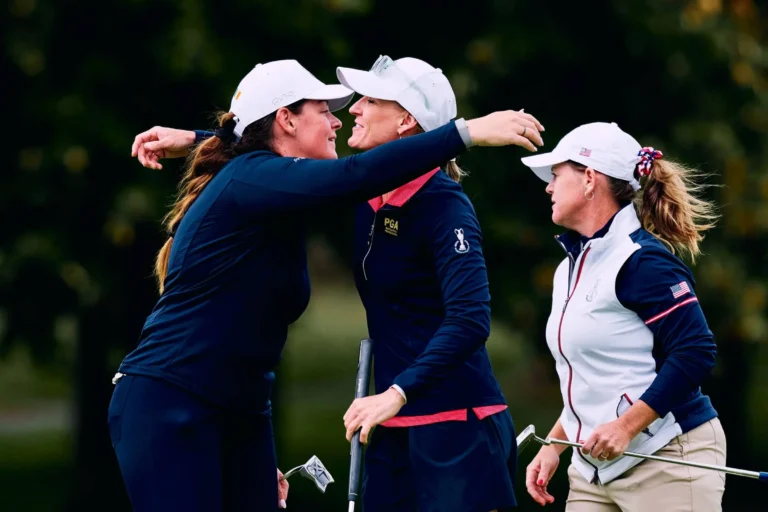
The 2026 Women’s PGA Cup began with the United States doing the golfing equivalent of arriving early, choosing the best table and ordering before anyone else had found the menu.
A 7-under team total of 212 at Carden Park gave the Americans a 12-shot lead over Great Britain and Ireland after Thursday’s opening round, with South Africa a further shot back.
Connelly Eiswerth sets the tone at Carden Park
Stephanie Connelly Eiswerth supplied the lowest American card, a 3-under 70 that left her sharing the individual lead with South Africa’s Tandi Marina McCallum.
The 2024 medalist, making her third consecutive Women’s PGA Cup appearance, did not produce a spotless card. That was rather the point. After a bogey at the par-4 third, she steadied herself with birdies at the sixth and seventh, then found another gear on the back nine.
A 30-foot birdie putt at the par-5 11th was followed by a tap-in birdie at the 12th. Even a bogey at the 14th failed to disturb the rhythm for long; she answered at once with a birdie on the par-3 15th.
“I felt like I started hitting it a little bit better and got my speed on the putts,” said Connelly Eiswerth. “Then I made a couple and felt comfortable from there, and then really had a lot of good chances the rest of the way.”
That combination — patient early, productive later — suited a Cheshire course that rewards thought before enthusiasm. Connelly Eiswerth described the task neatly.
“The golf course is fun,” said Connelly Eiswerth. “We’ve got some really good par 4s. You’ve got to place yourself around off the tee. If you can place your approach as well, you’ve just got a better chance. It’s nice if you’re hitting it well enough that you can really just get yourself in position.”
Changkija and Paez turn strength into separation
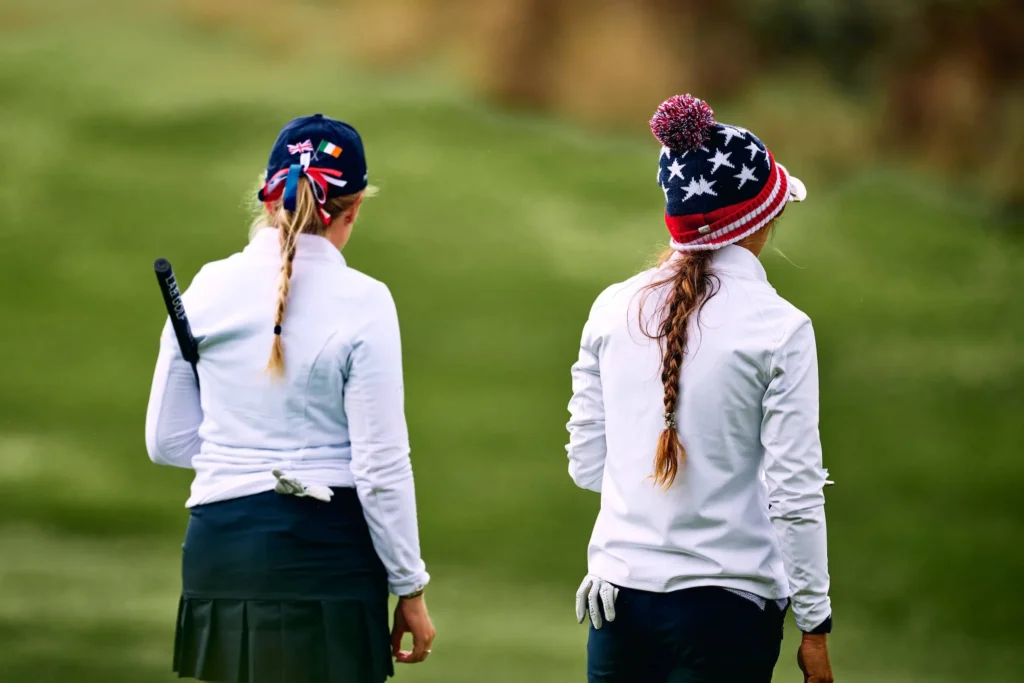
The American lead was not built on one exceptional round but on three strong ones, which matters in a format where only the lowest three of five scores count each day.
Sandra Changkija and Kim Paez both returned 2-under 71s, tying for third individually. Their routes there were markedly different.
Changkija opened with eight straight pars before birdieing the par-5 ninth. She picked up another shot at the 14th, dropped one at the 17th, then closed with a birdie at 18. It was a round with very little wasted motion, which is often more useful in team golf than a scorecard full of fireworks and small disasters.
Paez, making her Women’s PGA Cup debut, started faster. Birdies at the second and fifth were offset by bogeys at the sixth and eighth, leaving her level par at the turn. She then played the back nine in a bogey-free 2-under 34.
Three counting scores of 70, 71 and 71 produced 212. The arithmetic was unkind to everyone else.
The USA’s depth is already doing damage
Playing captain Ashley Grier signed for a 2-over 75, while Allie Knight shot 4-over 77. Neither score counted towards the team total.
In another format, those rounds might have introduced some unease. Here, they instead underline the advantage of depth. The United States could discard two over-par scores and still finish Thursday 12 shots clear of Great Britain and Ireland.
“I’m so proud of them,” said Grier. “Everybody played fantastic. Stephanie, Sandra and Kim all got it under par. Allie and I didn’t quite have our best, but we scraped it around to hang in there. We’re in a phenomenal spot leading with a decent sized lead, which is always a good place to be.”
It is. The tournament is not decided on Thursday, however, and the demands Connelly Eiswerth identified around Carden Park leave little encouragement for anyone inclined to start steering the ball simply because there is blue sky beneath them on the leaderboard.
A fourth straight Women’s PGA Cup title comes into view
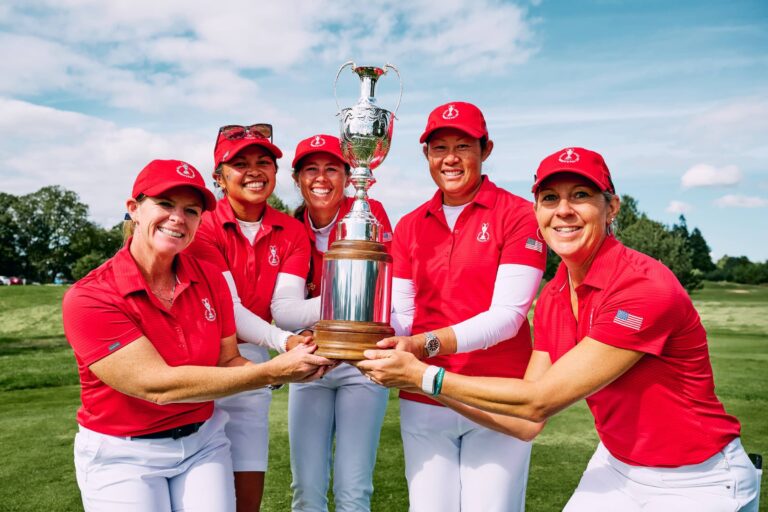
The United States arrived in England seeking a fourth consecutive Women’s PGA Cup victory. One round has not settled that argument, but it has altered its tone.
Great Britain and Ireland’s 224 leaves them with a considerable deficit to erase. South Africa, on 225, are one shot further back, although McCallum’s share of the individual lead gives them a foothold at the sharp end of the leaderboard.
For the USA, the danger now is the oldest one in front-running golf: trying to protect a lead rather than continuing to earn it. Grier’s message suggested she has little interest in that sort of defensive arithmetic.
“You just keep playing your game, keep trying to see how well you can do, how well you can shoot, and then when you add it up at the end, hopefully it’s the lowest,” said Grier.
Not sophisticated sports psychology, perhaps. Quite difficult to improve upon, though.
Friday brings a different kind of pressure
The second round begins at 8 a.m. BST on Friday at Carden Park in Chester. The Americans will start it with the luxury of margin, but also with the attention that comes with being 12 clear.
Changkija has already demonstrated the value of patience. Paez has shown she can recover from a mixed opening nine. Connelly Eiswerth has the confidence of an individual leader and the experience of successive Women’s PGA Cup appearances behind her.
Grier, meanwhile, has the unusual pleasure afforded by this format: she can shoot 75 herself and still captain a side that spends the evening looking down at everyone.
Twelve shots after one round is not a trophy. It is, however, a very efficient way of making the rest of the field check the leaderboard twice.
The USA have not won the 2026 Women’s PGA Cup yet. They have merely made everyone else’s Friday substantially more complicated.
For additional information on the Women’s PGA Cup, visit here.