 Chandni Canan Bauer
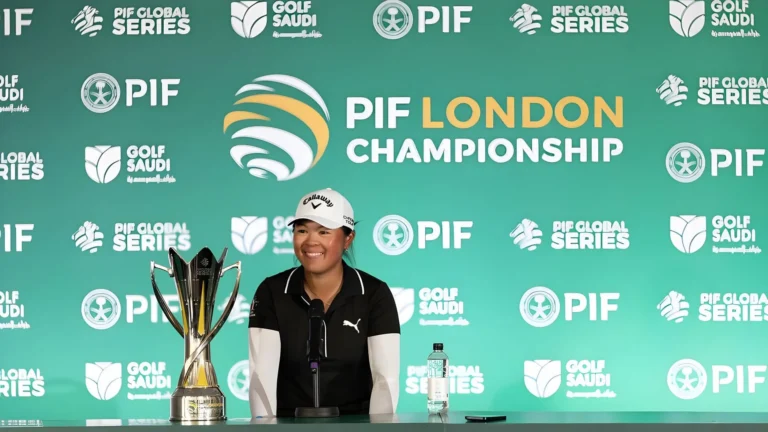
There are easier ways to win a golf tournament than making eagle on the 72nd hole with Charley Hull and a home crowd waiting to see whether you blink.
Anna Huang chose the more entertaining option.
Her dramatic finish at the PIF London Championship at Centurion Club delivered a fourth Ladies European Tour victory and, at 17, made her the youngest player in LET history to reach that mark. It was the sort of ending that can alter expectations rather quickly. One moment you are the precocious teenager chasing trophies; the next, people are wondering how many you might collect.
Now Huang has arrived at the Aramco Korea Championship at New Korea Country Club with another intriguing possibility in front of her: consecutive victories across the PIF Global Series.
The circumstances have changed. The essential challenge has not.
Golf remains horribly indifferent to what happened last week.
London showed why Huang is difficult to shake
Huang’s victory in England was revealing because of how late it was won.
Hull had home support behind her, the tournament had reached its final hole and Huang still needed something exceptional. The resulting eagle was precisely that.
Yet Huang’s own explanation is considerably less theatrical. Her approach is based on staying in the contest until the maths says otherwise.
“Golf is definitely a really interesting sport, and I think the mindset you always have to have is that it’s not over until the last putt drops, because anything can happen,” Huang said. “What happened in London was a prime example of that. You can’t give up, and you just gotta keep pushing until you finish out.”
That sounds obvious until somebody actually has to do it.
Tournament golf is full of players who know they should remain patient, trust the process and stay committed. Doing so when a title is disappearing over the horizon is another matter entirely.
Huang has already demonstrated a useful ability to separate the situation from the shot in front of her. At 17, that may be as interesting as the four victories themselves.
The Aramco Korea Championship asks a different question
New Korea Country Club presents a less sentimental examination.
The tree-lined layout in Goyang-si puts a premium on positioning, disciplined approach play and the ability to commit to a target. Huang arrives with recent proof that her game can survive pressure, but Korea demands that she begins again rather than simply continuing where London finished.
“My next stretch is all in Asia, so this definitely prepares me for what’s coming,” Huang explained. “You just got to be really consistent off the tee, dial in your approach shots, and just pick a target. The golf course here, you need to have a lot of trust in your game.”
There is the interesting bit.
Huang’s rise has understandably been framed through trophies and age records, but her comments keep returning to the less glamorous mechanics of elite golf: targets, patience, consistency and trust.
Nobody engraves those words on a trophy.
They are usually what gets you one.
The field in Korea includes home favourites and LPGA players, adding another high-level test to a schedule that has already taken Huang through significant international competition. The PIF Global Series has placed players from different tours and stages of their careers into the same tournaments across Europe, Asia and the Middle East, giving Huang repeated opportunities to measure herself against experienced opposition.
For a teenager already contemplating LPGA qualifying, that exposure is hardly decorative.
From watching Brooke Henderson to carrying Canada’s flag abroad
There is another strand to Huang’s emergence that reaches well beyond one week’s leaderboard.
Brooke Henderson provided the Canadian reference point.
Huang grew up watching the two-time major champion at the Canadian Open, studying somebody who had already demonstrated that a Canadian golfer could build a career at the highest levels of the women’s game.
“Brooke definitely had a huge impact in my upbringing; she was my idol growing up. I watched her many years at the Canadian Open when I was still a kid,” Huang said. “Being able to look up to someone that’s from your country is really special. Now that I’m playing across in Europe and Asia, hopefully I’m bringing more attention over here, growing the game internationally for Canadians, and inspiring younger golfers to do the same.”
The comparison should not be stretched further than Huang herself takes it. Henderson has her own career and Huang is constructing hers.
What is striking is how rapidly the view has changed.
The child behind the ropes is now the player being photographed alongside Henderson at the U.S. Women’s Open. Huang is competing internationally, winning on the LET and beginning to occupy some of the space once reserved for the golfers she watched.
That is not quite the same thing as replacing an idol. Golf careers are rarely obliging enough to follow such tidy scripts.
It does, however, show how quickly Huang’s professional world has expanded.
Turning professional early has accelerated everything
Huang became a professional at 16.
By 17, she has accumulated four LET victories, played in multiple major championships and competed against established players across international fields.
For most golfers, the first seasons of professional life involve discovering just how many things can go wrong when every shot suddenly has consequences. Huang’s introduction has hardly been gentle.
That appears to have been part of its value.
“Being on tour from 16, 17 has taught me so many life lessons, but I think the most important lesson I’ve learned is that if you want to achieve something and you put your mind to it, then you can do anything you want,” Huang said. “Definitely, I learned a lot about self-belief, patience, and just trust.”
The temptation with an exceptionally young winner is to spend too much time marvelling at the birth certificate. Four victories suggest the more useful question is what happens when the novelty disappears.
Opponents now know Huang can win.
Expectations will be higher. Attention will increase. A good week will no longer seem surprising, while an ordinary one may attract rather more scrutiny than it once did.
That is one of professional sport’s less charming rewards for success.
Korea is another marker, not a coronation
A second consecutive PIF Global Series victory would sharpen the trajectory considerably.
It would also be dangerous to treat the Aramco Korea Championship as some definitive test of Huang’s future. Golf is much too awkward a sport for that, particularly at 17.
What Korea offers instead is another useful measurement.
Can the player who produced the shot of the week in London reset quickly enough to deal with tighter fairways, different conditions, another strong field and the expectation created by winning?
Huang appears to understand the distinction.
Her language is rarely about proving that London was the beginning of something inevitable. It is about selecting targets, trusting the swing and staying involved until the final putt has disappeared.
Four victories before an 18th birthday makes for a striking statistic.
The more interesting part may be how little Huang seems inclined to play as though the statistic owes her anything.