 Andy Devaney
A Golf launch monitor is no longer the preserve of tour vans, teaching studios and golfers with garages large enough to qualify as indoor arenas. The modern player can now access useful practice data for a fraction of what elite technology once cost, which is splendid news for anyone tired of hitting balls into the distance and calling it “work”.
Because let’s be honest: plenty of golf practice is not practice at all. It is repetition with a bucket. A therapeutic thwacking session. Forty minutes of hope, denial and the occasional seven-iron that feels so good it justifies every previous error since 1998.
Jon Sherman, founder of Practical Golf, has spent years trying to steer golfers towards something more useful. His argument is not that technology should replace good coaching, instinct or feel. It is that feedback matters. Practice without feedback can become an expensive way of rehearsing the same mistakes with admirable commitment.
“A personal launch monitor gives golfers better practice feedback and makes practice more engaging and memorable,” Sherman says. “It allows golfers to challenge themselves instead of just hitting balls aimlessly. And it helps them understand their actual club distances and shot patterns.”
That is the heart of it. Not more noise. Better information.
Why Feedback Changes The Way Golfers Practise
Golfers are famously unreliable witnesses to their own games.
They remember the one drive that carried 275 yards downwind in July and quietly misplace the seventeen that came off the heel like a wet newspaper. They claim they hit an eight-iron 150 yards, which may be true provided you include the cart path, two bounces and divine intervention.
A launch monitor makes that sort of creative accounting more difficult.
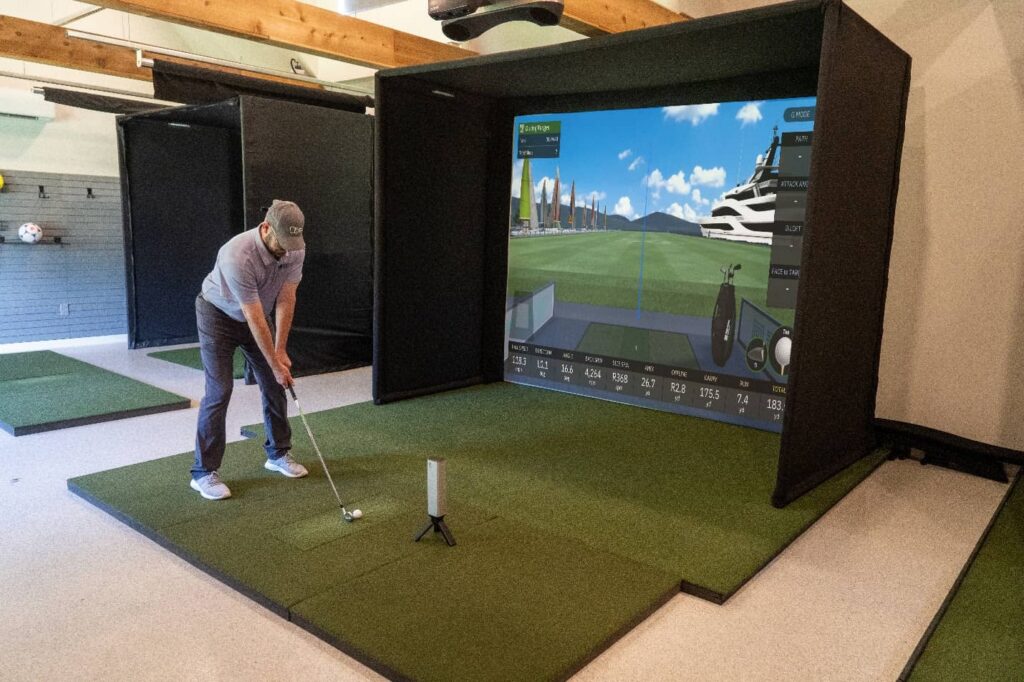
Even basic information — carry distance, ball speed, clubhead speed and shot tendencies — can help golfers build a clearer picture of their game. The value is not in becoming obsessed with numbers. It is in knowing which numbers matter enough to shape better practice.
Sherman’s wider message is simple: technology works best when it gives purpose to a session. A golfer who knows what they are measuring is far more likely to improve than one who is merely firing balls into the horizon and hoping improvement wanders by.
Start With Use, Not Spec Sheets
The launch monitor market has grown quickly, and with growth comes confusion. There are radar-based units, camera-based systems, outdoor devices, indoor simulator options, portable monitors and premium systems with enough capability to make a tour coach purr.
Sherman, who works as a consultant for The Indoor Golf Shop in Celina, Texas, has kept a close eye on that expanding world. The company offers launch monitors and simulators from Trackman, Uneekor, Garmin, Bushnell, Flightscope, ProTee, Full Swing and Tru Golf, alongside projectors, wall padding, golf mats and other home simulator essentials.
Still, the first question is not “Which is the most advanced?” It is “What am I actually going to use this for?”
“When someone’s looking to purchase one of these things, they have to think about what are you going to actually use it for,” says Sherman. “I would say if you’re on a budget and you just want basic numbers, the Voice Caddies, Shot Scope LM1, PRGRs are fine.”
That advice will not thrill the golfer who secretly wants to build Mission Control behind the utility room. But it is sensible. Not every player needs every metric. For many, a straightforward device that brings structure to range sessions will be enough to make practice more productive.
The Case For Starting Small
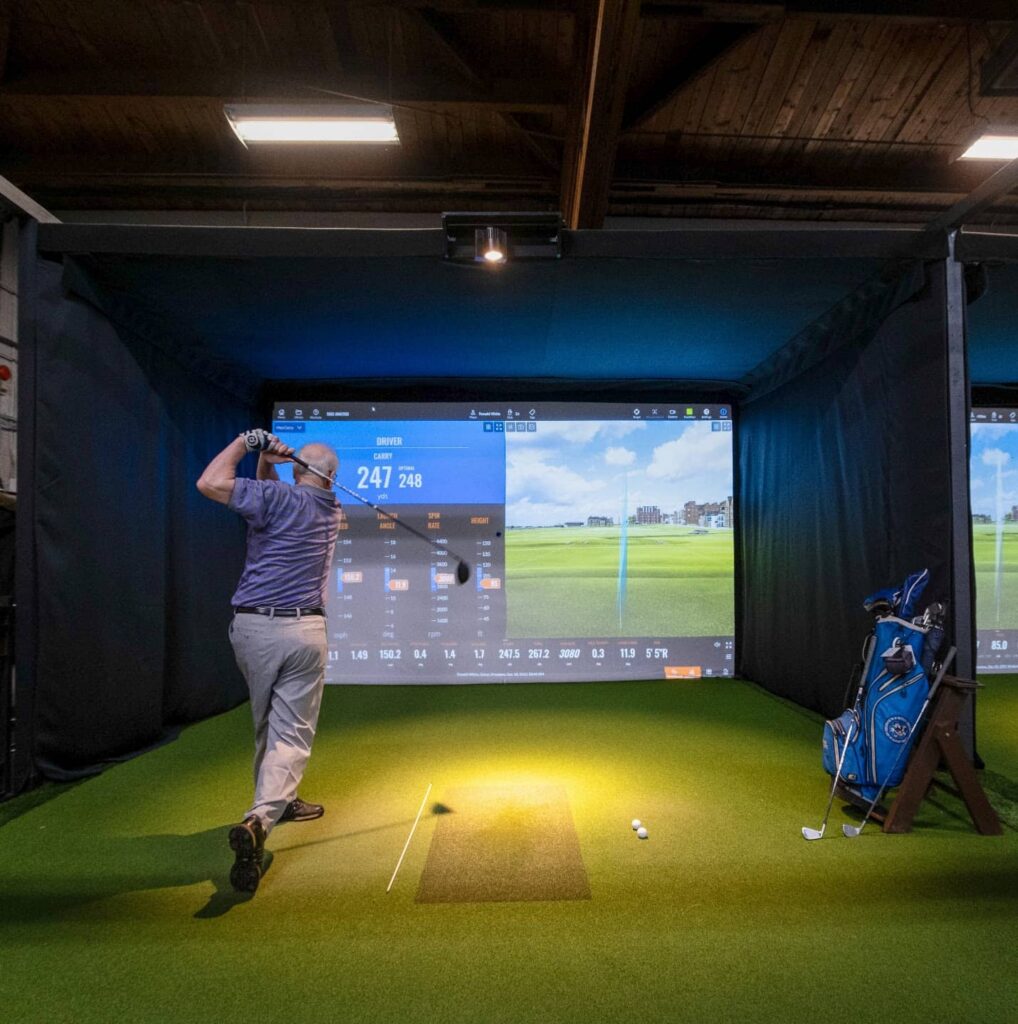
At the basic end of the market, radar-based launch monitors can start at around $200. They will not provide the full buffet of advanced ball and club data, but they can give golfers something they badly need: a reality check.
One especially useful area is wedge practice.
Partial wedge distances are where good scoring lives, yet many amateurs treat them like folklore. They think they know how far a three-quarter sand wedge goes. They often do not. A simple launch monitor can help golfers build distance control with far more precision, turning guesswork into a repeatable system.
The same applies to club gapping, strike quality and speed training. None of this needs to feel clinical. It simply gives the golfer a target, a number and a reason to care about the next shot.
That is a considerable upgrade on beating range balls into the dusk while pretending the last one did not count.
When Software Becomes The Difference
There is, however, a point where the device itself is only part of the story. The software layered on top can be just as important as the hardware.
“For example, if I wanted to use it to get better, especially outdoors, I would lean more toward something that has integrated software like a Rapsodo MLM2 Pro because they’re actually collecting dispersion data that’s going to be stored long term. And more importantly, there are practice schemes and drills that are gamified,” Sherman says.
This is where launch monitor practice begins to look less like data collection and more like player development.
Dispersion patterns matter. They show where shots actually finish over time, not where the golfer insists they would have finished had the wind, lie, mood and planetary alignment been more favourable. That information can influence how a player practises and how they thinks on the course.
The Rapsodo MLM2Pro is listed at $600 for the basic unit and can be used outdoors on its own. It can also sit at the centre of an indoor simulator package for well under $2,000. For golfers wanting meaningful data without leaping into the deep end, that kind of setup has obvious appeal.
Indoor Golf Has Changed The Conversation
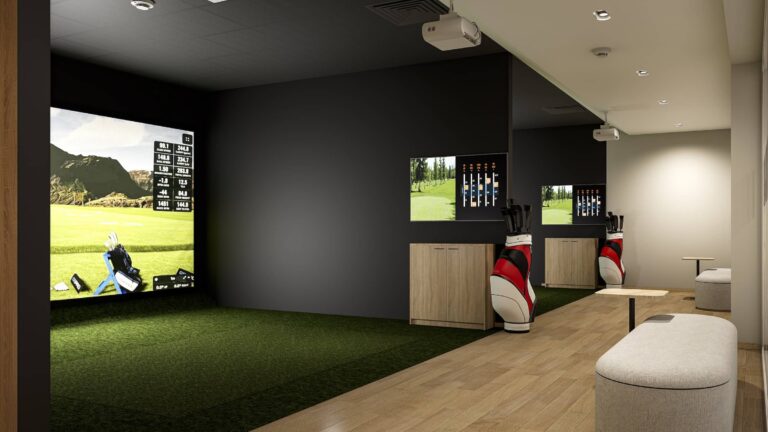
Home practice used to mean a net, a mat and a mild fear of destroying something expensive. Indoor golf has changed that.
A growing number of golfers now want technology that can work in a simulator environment, on the range, or ideally both. That distinction matters. Some devices are designed primarily for indoor use, while others can move between settings.
Square Golf, for example, has built out a collection of budget options. Its Square Golf launch monitor is listed at $700, though it is not designed for outdoor use. The newer Square Golf Omni, retailing at $1,600, has twice as many cameras and can be used outdoors as well as indoors. According to the supplied information, it is accurate and comparable to monitors costing thousands more.
That flexibility may be the deciding factor for many golfers. A launch monitor that suits your actual practice environment will always be more valuable than one that looks impressive in theory and sits unused in a box.
The Premium Systems Still Set The Standard
At the top end, the market becomes considerably more serious.
Trackman 4, at more than $25,000, remains the gold standard. Foresight GC3, GCQuad, Flightscope Mevo Gen 2, Skytrak ST Max, Garmin R50 and Bushnell Launch Pro all offer different combinations of price, software, hardware and sophistication.
These systems are aimed at players, coaches, fitters and dedicated home simulator users who want deeper information: launch angle, descent angle, spin rates, club path, dispersion and more detailed performance analysis.
Driver optimisation is one obvious example. Spin rate and launch conditions can make a significant difference to performance, but most golfers cannot see those numbers with the naked eye. They can see the ball fly, certainly. They may also see it vanish into trees with the doomed majesty of a migrating goose. But they cannot diagnose everything from ball flight alone.
That is where better data can help.
From Practice Bay To First Tee
The most useful launch monitor data does not stay on the range. It travels to the course.
“More advanced software can help golfers test dispersion patterns with different clubs,” Sherman says. “And dispersion testing can improve tee shot strategy and approach shot strategy.”
This may be the most underrated benefit of all. A golfer who understands their real shot pattern with driver might choose a different club on a tight par four. A player who knows their actual carry numbers may stop attacking tucked pins with the confidence of a man who has forgotten every previous double bogey.
Good data does not remove decision-making. It improves it.
And, crucially, it can make golfers more honest. Not brutally honest. Golf has enough brutality already. But usefully honest.
The Smart Way To Choose
The best launch monitor for any golfer is not automatically the most expensive one. Nor is it the one with the longest spec sheet, the flashiest simulator graphics or the most impressive list of acronyms.
It is the one that fits the golfer’s practice habits, budget and appetite for information.
“Work backwards from your budget,” Sherman says. “But I think getting a layer of software on top of just the basic numbers is something that is worth investing in.”
That is a pragmatic place to land. Start with the budget. Decide whether the monitor will be used indoors, outdoors or both. Think about whether basic numbers are enough, or whether long-term data, drills and dispersion tracking will make practice more effective.
Golfers do not need technology to make the game complicated. They have been doing that perfectly well for centuries. What they need is technology that makes practice clearer.
A launch monitor will not swing the club for you. It will not cure vanity, impatience or the baffling urge to take on a tucked pin from 186 yards over water. But it can turn a practice session into something measurable, memorable and useful.
And in golf, that is dangerously close to progress.