 Andy Devaney
The Old Course is not easily impressed.
Golf has been played across this ground since the 15th century, which gives St Andrews a rather unfair advantage when somebody turns up hoping to make history. Revolutions have come and gone. Wars have redrawn the world. Golfers arrived, departed and eventually started being photographed doing both.
Some of the greatest have left something behind here.
Old Tom Morris tended the course. Seve Ballesteros celebrated on the 18th green with the sort of fist pump that would later become familiar elsewhere. Tiger Woods joined the Grand Slam club here. Gary Player, long before becoming one of golf’s great champions, slept among the dunes. Jack Nicklaus crossed the Swilcan Bridge for the last time as a competitive golfer with tears close at hand.
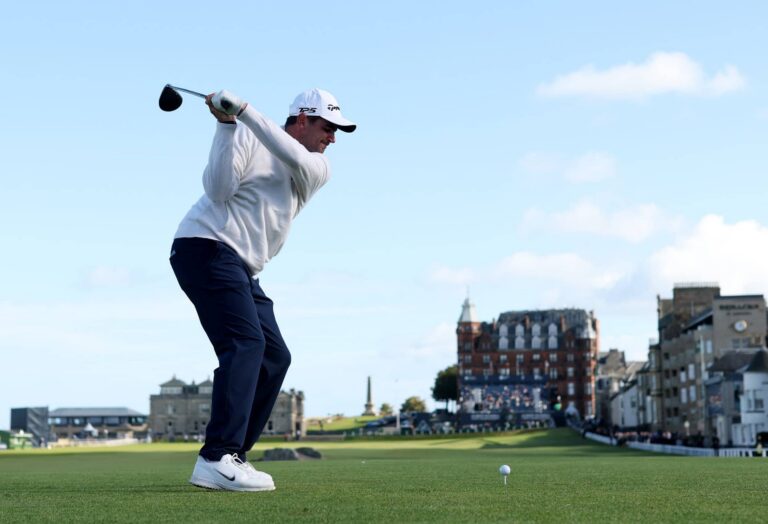
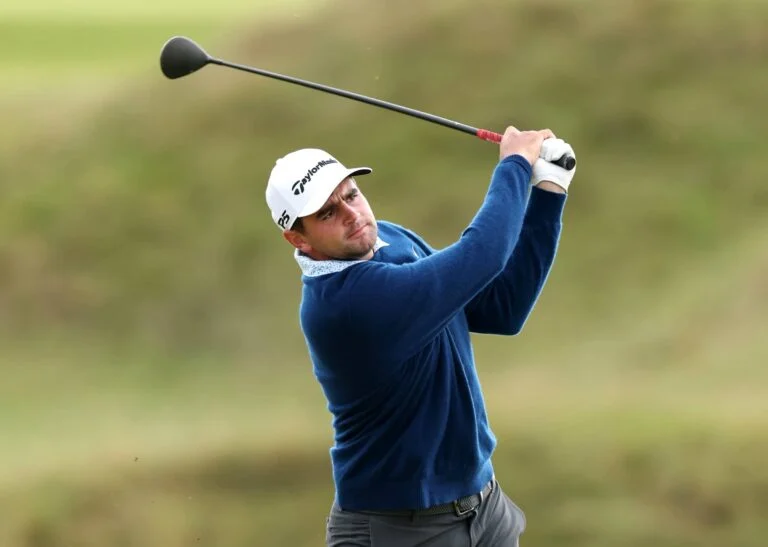
So when Casey Jarvis at the Old Course became one of the stories of the Alfred Dunhill Links Championship, there was considerable competition for space in the old place’s memory.
The 23-year-old South African made a decent argument anyway.
A young South African making himself noticed
Jarvis arrived in Scotland with a growing reputation back home and left St Andrews having finished second to Adrian Meronk, two shots behind the winner.
The result matters. So does the manner of it.
There was a youthful freedom about Jarvis as he moved around the Old Course on Saturday, playing the kind of inventive golf links courses tend to demand from anyone hoping to negotiate them properly rather than merely overpower them.
The particular challenge was a left-to-right wind.
That detail becomes more interesting because it is precisely the sort of wind Jarvis can struggle with. Links golf has a cheerful habit of identifying whatever part of your game you would most prefer to keep private and introducing it to everybody.
Jarvis handled it.
Rather than looking uncomfortable, he worked his way around the problem. That matters at St Andrews because the Old Course has never been simply a question of execution. Understanding where to hit the golf ball, how to shape it and when imagination is worth more than orthodoxy is part of the examination.
Jarvis appeared willing to learn the paper before attempting to answer it.
The Old Course rewards understanding
There is something fitting about that.
St Andrews has always carried a peculiar contradiction. Its fairways are enormous in places, its hazards often perfectly visible and its most famous feature is a tiny stone bridge that presents no golfing difficulty whatsoever.
Yet the course keeps revealing different problems.
Wind changes angles. Angles change decisions. Decisions change everything that follows.
Jarvis’s response to the left-to-right breeze offered a small but revealing glimpse of why his performance was worth more attention than the finishing position alone.
A young player known to have difficulty with a particular condition encountered exactly that condition on one of golf’s most demanding strategic stages and found a way through it.
He did not win. Golf remains annoyingly particular about that distinction.
But he gave himself the chance.
Two shots short, with plenty left intact
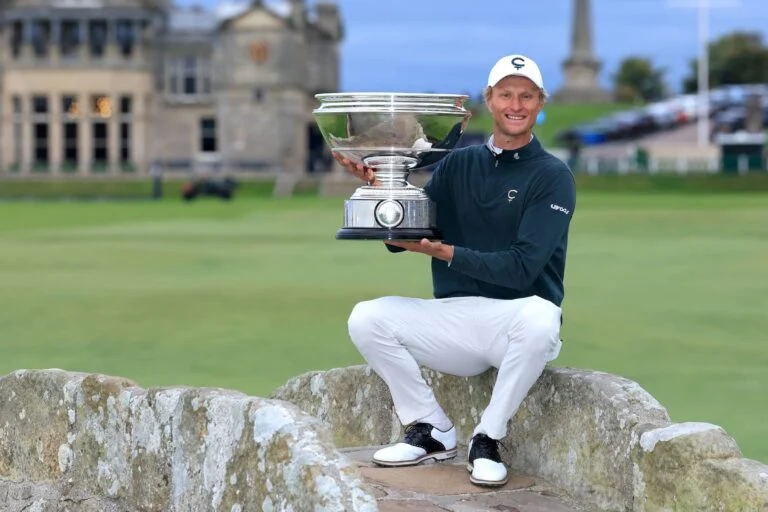
Sunday eventually belonged to Meronk.
Jarvis gave his best in the final round but could not close the remaining gap, finishing two shots behind. For a young player chasing a significant victory, second place has its obvious frustrations.
His reaction offered another useful glimpse.
Jarvis waited while Meronk received the trophy and the congratulations that came with it. Only afterwards did the South African approach the winner and shake his hand.
It was a small moment, and probably more revealing because nobody needed to make a fuss about it.
Golf has no shortage of elaborate analysis for swings, statistics and technique. Character tends to announce itself more quietly.
St Andrews has seen losing finalists before.
Bobby Locke, Ernie Els, Payne Stewart, Bernhard Langer, Tom Watson, Jack Nicklaus and Arnold Palmer have all known what it is to finish second on the Old Course’s 18th green.
It is a rather distinguished group in which to suffer disappointment.
There is already another date with St Andrews
Jarvis’s week becomes more intriguing when placed alongside his tied-sixth finish in this year’s Open.
That gives the South African two notable performances in Scotland and another reason for golf followers to keep his name somewhere accessible.
Because St Andrews is not finished with him yet.
The Open returns to the Old Course in 2027.
Nobody needs to turn that into prophecy. St Andrews has been around far too long for premature coronations, and professional golf has a habit of dealing rather severely with anybody tempted by them.
But Jarvis has already shown that he can compete when links golf asks unfamiliar questions. He has shown imagination around the Old Course, managed a wind that does not naturally suit him and handled a runner-up finish with composure.
At 23, that is enough to make the next visit interesting.
The Old Course has watched better players arrive with greater reputations. She has watched champions become immortal and favourites discover that history is under no obligation to cooperate.
Casey Jarvis merely gave her something else to remember: a young South African with a genuine smile, playing with all of his heart, who came two shots short this time.
And there is always a next time at St Andrews.