 Wayne Lèal
Adam Davison has spent his life around golf. Then he looked at what it had done to his own body.
He played seriously as a young man, represented Yorkshire at county level, went into coaching, and today is Director of Golf at Minthis in Cyprus.
Ask him what golf has given him and he doesn’t begin with competition or memorable rounds. He talks about patience. Respect. Rules. The things he learned young and carried into the rest of his life.
But I asked Adam to look at that relationship from the opposite direction. We spend a lifetime asking what the body can do for the golf swing. Perhaps we should also ask what thousands of golf swings eventually do to the body.
Adam didn’t have to look far for the answer.
Thousands of Balls. One Direction.
When Adam was around 19 or 20, playing amateur golf for Yorkshire and hitting thousands of balls a week, his physical development was assessed.
Something had happened to his body.
The right side of his back had become noticeably bigger than the left. He is a right-handed golfer. Thousands of repetitions of an asymmetric movement had left their mark. He was even encouraged to hit balls left-handed occasionally to restore some balance.
Years later, he can still see the difference.
Golf had shaped the golfer. Literally.
We analyse the swing endlessly. Grip. Posture. Rotation. Club path. Equipment. If the ball isn’t behaving, we look for the fault. But the body producing that swing may have been adapting to it for twenty, thirty or forty years. Eventually adaptation can start to feel like identity.
This is just my body now.
Before You Change the Swing
Adam saw the problem from another direction when he was coaching.
A golfer would arrive for a lesson. Adam could see something in the swing he wanted to change. The conventional response might be to prescribe the correction. Move this. Rotate that.
But higher-level coaching has recognised something that sounds obvious once somebody says it: before asking a golfer to move differently, find out whether their body actually can.
What looks like a technical fault may not simply be a technical fault. The body may have found a solution. Years of injury, repetition, stiffness and compensation may all be present in the movement you are looking at.
Adam encountered another obstacle too. Older golfers can reach a point where they assume very little can change. When Adam warned golfers that continuing with a particular movement might eventually cause problems, some wanted to do something about it. Others accepted it as the price of playing.
Perhaps the question isn’t whether we can create the perfect golf body. Perhaps it’s whether we remain curious about the body we’ve already got.
“Tension Kills Speed”
Adam described someone who was physically strong but extremely restricted in the way he moved. Strength, but very little mobility or flow.
His description was wonderfully unscientific. He moved like a plank of wood.
Then came the line that stayed with me: “Tension kills speed.”
Watch very good performers in golf, tennis or boxing and there is often a rhythm to what they do. Power doesn’t necessarily look like effort.
A child doesn’t possess much strength, so the club itself encourages the body to find a sequence. An adult may already possess enough upper-body strength to make the club move. So that’s what they use.
The movement works. Until we start asking what else that solution has taught the body not to do.
Playing Better or Playing Longer?
That led me to ask Adam a different question. Has golf become too preoccupied with helping people play better and not sufficiently interested in helping them play for longer?
At the higher levels, physical screening has increased considerably. Elite players know that remaining physically capable is part of remaining competitive. Among ordinary amateurs, Adam sees a different picture.
And perhaps that’s where the bigger opportunity lies. Because one of golf’s great strengths is that it is a sport people genuinely can continue deep into later life. Adam sees members at Minthis in their seventies walking the course three or four times a week. Compare them with contemporaries who no longer participate in sport and the value of golf becomes much bigger than what appears on the scorecard.
So perhaps golf shouldn’t merely ask how it can help this person play better. It might also ask how it can help this person keep playing. Those aren’t necessarily the same question.
The Other 18
This is where my own interest in golf began to change. I wasn’t interested in inventing another golf fitness programme. There is already an entire industry devoted to improving golfers. I became interested in something slightly different.
What happens when a body shaped by years of golf enters an environment where its familiar solutions no longer work?
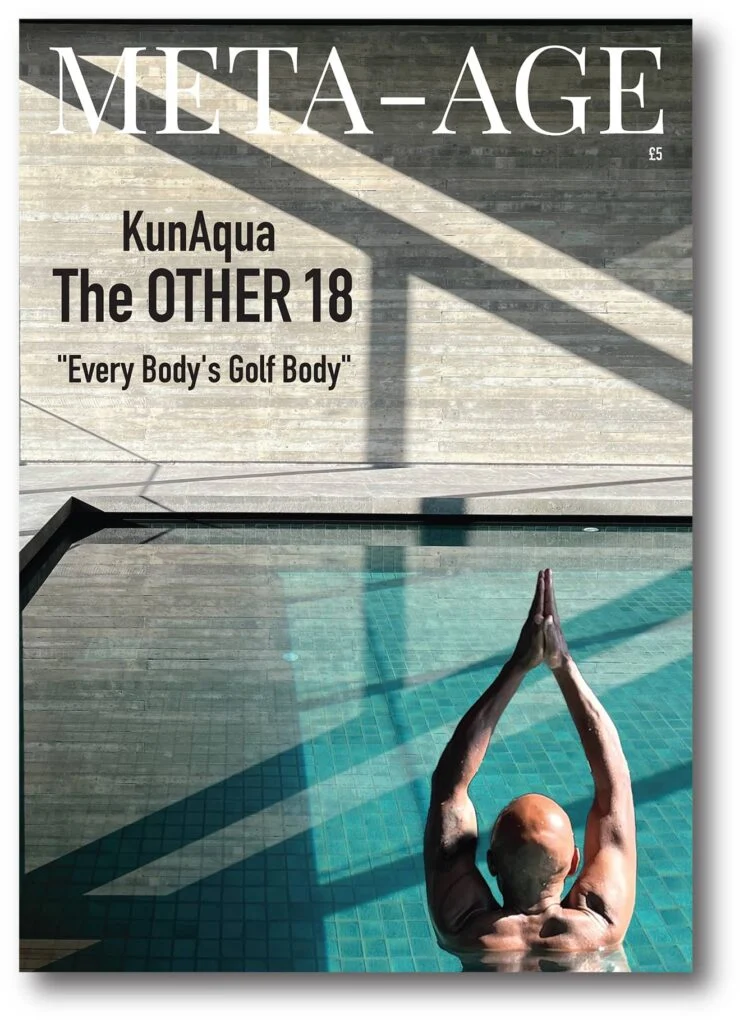
Take away the club. The ball. The target. The score. Put the golfer in water. Suddenly strength behaves differently. Balance behaves differently. Speed behaves differently. The ground is no longer providing the same information. And perhaps the golfer begins noticing the body rather than simply asking it to produce another golf swing.
That became KunAqua’s The Other 18. Eighteen movements. Not eighteen exercises designed to improve eighteen holes. The first 18 belong to the golf course. The Other 18 belong to the water.
Why Minthis?
Minthis doesn’t need another reason for somebody to play golf in Cyprus. There are beautiful golf courses all over the world. What interests Adam is the wider experience: the course, the landscape, the spa, the environment and wellness as parts of the same place. He talks about quality of experience. About taking care of people. About a golf course that belongs within the wider character of the resort.
You don’t necessarily have to play your best game of golf, he says. The point is also to enjoy being there.
That is why The Other 18 makes sense at Minthis. Not because the resort needs another fitness class, but because it opens another way of thinking about the golfer. Not simply as a swing to improve. Not simply as a handicap to reduce. But as a person who may want to be walking onto a first tee ten, twenty or thirty years from now.
Adam described the connection between golf, the body and KunAqua as a light-bulb moment. It made sense because it offered the golfer something different without asking them to become somebody different.
Not another intervention designed to make golfers hit the ball further.
Something designed to help the golfer continue being a golfer.
The golf industry has become extraordinarily good at asking what the body can do for the game. Perhaps the next question is what the game has been doing to the body.
Golf gave us the metaphor. Water gives us the method. The subject is participation.
The OTHER 18