 Andy Devaney
Golf spends plenty of time worrying about how to get more youngsters into the game. The JOLF Nurture Project has approached the question from another direction: start with what children need, give them a club and space to play, and let golf prove useful.
Since launching in January 2026, the programme has engaged 2,300 children. That figure has been built through sessions in 44 schools across Mid-Sussex and 10 free JOLF in the Park events held during the summer holidays, with funding from the Kate & Justin Rose Foundation.
The numbers are substantial. More interesting, though, is what JOLF is trying to do with them.
Golf without the usual scorecard
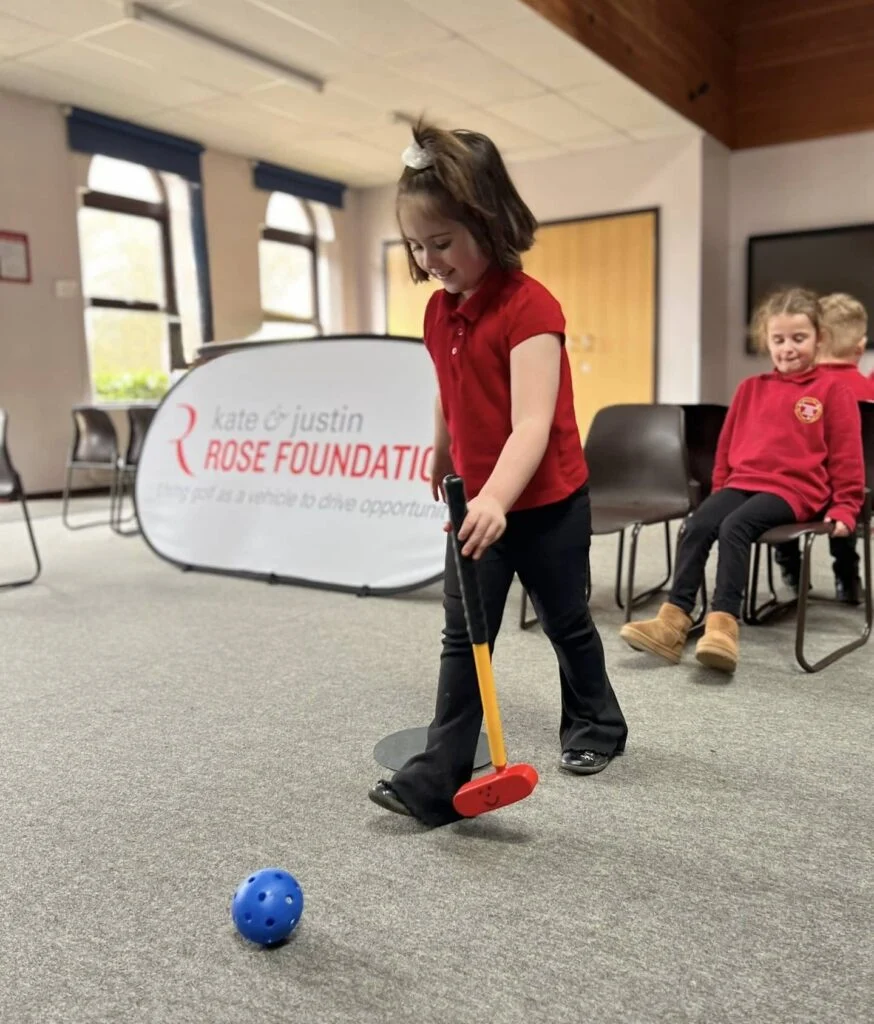
The Nurture Project is designed for children who may benefit from additional support with confidence, communication, emotional wellbeing, resilience and positive relationships.
Rather than treating golf purely as a technical exercise, the sessions use play to give children opportunities to make decisions, solve problems, help one another and become more comfortable with mistakes.
That last point matters more than it might sound.
Claire Batchelor, SEND Co-Ordinator at Lindfield Primary Academy in West Sussex, has seen the effects travel beyond the sessions themselves.
“We absolutely love working with JOLF. We can see the impact of the sessions and how they’re taking the skills into the classroom. A great example is a year 4 boy who has found making mistakes very difficult, but this term he dealt with it like a pro and said to us that it was OK because you just try, try, try like at JOLF!”
For anybody who has spent time around golf, learning to survive the occasional mistake without declaring the afternoon a catastrophe is useful training at almost any age.
Five weeks gives relationships time to develop
Each participating school receives five weeks of half-day sessions, funded wholly by the Kate & Justin Rose Foundation.
That regularity is central to the project. It allows children to become familiar with the JOLF team rather than encountering the programme as a one-off activity, while schools have the opportunity to see whether behaviours developed during the sessions begin appearing elsewhere.
Batchelor says that consistency has also mattered for children who sometimes struggle with attending school.
“Some of the children find it very difficult coming into school, but they always come in for their JOLF sessions. Having funding from the Foundation has enabled us to have regular sessions and for the children to develop those relationships. They’re all so excited when the JOLF man is coming!”
Neil Plimmer, founder of JOLF, believes the programme reflects an evolution in what the organisation discovered golf could offer.
“To reach so many children has long been a goal of ours and I can’t thank the Kate & Justin Rose Foundation enough for making it possible,” he said. “We created JOLF to engage children and families in the game of golf, but it became clear that our programmes can do so much more than that.”
Taking JOLF beyond the school gates
The summer added a different test.
With Foundation funding, JOLF staged 10 free JOLF in the Park events in public spaces around Mid-Sussex. Twelve “Crazy JOLF” holes were set up at each event, with children and families invited to take part.
Some had already encountered JOLF through school. Others were being given a chance to pick up a club without first having to negotiate the more familiar barriers surrounding organised golf.
For Plimmer, the value was as much about the interaction around the holes as the golf itself. “JOLF in the Park took golf to communities that would never have the chance to pick up a club,” he said. “Children played with children they had never met before.
Parents talked and made connections. Families who already knew one another spent time together in a different environment. Golf became a simple way of bringing people together. They were amazing events that would not have happened without the support of the Foundation.”
It is an uncomplicated concept: put something playable in a public space, make it free and see who joins in.
Kate and Justin Rose Foundation commits to 2027
The programme will return in 2027 with continued funding from the Kate & Justin Rose Foundation and an expansion to schools in Worthing.
Kate Rose, Chair of the Foundation, said the project matched its ambition to use golf beyond its traditional sporting purpose.
“The JOLF Nurture Project realises our ambitions to use golf as a vehicle for change. It’s wonderful to see the impact that the sessions have had on children across the region and how golf can not only be a fantastic activity, but can help promote resilience, teamwork, confidence and communication.
The work that Neil and his team have done this year is everything that we want to support, so we are delighted to continue funding the programme into 2027.”
The Foundation has also released a video filmed at one of this year’s JOLF in the Park events, showing the project and some of the children and families involved.
For JOLF, reaching 2,300 children is a sizeable first-year marker. The more intriguing achievement may be proving that, stripped of handicaps, scorecards and much of golf’s usual furniture, a club and a ball can become tools for something rather broader than learning how to play the game.