
 Andy Devaney
Kipp Popert did not arrive at the English Amateur Championship looking for a ceremonial pat on the shoulder. He came to measure his game against the country’s strongest amateurs and reached the semi-finals, turning a fine individual performance into a pointed argument about where disability golf belongs.
A place in the last four, earned the hard way
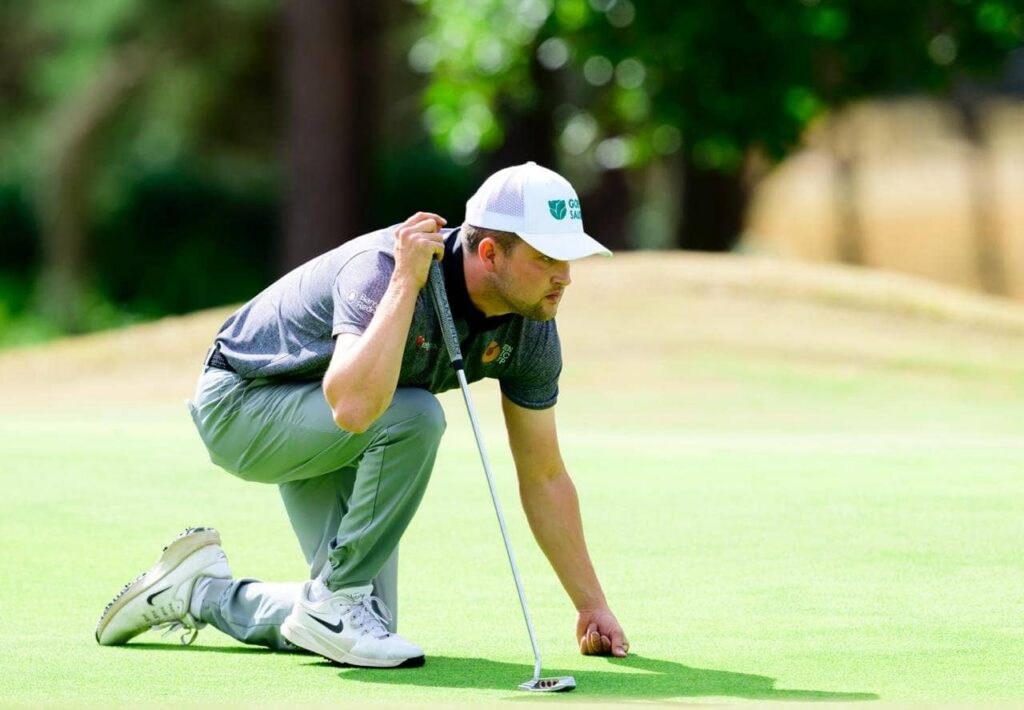
The field began with 288 players. Popert first had to survive the stroke-play cut into the leading 64, then win four match-play contests. There was nothing ornamental about it. By the quarter-final, he was six under par through ten holes and playing with the authority of a man who had stopped asking permission.
“I just want to thank both the golf clubs for hosting this week. They’re in exceptional condition. In the quarter-final, I was 6-under through 10 holes; I was playing the golf I know I can play. And in the semi-final, I think I was maybe 3-under through 12 but I just want to say that Morton played incredible, where I think he birdied five holes from the 11th onwards.”
That semi-final was where the contest acquired teeth. Popert moved three up against Morton Bailey and appeared to have the match under control. Golf, naturally, regarded this as an invitation to misbehave.
Bailey answered with five birdies on the back nine and forced extra holes. Popert then came agonisingly close with a difficult birdie putt on the 19th before Bailey won on the 20th. Bailey later lost the final to Jamie Van Wyk, but his recovery against Popert was the decisive burst of the day.
The defeat that strengthened his case
There are losses that expose a gap and losses that erase one. This was the latter.
Popert, who has cerebral palsy, did not merely occupy the same draw as the leading English amateurs. He beat four opponents, built a commanding semi-final lead and required a remarkable run of scoring to be denied a place in the final.
The distinction matters. Inclusion is useful; contention is harder to ignore.
“Being a disability golfer, I’m extremely proud. It’s not just happened overnight. I’ve worked so extremely hard. And you can see all the sponsors on me—I wouldn’t be here if it wasn’t for them.”
The gratitude was genuine, but so was the reminder. Elite golf is expensive, relentless and not especially sentimental. Talent still needs travel, entry fees, equipment, support and the sort of backing that tends to arrive more readily once a player has already proved he can survive without it.
Popert has done rather more than survive.
Kipp Popert and the pathway that did not exist
His performance also carried historical weight. Popert grew up without the national disability structure now available to younger players.
“There was no England Golf Disability Team for me growing up. There now is one for the next generation and I’m extremely proud of that.”
That sentence contains both progress and indictment. The pathway exists now, which is welcome. It did not exist for him, which helps explain why his success feels less like the product of a polished system and more like the consequence of one player refusing to accept its omissions.
Visibility alone does not solve those structural problems, but it makes them harder to shelve. A disability golfer reaching the last four of the English Amateur offers evidence rather than aspiration. Nobody needs to imagine the standard. It was there on the scoreboard.
“I just hope this keeps moving disabled golf forward,” he said. “To compete with these boys is an absolute pleasure. I guess I showed I can compete with them.”
The final sentence is almost comically modest. Four match-play victories and a lead deep into the semi-final tend to qualify as a touch more than a guess.
Disability golf needs somewhere for its best players to go
Popert is encouraged by the development of the England Golf team and the U.S. Adaptive Open, but his ambitions are not confined to better amateur opportunities.
“There’s a lot of positives,” said the Kent golfer. “We’ve got the England Golf team. We’ve got the U.S. Adaptive Open. I just think we need a professional tour.”
The closure of the G4D Tour has left the top end of disability golf without the professional platform Popert believes its best players have earned. His case is direct.
“The best players in the world are off plus one or scratch with one arm, one leg. They’re exceptionally talented and deserve an opportunity to play this game like women and men do.”
That is not a request for lowered standards. It is a demand for a stage proportionate to the standard already being produced.
Golf has never been shy about building tours, series and invitationals once the commercial appetite exists. The challenge here is to make sporting merit impossible to overlook long enough for investment to catch up.
Building the platform, not merely discussing it
Popert is already trying to supply some of that momentum himself. The Kipp Popert World Invitational, held earlier in the year, raised £200,000 with Variety Golf to support disabled golfers, disabled children and adaptive players who need financial help to compete.
“I’d love to work with companies to try and keep growing that and make a platform for the best disabled golfers in the world. I’m trying to do every bit and give my life to provide an opportunity for the next generation…This feels right to do.”
The scale of the sum is impressive. The intent behind it is more revealing.
Popert is not treating advocacy as a pleasant side project to be wheeled out after the golf. He is tying his competitive career to the creation of opportunities that were absent when he needed them.
That can become a burden. Athletes from underrepresented groups are often expected to compete, educate, campaign and smile for the photograph. Popert appears willing to carry the load, but the sport should be careful not to confuse his willingness with an excuse for everybody else to admire from a safe distance.
The next examination
His campaign was set to continue with DP World Tour Q School and Asian Tour Q School after a quieter August. Those targets are ambitious, which is precisely the point. Popert’s English Amateur run did not settle the argument; it moved it to a tougher examination.
He has shown he can beat leading amateurs in match play. He has shown he can score heavily under pressure. He has also shown that disability golf does not lack elite competitors. It lacks a complete ladder for them to climb.
At the English Amateur, Kipp Popert came within two holes of the final. He left with something sturdier than consolation: proof that the standard is already there, and a sport still deciding whether its structure deserves the players it has.