 Robert Theodorson
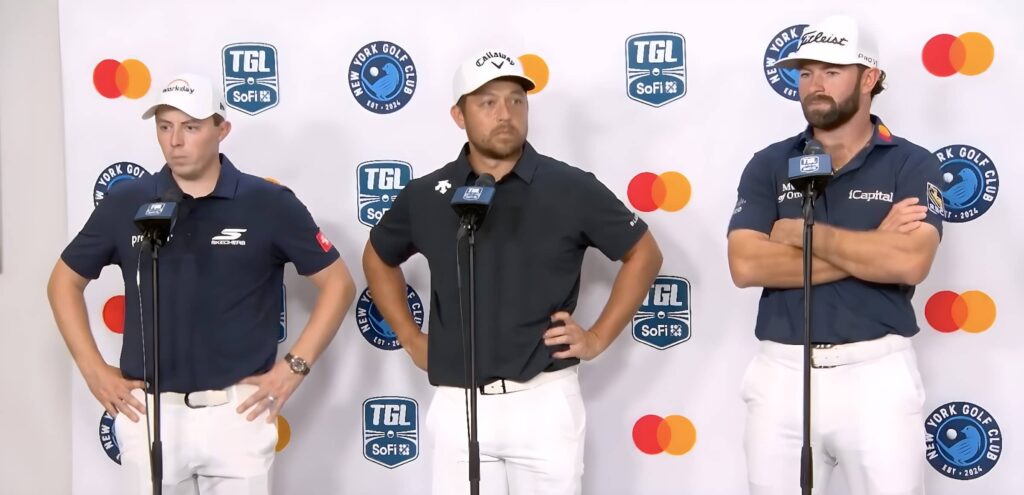
If you came for tidy, well-mannered golf, TGL had other plans. This was modern, noisy, mischievous golf—part arena sport, part chess match, part pub story you swear is true. And by the time the dust settled at SoFi Center, New York Golf Club had done just enough to beat Atlanta Drive GC, 4–0, in a match that felt more like a test than a showreel.
Asked what looked different compared to last year, Cameron Young didn’t dress it up. The place is playing tougher, the landing zones are meaner, and the learning curve is still steep.
“Yeah, we were just talking about it out there. I think generally a lot of the holes seemed to be playing more difficult. They’re longer. It’s harder to hit the fairway. Then when it comes to the green, the grain all being kind of toward the green is helpful, but at the same time, the green still has big slopes on it, and we’re still learning those and learning the holes. I think overall it’s playing a bit more difficult, and I think you all saw that the first eight, nine holes today.”
That’s the thing about TGL: it looks like a party, but it punishes you like a proper examination paper. The visuals are bright, the pace is brisk, and then the greens quietly take your lunch money.
The “Golden Tee” vibe—and the tee shots that make you grin
One of the joys of TGL is that it doesn’t pretend to be a polite re-creation of your Saturday medal. It leans into the idea that golf can be playful without being silly. The holes have personality. They tempt you. They also embarrass you on live television if you get cocky.
When asked about those real-life, Golden Tee-style holes, Xander Schauffele sounded like a man who enjoyed the chaos—and didn’t mind admitting it.
“Yeah, I guess I had the honour of hitting a lot of the fun tee shots. I don’t think they expected that stinger hole to go that way, but I would imagine it was rather entertaining. It was cool to see our teammate Cam hit like a 50-yard hook into a screen. That was pretty cool. I think it’s a little interesting. The tree in the middle of the hole, that’s kind of fun for us to flight shots in a certain way.”
A tree in the middle of the hole is the sort of thing golf’s traditionalists would once have called “nonsense.” Yet here’s the uncomfortable truth: it creates decisions, it exposes skill, and it forces players to commit. Old golf values—shot-making, nerve, imagination—dressed in new clothes. That’s TGL at its best.
Asked whether the answer was to launch it lower, Schauffele didn’t overcomplicate it.
“Or higher. I think both of us went over the tree, so clearly I need to come back and hit my driver a little lower. Maybe we’ll get some pointers from Fitzy.”
The hammer: brilliant idea, ruthless consequences
If TGL has a signature piece of theatre, it’s the hammer. The concept is simple: press your advantage, raise the stakes, swing momentum. The execution, however, is where grown men start looking for a flag like they’ve lost their passport in an airport lounge.
Late in the match there was a sense of confusion around who makes the call and how quickly it has to happen. Schauffele was candid, and the honesty was the point: in this format, details aren’t details—they’re the match.
“All of us are in charge of that. Our big bogey was we didn’t have the flag on us to even throw the hammer. But I thought just to get the match — Cam and Fitzy played great. I dragged them — they dragged me along for the first however many holes on the front nine, and then I thought we strung together a few nice holes. I would have been stoked if someone said you guys are going to be tied going into the last hole with an even chance to win. Yeah, I think the hammer is on all of us, and most importantly we just need to make sure we have it on us when we’re up there on the green.”
That’s TGL in a nutshell: teamwork with consequences. It rewards communication the way traditional golf rewards routine. If you’re sloppy, it shows. If you’re sharp, you look like geniuses.
Going second after a dagger putt: the oldest pressure in the newest format
At some point, golf always returns to the same cruel question: can you answer? In this match, Schauffele found himself following putts after momentum-swinging makes—an uncomfortable echo of previous pain.
Matt Fitzpatrick, never one to waste an opening, offered a solution that sounded suspiciously like self-preservation.
“We need to change the order then. If he’s the one that keeps missing –”
Schauffele didn’t argue.
“Yeah, it’s true. It’s true. I think the exact same thing happened. History happened to repeat itself tonight. I think Fitzy is planning to change the order. Maybe he can dunk on someone else.”
That line lands because it’s funny, but it also lands because it’s true: team golf has pecking orders, and pressure finds the same addresses again and again.
Asked whether he felt the familiar “here we go again” when the putt dropped, Schauffele leaned on something every champion quietly masters—selective memory.
“Luckily, I have sort of short-term memory when it comes to certain things. My mind was more like, all right, I need to make this putt. I thought I was going to have a putt to win, not to tie. That’s poor thinking on my part.”
Then he tipped his cap to the man causing the trouble.
“Once I saw Billy’s ball tracking, he almost made a 50-footer earlier, like a few holes before on the par-3. The guy is really good at this stuff. Kudos to him. That was a hell of a putt.”
The stinger hole, the rock, and the one-club verdict
Every format needs a villain, and on this night the stinger hole with the overhanging rock played the role perfectly. It looked enticing, then started swatting golf balls like it had a personal grudge.
Was driver the right play? New York’s room sounded unanimous—borderline offended that anyone asked.
“I mean, we’ve all hit it.” Schauffele said.
Fitzpatrick followed, blunt as a hammer.
“Yeah, I think driver is the answer. Yeah. Without stating the obvious, yeah. I don’t know what the carry is with an iron and stuff –”
Schauffele, helpfully unhelpful, chimed in:
“90, 200.”
Cameron Young landed the plane:
“I think driver is the only answer there.”
And Schauffele, because TGL encourages specifics, gave the kind of practice-range detail golf fans love.
“Yeah, Fitzy launched one 1.1 in practice, I launched one two degrees. Cam tried to hook it around the rock. Weird. We all had good fun. Last night Billy and I were in here, Billy hit driver off the deck and we were both under it easily, so we were both a little surprised when both our shots smoked the rock”
That’s the format again: fast, loud, and unafraid to show you the seams. The players aren’t reading from a script. They’re diagnosing problems in real time—together.
What New York Golf Club take from it, and what TGL is proving
New York Golf Club won 4–0, but TGL isn’t the kind of sport that lets anyone feel entirely comfortable afterwards. The margin says “routine.” The quotes say “work in progress.”
New York’s big takeaway is obvious and refreshingly practical: keep the hammer flag on you, tighten the late-match process, and keep learning the greens that are still writing new chapters in everyone’s yardage books.
And the larger point for TGL is equally clear. When it’s done right, it doesn’t replace golf’s past—it borrows the best of it: shot-making, nerve, problem-solving, accountability. Then it puts those virtues under brighter lights and faster clocks.
That may not be how things have always been done. But it is, increasingly, how the next era will be judged.