 Andy Devaney
Finish 50th at this week’s DP World Tour Championship and there is still $33,500 waiting on the published prize-money schedule.
Finish outside the leading 100 in the season-long Race to Dubai standings, however, and your prospects for 2027 could look considerably less comfortable.
That is the peculiar contrast at the heart of professional golf’s European circuit.
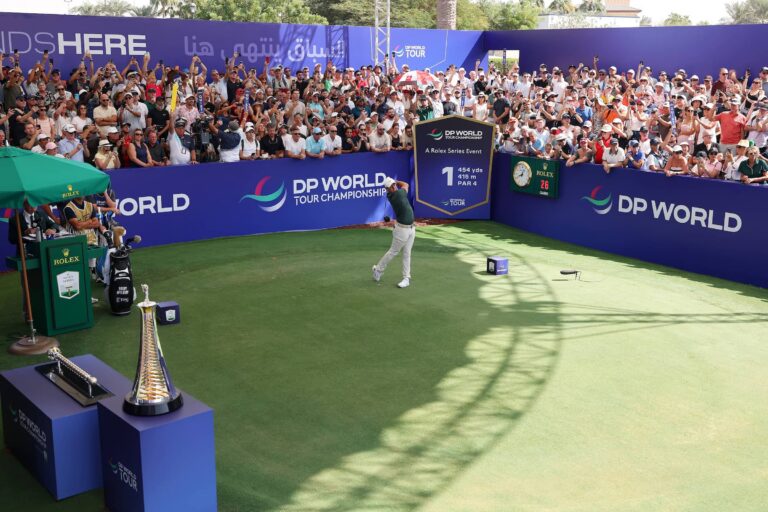
At Jumeirah Golf Estates, the game’s leading players are chasing a $3 million winner’s cheque, another enormous season-ending bonus and the Harry Vardon Trophy. Even those at the bottom of the 50-player finale have already accomplished something important simply by qualifying.
Elsewhere, golfers have spent recent weeks trying to protect their livelihoods, recover lost playing privileges or earn their first proper opportunity on the DP World Tour.
And the competition has become tougher.
Changes introduced for 2026 mean fewer full cards are available through the season rankings and the two principal promotion routes.
So what exactly is the Race to Dubai, how much can players earn, and what happens to those who fail to retain their place?
What Is the Race to Dubai?

The Race to Dubai is the DP World Tour’s season-long points competition, introduced in 2009 to replace the European Tour Order of Merit.
Despite the name, the competition stretches considerably further than the United Arab Emirates.
The 2026 DP World Tour schedule comprises 42 tournaments across multiple continents, beginning in November 2025 and concluding at the DP World Tour Championship on 15 November 2026.
Players accumulate Race to Dubai points according to their performances, with different tournaments offering different allocations.
Major Championships and selected Rolex Series events carry greater points opportunities than regular tournaments, while consistency throughout the season can prove just as valuable as an occasional victory.
At the end of the campaign, the player leading the standings receives the Harry Vardon Trophy and is crowned Race to Dubai champion.
Previous winners include Rory McIlroy, Jon Rahm, Lee Westwood and Tommy Fleetwood.
McIlroy claimed his seventh title in 2025, despite Matt Fitzpatrick winning the season-ending tournament.
That distinction matters. Winning the DP World Tour Championship and winning the overall Race to Dubai are two different achievements.
How Does the Race to Dubai Work?
The competition has three principal phases.
The Global Swings
The season begins with five geographical swings: Opening, International, Asian, European and Closing.
Players earn points through tournaments staged across the international schedule, with swing leaders also gaining additional playing opportunities.
For golfers outside the established elite, these events are an important opportunity to establish their position before the bigger tournaments arrive.
The Back 9
Nine established tournaments make up the next phase, including historic national Opens and the BMW PGA Championship at Wentworth.
With increased Race to Dubai points available, strong results can make a considerable difference to a player’s season.
By the time the regular campaign ends, the rankings have determined not only who has performed best but also which members have protected their playing status for the following year.
The DP World Tour Play-Offs
The season concludes with two tournaments in the United Arab Emirates.
The leading 70 qualifying players advance to the Abu Dhabi Aldar Championship at Yas Links, staged from 5–8 November.
The leading 50 available players then progress to the DP World Tour Championship at Jumeirah Golf Estates, held from 12–15 November.
The final tournament takes place over 72 holes on the Earth Course, designed by Greg Norman, with no halfway cut.
Everybody who completes the championship receives prize money.
The competition for the season-long title is a separate calculation, based on the final Race to Dubai points standings.
As our look at the 2026 title permutations explains, even a player finishing a long way down the Dubai tournament leaderboard can remain in contention for the overall crown.
How Much Prize Money Is Available at the 2026 DP World Tour Championship?
The 2026 DP World Tour Championship has an official tournament prize fund of $10 million.
The winner receives $3 million, the runner-up collects $1.27 million and third place is worth $820,000.
Here is the published breakdown for selected finishing positions.
Figures represent the published individual finishing-position allocations in US dollars. Actual payments can change where players tie.
The difference between winning and finishing last is substantial, naturally. But the sums further down the leaderboard are hardly insignificant.
Twentieth place is scheduled to receive $92,500. Fortieth earns $48,500.
Even 50th is worth $33,500.
Those figures are tournament earnings rather than take-home pay. Professional golfers have costs to cover, including caddie payments, travel, accommodation, coaching and any applicable taxes.
There is also an important distinction between the players competing in Dubai and everybody who has held DP World Tour membership during the season.
These payments are available to the small group who have qualified for the season finale. They are not guaranteed to every golfer who competed on the circuit in 2026.
How Much Does the Race to Dubai Champion Earn?
The tournament purse is only part of the financial picture.
The DP World Tour also offers a separate $6 million Race to Dubai bonus pool, shared between the leading ten eligible players in the final season-long rankings.
| Final Race to Dubai ranking | Bonus (USD) |
|---|---|
| 1st | $2,000,000 |
| 2nd | $1,000,000 |
| 3rd | $750,000 |
| 4th | $550,000 |
| 5th | $450,000 |
| 6th | $350,000 |
| 7th | $300,000 |
| 8th | $250,000 |
| 9th | $200,000 |
| 10th | $150,000 |
Players must satisfy the Tour’s bonus eligibility requirements, including participation in at least four counting tournaments during the season, one of which must be the DP World Tour Championship.
The two prize funds are separate.
That means a golfer winning both the DP World Tour Championship and the overall Race to Dubai could collect $5 million in combined tournament prize money and season-ending bonus payments.
A player finishing second in the season-long standings could receive a $1 million bonus in addition to whatever they earn from their performance at Jumeirah Golf Estates.
And all of that comes on top of their tournament earnings from the rest of the campaign.
Why the Race to Dubai Matters Beyond Prize Money
For established stars, the Harry Vardon Trophy adds another prestigious honour to an already successful career.
For other players, a high finish can open doors that might otherwise remain firmly shut.
Ten PGA Tour cards for 2027
Through the DP World Tour’s strategic alliance with the PGA Tour, the leading ten eligible DP World Tour members in the final 2026 Race to Dubai rankings who are not already exempt can earn PGA Tour membership for 2027.
That offers the opportunity to compete regularly in America, with access to additional tournaments, substantial prize funds and potential commercial opportunities.
Successful players become dual members, rather than automatically surrendering their DP World Tour membership.
For someone trying to establish themselves internationally, that opportunity could prove more valuable over the long term than a single tournament cheque.
A route into The Open at St Andrews
There is another significant incentive further up the rankings.
Under The R&A’s published qualification criteria, the leading 25 players in the final 2026 Race to Dubai standings qualify for the 155th Open Championship at St Andrews in July 2027.
For a golfer yet to compete in an Open Championship at the Home of Golf, that is quite an opportunity.
It also explains why movement further down the standings can remain important even when the overall title appears beyond reach.
A player climbing from 27th to 24th could secure a Major Championship appearance. Another moving into the eligible PGA Tour promotion places could change the direction of their career.
Not every important result involves lifting a trophy.
What Happens if a Golfer Finishes Outside the Top 100?
Here is where the distinction between the Dubai tournament and the season-long competition becomes crucial.
Finishing 50th at the DP World Tour Championship does not mean losing your Tour card. Reaching the final tournament is already evidence of a strong season.
The battle to retain ordinary playing status was largely settled before the play-offs began.
In 2026, the DP World Tour reduced the number of players retaining full membership through the regular-season Race to Dubai standings from 110 to 100.
The decisive cut-off came at the Genesis Championship in South Korea on 25 October.
Under the revised structure:
- Top 100: Players secured Category 10 membership, providing strong playing priority for 2027.
- 101st–110th: Players received Category 18 conditional membership, with more restricted tournament access.
- 111th–125th: Players received lower-priority membership status.
- Outside those positions: Players may need another exemption, a development-tour route or Qualifying School to regain suitable playing privileges.
These rankings are not the only way to obtain access.
Tournament winners and players holding other exemptions can retain playing rights independently of their position in the season standings.
Nevertheless, for members without that protection, the difference between full and conditional status is considerable.
A full card provides a more dependable schedule and greater opportunity to earn ranking points and prize money.
Conditional membership can mean waiting to discover which events have room for you, receiving fewer starts and trying to build a season around opportunities that are not always guaranteed.
A player’s priority may subsequently improve through the Tour’s re-ranking process.
But with travel, accommodation and support costs to manage, uncertainty over tournament access is hardly an ideal way to prepare for a professional season.
Who Replaces the Golfers Who Lose Their Tour Cards?
The DP World Tour does not operate a simple one-out, one-in relegation system.
Tournament entry depends on exemption categories, each carrying its own level of priority.
Two of the most important pathways are the HotelPlanner Tour and Qualifying School.
The HotelPlanner Tour: 15 promotion places
Previously known as the Challenge Tour, the HotelPlanner Tour serves as the principal development circuit beneath the DP World Tour.
Players accumulate Road to Mallorca points throughout the season, with the leading golfers earning promotion.
For 2026, the number of full DP World Tour cards available through this route was reduced from 20 to 15.
Denmark’s Hamish Brown topped the final Road to Mallorca Rankings, while France’s Julien Sale won the season-ending Grand Final in Mallorca and finished second overall.
Scotland’s Marc Warren supplied another particularly interesting result.
The four-time DP World Tour winner began the Grand Final in 20th place in the rankings, outside the promotion positions.
A tied-fifth finish lifted him seven places to 13th, enough to regain full playing privileges for 2027.
Our report from the HotelPlanner Tour Grand Final covers the final promotion battle and the contrasting achievements of Sale and Brown.
For Warren, the result offered a route back to a circuit on which he had enjoyed considerable success. For emerging golfers, the same pathway offers the chance to establish themselves at a higher level.
Players finishing 16th to 20th in the Road to Mallorca Rankings can also obtain Category 19 status, although that carries lower playing priority than full promotion.
Qualifying School: 20 players earn cards
The other principal pathway is DP World Tour Qualifying School, generally known as Q-School.
It is a demanding sequence of qualifying tournaments culminating in a six-round Final Stage.
The 2026 Final Stage concluded at INFINITUM in Tarragona, Spain, on 11 November.
Under the revised rules, the leading 15 players and ties earned DP World Tour membership for 2027, rather than the previous top 20 and ties.
Because several players shared the final qualifying position, 20 golfers ultimately secured their cards.
Spaniards José Luis Ballester and Rocco Repetto Taylor shared victory at 32 under par.
Other successful graduates included Byeong Hun An, Edoardo Molinari, Tom Lewis and John Catlin.
Repetto Taylor provided an example of how quickly a professional golfer’s circumstances can change.
After finishing 152nd in the Race to Dubai rankings, he returned to Qualifying School and regained his playing rights at the first opportunity.
The full list of 20 Q-School graduates includes both established Tour winners and players preparing for their first full season.
For those who qualify, it is an opportunity to compete at the next level.
For those who miss out, another year of uncertain starts and further attempts to earn promotion may follow.
Do Golfers Who Lose Their Cards Still Earn Money?
Losing full DP World Tour status does not automatically mean a professional golfer stops earning.
Players with conditional membership can still enter tournaments when their priority allows. Others may compete on development circuits, enter qualifying events or obtain starts through alternative exemptions.
What they do not receive is a blanket payment simply for finishing outside the leading 100.
The DP World Tour does, however, operate an Earnings Assurance Programme for qualifying members.
Under the programme, eligible players in Categories 1–18 can receive minimum annual earnings of $150,000, provided they meet the necessary participation conditions.
Those include competing in at least 15 eligible Race to Dubai tournaments, excluding Majors, or taking up at least 70 per cent of their defined playing opportunities.
It offers a degree of financial protection for members who satisfy the requirements.
It is not an unconditional salary for every professional golfer, nor does it automatically apply to somebody who has lost their playing privileges.
For players trying to rebuild a career on a development circuit or through qualifying events, the financial position can be much less secure.
Has the Race to Dubai Become Harder to Survive?
The revised 2026 membership system has made several important routes into full DP World Tour status narrower.
The regular-season retention cut-off has fallen from 110 to 100 players.
The HotelPlanner Tour now promotes 15 golfers rather than 20.
Qualifying School awards cards to the leading 15 and ties, rather than the previous top 20 and ties.
According to the DP World Tour, the changes are intended to provide members with greater certainty over their schedules and create more balanced playing opportunities.
For those who secure full membership, that may prove beneficial.
For those near the qualifying thresholds, however, the consequences of a poor week or a few missed points have become more significant.
A golfer can find themselves moving from a relatively dependable schedule to conditional access, another attempt at Q-School or a return to the development circuit.
Meanwhile, the players who have earned promotion arrive with their own ambitions, determined to make the most of what is often a hard-won opportunity.
That is what makes the Race to Dubai considerably more interesting than a contest over the final leaderboard.
At Jumeirah Golf Estates, one player could collect $5 million by winning both the tournament and the season-long title. Even the final scheduled finishing position offers $33,500.
But the golfers competing in Dubai have already earned the privilege of being there.
For many of their colleagues, the most important results of the autumn have come elsewhere — in South Korea, Mallorca and Spain, where the difference between another year on Tour and another year trying to get back was decided.
The champion will leave Dubai with the Harry Vardon Trophy.
Others will have to settle for something rather less glamorous.
A Tour card. And the chance to do it all again.