 David Gonzalez
The Scottish Challenge has reached the useful stage where pretty golf counts for no more than ugly golf, provided the arithmetic behaves.
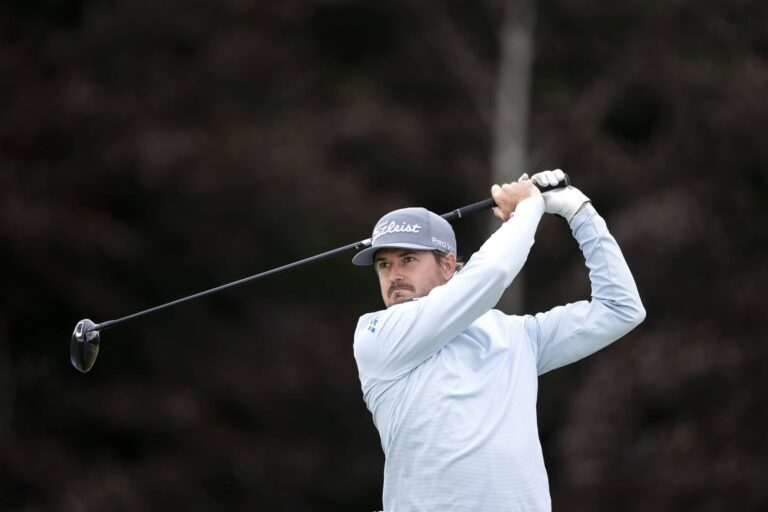
Christofer Blomstrand discovered as much at SCHLOSS Roxburghe, following Friday’s sparkling 61 with a far more stubborn one-under-par 70 to reach 16 under and preserve a two-stroke lead over Tomas Gouveia heading into the final round.
Blomstrand swaps fireworks for survival at SCHLOSS Roxburghe
A day earlier, Blomstrand had made the place look suspiciously accommodating. Moving day restored the course’s dignity.
The 34-year-old Swede began two clear, but his advantage immediately became less comfortable after a bogey at the par-four second dropped him back to 14 under. With the wind still asking awkward questions and the greens becoming firmer, the round demanded rather more patience than pyrotechnics.
“I didn’t play as good today as I did yesterday,” he said. “It’s not that easy out there.
“It’s easy to be in the wrong place, especially on a day like today where I didn’t hit it that good off the tee.”
That admission rather neatly described his afternoon. Blomstrand was not in command of every part of his game, but he remained in command of the tournament.
Birdies at five and ten steady the Scottish Challenge leader
A birdie at the fifth repaired the early damage and sent Blomstrand to the turn level par for the round. Another at the tenth proved to be his only gain on the back nine, yet it was enough to give him breathing room while those around him tried to make something happen.
There was little resemblance to the ten-under-par 61 that had carried him to 15 under after two rounds. That was not necessarily a problem. Final-round leads are rarely awarded for artistic impression.
“I didn’t have any expectations,” he added. “It was a new day, it’s golf, it’s still a hard game so I just came here and did my best today.
“The conditions were similar to yesterday in terms of the wind direction and strength, but I just didn’t manage to play as good.
“The greens are getting harder, it’s harder to hit the right spots on the greens.”
The harder surfaces may yet be one of the decisive details of the final round. A player protecting a lead generally prefers predictability. Firm greens have other ideas.
Tomas Gouveia recovers to keep the pressure on
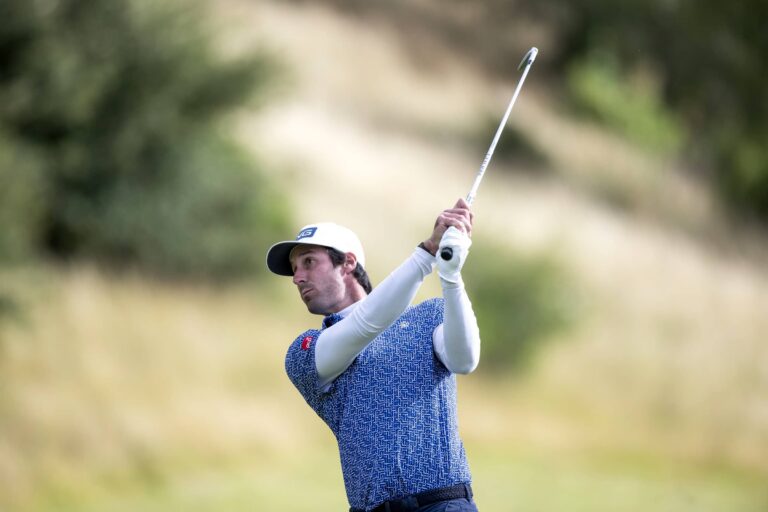
For a time, Blomstrand looked capable of escaping with a much healthier margin. Playing partner Gouveia endured a two-over-par front nine, leaving the Portuguese chasing both the leader and his own round.
He recovered impressively. Birdies at the 11th, 14th and 17th pulled him back into contention and reduced Blomstrand’s advantage to two. It was a useful reminder that the final pairing is unlikely to become a ceremonial stroll through the Borders.
Blomstrand, though, sounded more relieved than restless after getting his score signed.
“I’m just super happy that I’m still in the lead,” he said. “I’m going to go home now, I’m quite tired.
“It’s time to recharge the batteries and go again tomorrow.”
There are more sophisticated sports-psychology programmes, certainly, but sleep remains competitive.
Six players sit within striking distance behind Gouveia
The leaderboard behind the leading pair is congested enough to discourage complacency. Scotland’s Marc Warren, Spain’s Javier Barcos Garbayo, England’s Andrew Wilson and Belgium’s James Meyer De Beco share third place with German pair Jannik Paul and Hurly Long.
That group sits three strokes behind Gouveia, while seven more players share ninth, another shot further back. In practical terms, Blomstrand has a lead; he does not have permission to coast.
The shape of the contest therefore looks straightforward only from a distance. Blomstrand has the advantage, Gouveia has already shown he can recover from a poor stretch, and a sizeable group behind them is close enough to make an early run matter.
Final round sets up a test of patience rather than power
The final round begins at 7:27 am local time, with Blomstrand and Gouveia due away together at 12:34 pm.
For Blomstrand, the central task is unlikely to be reproducing the 61. Trying to do so would be an excellent way of making Saturday considerably more complicated than necessary.
His third-round 70 showed a different quality: he could miss fairways, find the wrong parts of a hardening golf course and still avoid surrendering control.
That is not as spectacular as ten under par. It may be more useful.
The Scottish Challenge now comes down to whether Blomstrand can make another imperfect round add up to a winning one.