 Andy Devaney
TGL doesn’t do subtle, and it certainly doesn’t do quiet. On Monday night, TGL returns to the SoFi Center with a match that feels less like a regular-season fixture and more like a courtroom drama where the evidence is ball speed, the witness is “Holes Won,” and the verdict could be a playoff ticket.
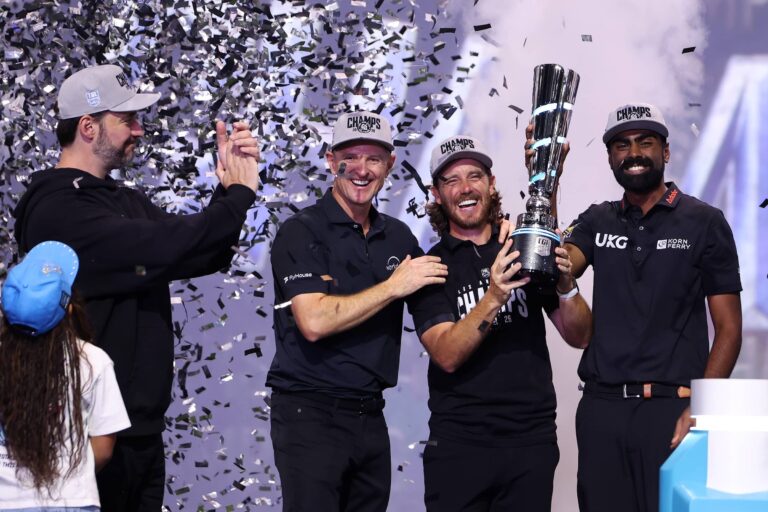
Los Angeles Golf Club arrive riding the kind of confidence you can only borrow when your roster includes three of the highest-ranked players on the planet: Tommy Fleetwood, Justin Rose, and Collin Morikawa. They’re chasing a third win of Season 2 and a second straight victory after a clinical 7–3 dismantling of defending SoFi Cup champions Atlanta Drive GC on Feb. 23, a match LA grabbed by the throat early—winning the first three holes and never letting go.
New York Golf Club, meanwhile, come back to the scene of the crime after a bruising doubleheader on Feb. 24—losses to both The Bay Golf Club and Boston Common Golf. They’re not out of it, but they’re not exactly strolling in either. This is the part of the season where you stop talking about “building” and start talking about “surviving.”
The stakes: playoff maths with teeth
Let’s not pretend this is just another night under bright lights and louder opinions. LA sit third in the standings with a 78.3% chance to make the playoffs. Win, and they clinch. Lose, and it’s suddenly a tiebreaker tango with any team that finishes on four points—because in TGL, the margins aren’t just small, they’re itemised.
New York’s situation is the sporting equivalent of needing a taxi in the rain when your phone is on 2%. They stay alive with a win, but they also need help: either BAY or JUP must finish the season with four points or fewer, and then NY have to win the tiebreaker. In other words: they need to beat a very good LA side, and they need the universe to show some manners.
And because TGL likes its drama measurable, the tiebreaker is Total Holes Won (then Singles Holes Won). That detail matters here: LA have 21 Holes Won; NY have 16. This isn’t only about winning—it’s about how you win.
The cast: star power, but also sharp matchups
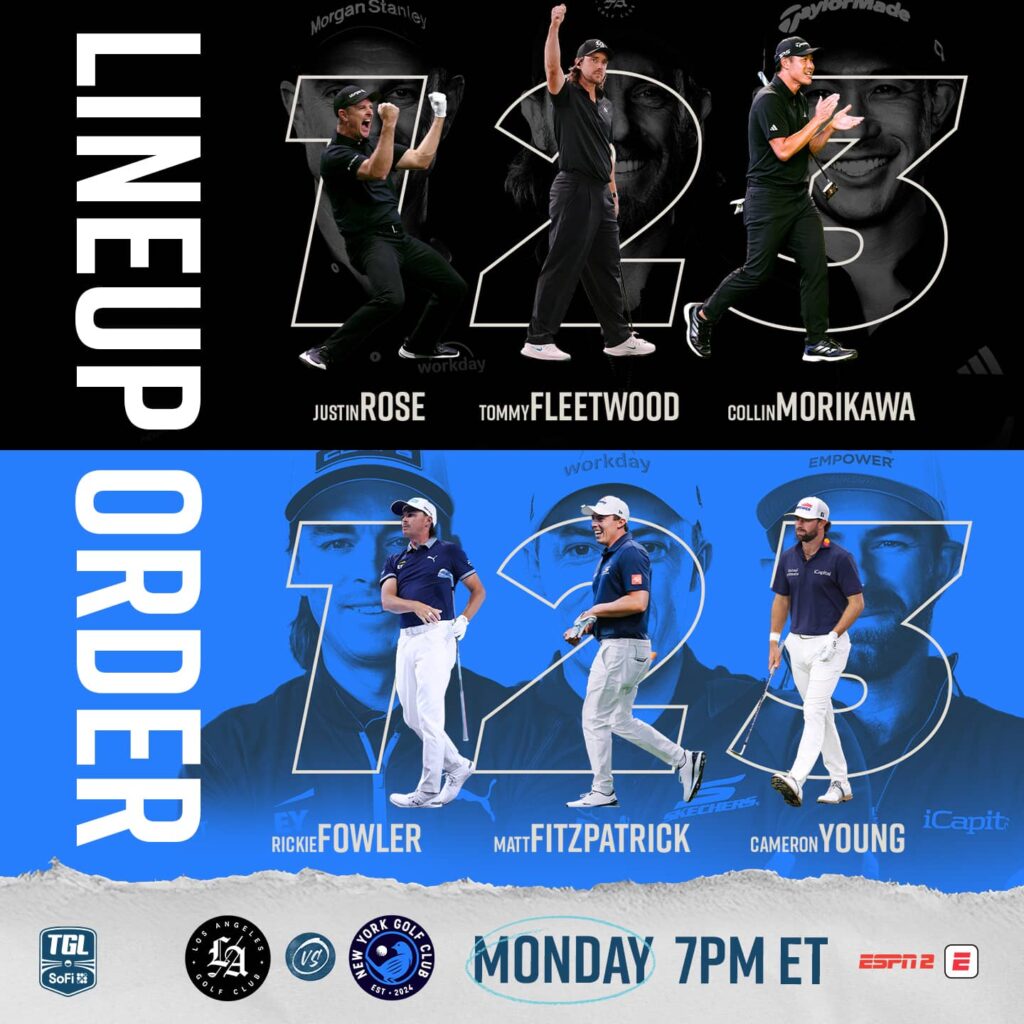
This one is loaded, even by TGL’s standards:
Los Angeles Golf Club:
1 – Justin Rose
2 – Tommy Fleetwood
3 – Collin Morikawa
New York Golf Club:
1 – Rickie Fowler
2 – Matt Fitzpatrick
3 – Cameron Young
On paper it’s glittering. In practice, it’s granular—angles, putts, short-game nerve, and the ever-present possibility that a single Hammer can turn a calm hole into a small public crisis.
Statistically, these two are closer than casual fans might expect:
- Avg. Driving Distance: NY No. 2 (319.2 yards) vs LA No. 3 (316.6)
- Greens in Regulation: LA 66.7% vs NY 64.4%
- Scrambling: NY No. 1 (71.4%) vs LA No. 2 (64.3%)
- Short-putt efficiency: NY 71.4% vs LA 68.4%
- Medium putt efficiency: LA 22.2% vs NY 14.3%
Where LA separate slightly is in Triples Points Won: 16 (T1) to NY’s 10. In this league, Triples can feel like a heist—three players, one plan, and no guarantee anyone leaves happy.
LA’s unbeaten trio: efficiency dressed as swagger
This is the third time across Seasons 1 and 2 that Rose, Fleetwood, and Morikawa team together—and, awkwardly for everyone else, they still haven’t lost as a unit.
Their combined record in this configuration tells its own story: LA have outscored opponents 13–5 across the two matches, averaging 6.5 points per match while allowing 2.5. The numbers don’t scream; they smirk.
They’ve hit 60% of greens in regulation, and when they’ve missed, they’ve scrambled for par or better on 8 of 10 opportunities (80%). It’s not flashy; it’s fatal. And in Triples, they’ve won 10 of 18 holes, which is the sort of detail that makes opponents start pressing—a terrible habit in a format that punishes impatience.
New York’s problem: pedigree doesn’t pay the bill
New York were finalists in Season 1, and you can still hear the echo of that run when the lights hit the simulator screen. But Season 2 has been less opera, more workday.
Their single win came on Jan. 13, when the trio of Fowler, Fitzpatrick and Young beat Jupiter Links 8–3. Since then, it’s been a lot of near-moments, a few missed chances, and the kind of schedule that doesn’t wait for anyone’s confidence to catch up.
Still: if you’re looking for a spoiler with sharp elbows, NY fit the part. They can keep their playoff hopes alive with a win—and, just as deliciously, derail LA’s clinch party in the process.
Rivalry fuel: last season’s chaos still lingers
These two met twice in Season 1 and split the series, but the details are what make this matchup worth your time.
In the regular season, LA beat NY in overtime 5–4 to clinch a playoff spot after a comeback that sounded ridiculous even as it happened. Trailing 4–0 with four holes to play, LA erased the deficit with a flurry of clutch moments: a 28’7″ birdie, a Hammer birdie from 9’10”, and another birdie to drag the match back from the edge. They then won the closest-to-the-pin shootout. It had the feel of a team refusing to accept reality.
Then came the semifinals—tied early, tight through five holes—before New York broke it open on Hole 8 (Bluebonnet) when Young chipped to 4’0″ and made birdie. NY built a 6–3 lead heading to the 14th. LA threw the Hammer, Fleetwood hit it to 5’2″, and his birdie putt lipped out. The hole halved. The match effectively ended right there, not with a bang, but with a rim-out.
That’s the thing about TGL: it gives you a thousand ways to lose, and most of them are loud.
The course: custom holes built to tempt bad decisions
TGL’s rotating catalogue of holes means strategy shifts every match. Fifteen are selected, and for Match 14, a few stand out as genuine plot devices.
Caverns (Hole 2, Par 5, 534 yards)
A par 5 routed through an underground chamber, with hanging formations that force decisions early. The tee shot must thread between two stalactites to find the fairway. Get it wrong, and you’re playing defence before you’ve even started the conversation.
The Last Toll (Hole 3, Par 3, 205 yards)
Apocalyptic visuals and a bridge to negotiate between tee and green. It owns the lowest par-3 Greens In Regulation percentage (53.3%) in TGL. That’s not a hole; that’s a warning label.
Stinger (Hole 8, Par 4, 416 yards)
A tribute to Tiger’s low bullet, with a rock formation encouraging tee shots no higher than 50 feet. It also leads the league in penalties this season. It’s the sort of hole that rewards control and punishes vanity—two qualities professional golfers rarely admit to struggling with, until the penalty lights up.
Bluebonnet (Hole 11, Par 4, 306 yards when drivable)
When it’s short, it invites chaos. Players have hit the green off the tee just 21.4% of the time, yet it’s produced six eagles and 12 birdies at that distance. It’s a temptation hole: the kind that makes aggressive players feel clever and cautious players feel late to the party.
Players to watch: the small edges that win big points
Collin Morikawa (LA) brings precision—he’s been a fairway-finder in Season 2 and has historically been hard to shake in Singles. In this format, driving accuracy and medium-range putting are gold because they shrink the volatility.
Tommy Fleetwood (LA) has already delivered a match-clinching moment this season, cashing in a Hammer with birdie from 8’8” to seal the win over Atlanta. He’s also proven he can flight it absurdly low on Stinger—useful on a hole designed to punish anything that floats.
Justin Rose (LA) remains one of the best “event golfers” in the modern game—someone who adapts quickly, especially when the format gets odd. In TGL, odd is the default setting.
For New York, Rickie Fowler has been spotless from short range in Season 2, and that matters because TGL compresses consequences: miss a short one and the scoreboard changes immediately.
Cameron Young brings power and the willingness to attack drivable setups—particularly on Bluebonnet, where he has twice driven the green this season. If NY are going to swing the match, it’ll likely involve Young turning a hole into a statement.
Matt Fitzpatrick has quietly improved his Singles return this season. In a format where individual holes are the currency, that trend line is exactly what New York need to believe in.
What it means: clinch, survive, or spoil
For LA, the path is clean: win and you’re in. The interesting question is whether they do it with the same front-running authority they showed against Atlanta—jump early, manage risk, and use their Triples advantage like a blunt instrument.
For NY, there’s no luxury left. They need points, momentum, and probably a moment of audacity on a hole like Bluebonnet or Stinger—something that turns the match from “LA cruising” into “LA sweating.”
Either way, this is what TGL does best: it takes elite golfers, removes the comfort of a long week and a long course, and asks them to perform under theatre lighting with the score moving like a stock ticker.
And if you’re New York, that’s the hope: that one sharp swing, one brave Hammer, one putt that refuses to lip out, can turn the season from obituary to afterword.