 Andy Devaney
There are matches that drift by with all the urgency of a man choosing wallpaper, and then there are TGL semifinals like this one, where the mood changes in a blink and reputations get tested under a very bright lamp. Los Angeles Golf Club looked wobbly early, fell 3-0 behind, trailed 4-3 after Triples, then turned the whole business upside down in Singles to beat Atlanta Drive GC, 6-4, and march into the finals.
Atlanta, the defending SoFi Cup champion and No. 3 seed, had every right to fancy its chances. This team came in with the sharpest Singles profile in the league, ranked No. 1 in Singles Holes Won and No. 2 in Singles Points Won. Los Angeles, meanwhile, had made its name in Triples. But sport is not a polite thing. It does not care what the trend lines said yesterday.
A fast start for Atlanta, then a shift in the air
At first, the match seemed to be moving to Atlanta’s tune.
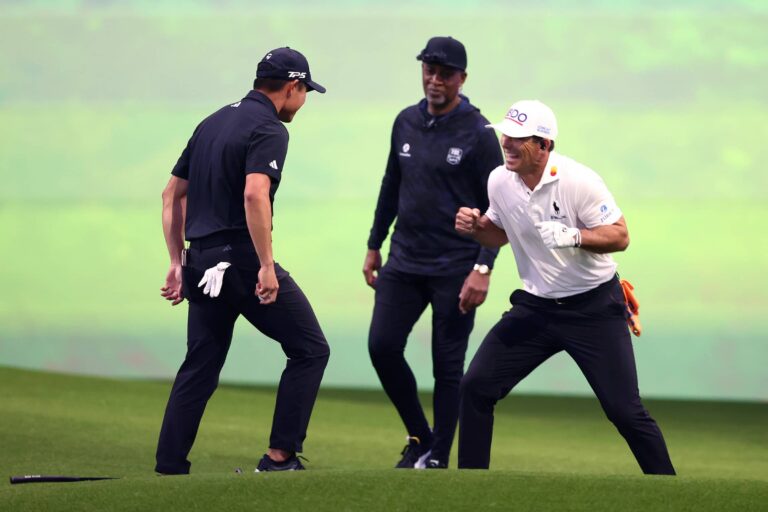
Patrick Cantlay, Billy Horschel and Chris Gotterup helped ATL build the early edge, taking Hole 1 and then striking harder on Hole 3, “Set in Stone,” for two points. By the time Atlanta added another on Hole 6, Los Angeles were 4-1 down through seven and staring at the sort of deficit that makes even calm men start blinking a bit too often.
Yet this TGL semifinal never settled. Los Angeles kept finding little ways to stay attached to the contest, and that is often how comebacks begin — not with fireworks, but with refusal.
Justin Rose supplied the first real jolt on Hole 4, “Fore-0-Fore,” Atlanta’s own team hole, by making birdie from 24 feet 4 inches. It cut the deficit to 3-1 and, more importantly, suggested Los Angeles had not come merely to admire the furniture.
Then came the stretch that changed the match.
Tommy Fleetwood helps swing the door open
Down 4-1 through seven, Los Angeles outscored Atlanta 5-0 over the closing eight holes. That was the match in a sentence, and a rather brutal one if you wore Atlanta colours.
Tommy Fleetwood played a central role in the turn. On Hole 8, “Bluebonnet,” he rolled an eagle putt to 10 inches, setting up a conceded birdie and a crucial point when Cantlay missed his own birdie chance. On Hole 9, “Showtime,” Fleetwood launched a 305-yard tee shot into the rough, which proved good enough to help LA win the hole after Gotterup found the penalty area and Atlanta declined the Hammer.
That decision-making became a theme of the evening. Los Angeles collected three of its six points when Atlanta declined Hammers on No. 9, No. 10 and No. 14. In a format like TGL, caution can sometimes look sensible right up until the moment it starts looking expensive.
By the end of Triples, Atlanta still led 4-3. On the card, that looked fine. In the room, it felt less convincing.
Singles is where Los Angeles took the match by the throat
If Triples softened Atlanta up, Singles finished the job.
Los Angeles, despite Atlanta’s strong Singles pedigree, swept the scoring 3-0 across the individual holes. Hole 10, “The Spear,” went LA’s way. Hole 13, “Cut The Sails,” followed. Hole 14, “Fallen Pine,” did too. Holes 11, 12 and 15 were tied, but by then the important damage had already been done.
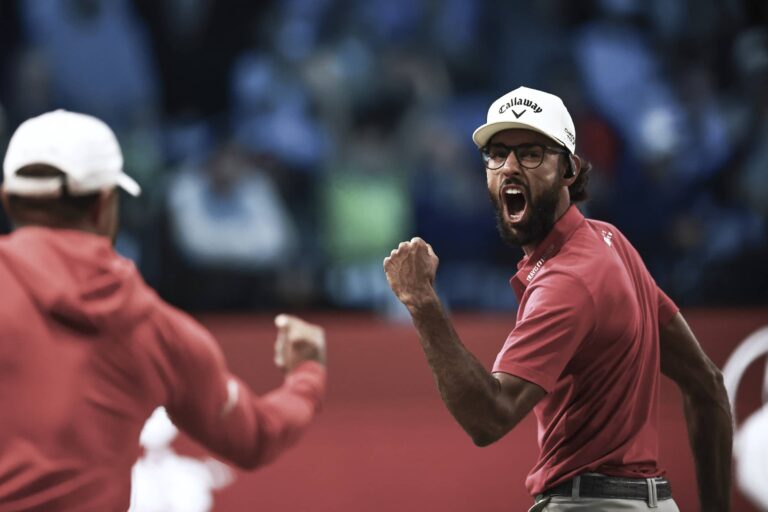
Rose was outstanding in the head-to-head moments, going 2-0-0 in Singles against Cantlay. He also produced the putt of the night on Hole 13, making birdie from 15 feet 10 inches to hand Los Angeles its first lead of the match at 5-4. It was a clean, cold piece of work under pressure.
There was a lovely statistical flourish to go with it: Rose made more feet of putts in this match, 40 feet, than he had during the entire regular season, where he totalled 38. Golf has a wicked sense of timing. Some days the hole looks as wide as a paddling pool; other days it appears to be guarded by solicitors. For Rose on Tuesday night, it looked generous.
The numbers behind the TGL turnaround
The raw match stats tell their own story.
Atlanta won four points in Triples to Los Angeles’ three, but LA shut them out in Singles, 3-0. Los Angeles won six holes in total to Atlanta’s three. Both teams threw three Hammers, but LA won three of them compared to Atlanta’s two. There were no shot-clock violations, which at least spared everyone the digital equivalent of dying by paperwork.
Longest drive honours were split between power and precision: Billy Horschel recorded 315 yards on No. 2, “Caverns,” while Rose went even longer at 321 yards on both No. 1, “Flex,” and No. 10, “The Spear.”
The Singles records also sharpen the picture. Rose went 2-0-0 in the match, Sahith Theegala 1-0-1, and Fleetwood 0-0-2, though that record hardly captures the weight of his contributions. For Atlanta, Cantlay finished 0-2-0, Horschel 0-1-1, and Gotterup 0-0-2. In other words, when the individual spotlight came on, Los Angeles were steadier and more decisive.
Fleetwood’s late putt carried more history than yardage
The final hole did not change the winner, but it did add a fine little layer of sporting symmetry.
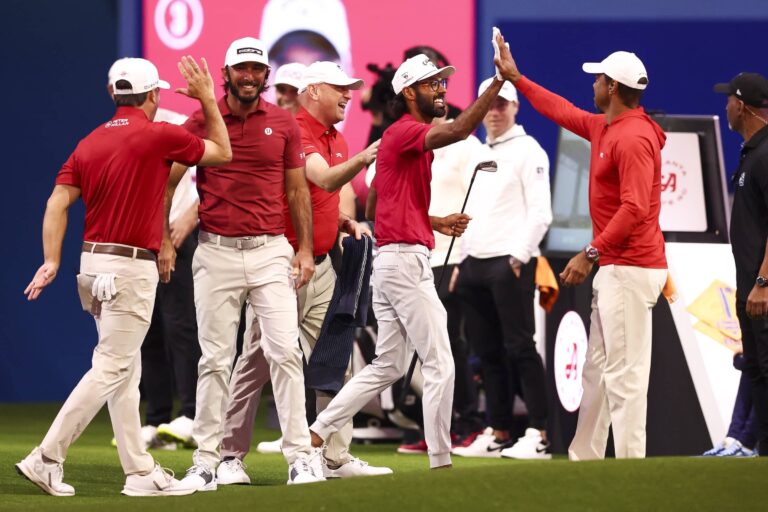
On No. 15, “Sterling,” Fleetwood made birdie from 3 feet 4 inches to tie the hole and send Los Angeles into the finals. It was not the longest putt of the evening, nor the most glamorous, but context can make a short putt feel like a confession.
In last year’s playoffs, Fleetwood missed a 5-foot-2 putt on the 14th hole in Los Angeles’ semifinal loss. That miss tied the hole against Rickie Fowler, put the match beyond reach, and sent LA home. This time, with the match balanced on a narrow ledge, he made the putt that ensured there would be no repeat misery.
That is one of the reasons TGL works when it works. The format moves quickly, but it still leaves room for memory, nerve and consequence. A putt can be only a few feet long and still carry the weight of a year.
What this result means for the finals
Los Angeles Golf Club had already beaten Atlanta 7-3 on February 23 on the way to securing a second straight playoff appearance. This rematch was tighter, nastier and far more revealing. Rather than controlling the evening from the front, LA had to absorb an early punch, stay composed, and then seize the match when the door opened.
That matters.
A team that can win beautifully is useful. A team that can win after being rattled is dangerous.
For Atlanta, this one will sting. The defending champions started well, led after the opening phase, and had the match precisely where they wanted it. Then they stopped scoring. They won the first hole too, which had been a near-guarantee of victory throughout the 2026 regular season, as all five teams that achieved that feat went on to win. Los Angeles shredded that pattern when it mattered most.
For LA, the path to the finals now looks built on more than style. It is built on resilience, Rose’s nerve, Theegala’s support, and Fleetwood’s timely redemption. That combination can take you a long way in TGL, especially when the lights are hot and the match starts misbehaving.
On this evidence, Los Angeles are not simply finalists. They are finalists who know how to survive the awkward bits, and that is often the last thing an opponent wants to see.