 Andy Devaney
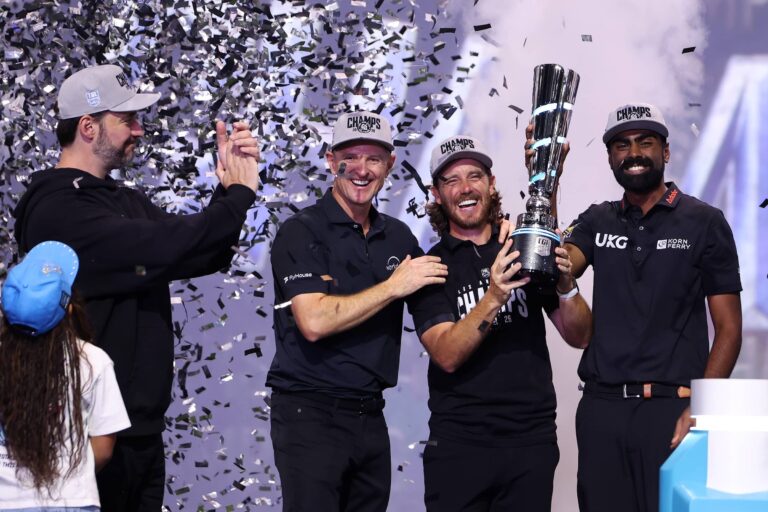
If anyone still thinks TGL is just golf dressed up for prime time, Tuesday night offered a neat rebuttal: it looked like a sport with its own pressure points, its own momentum traps, and its own brand of heartbreak. New York Golf Club stared down an early deficit, then flipped the script with a ruthless 7–0 run to beat Jupiter Links Golf Club 8-3 at SoFi Center in Palm Beach Gardens, Florida.
It ended with Rickie Fowler doing what the format demands: stepping into a moment that feels more like a playoff hole than a Tuesday exhibition and holing the putt anyway. Fowler’s final act was a 14-foot birdie that slammed the door, finishing off a match that began with misfires and ended with New York looking, finally, like a team that understands TGL rather than simply participating in it.
A fast start, a historic lefty, and then the floor fell away
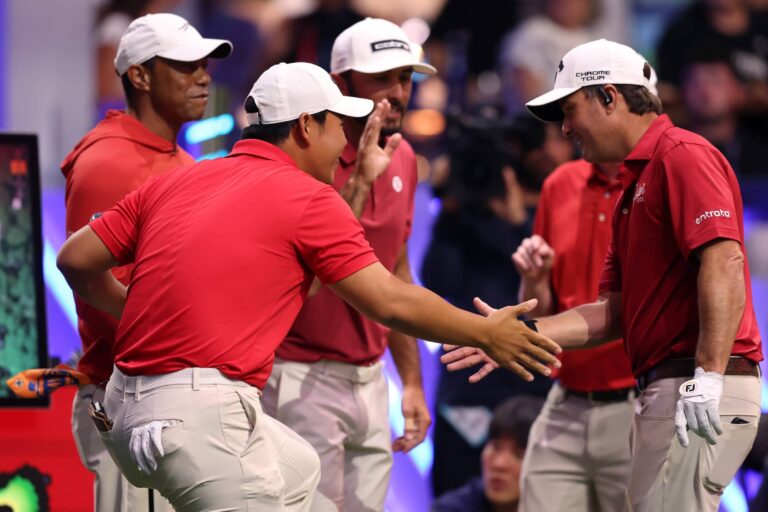
Jupiter didn’t just begin well — they began with a slice of league history. Playing as the first lefty in TGL history, Sahith Theegala’s teammate Akshay Bhatia opened Jupiter’s night with a 308-yard tee shot on No. 1 (Hatchet), and the early energy felt real. Tiger Woods threw the Hammer immediately; New York declined; Jupiter had the first point of its Season 2 campaign and the first-ever lead after the opening hole of a match.
Jupiter doubled down with another win on No. 2 (The Spear) to grab its first-ever two-point lead in TGL, and for four holes the match had that delicious sense of a new rivalry brewing under the lights.
Then the night took a sharp turn.
On No. 5 (Fallen Pine), Kevin Kisner was hit with a one-stroke penalty for a shot clock violation — only the second-ever in TGL history. (Tiger Woods had the first shot clock violation in Match 4 of Season 1.) Jupiter lost the hole, and with it, the control of the match. Points were won on each of the first six holes, setting a new TGL record for most holes without a tie to start a match. But what mattered more than the record was the emotional swing: Jupiter never scored again.
The Hammer, the clock, and the moment New York seized the night
In TGL, you can play well and still lose quickly if you hand over leverage. New York didn’t need Jupiter to collapse completely — just enough. The shot clock penalty was the kind of self-inflicted wound this format punishes mercilessly, and New York pounced.
Fowler, back in the lineup after missing New York’s first match, described the early jitters honestly, then delivered the finish that made the quote look like prophecy.
“I hadn’t been in competitive mode for a while,” said Fowler, who was not in the lineup for New York’s first match. “Shook some rust off. Seeing some putts go in was nice. That’s something that Atlanta did a lot better than us last year in the Finals.”
New York’s momentum wasn’t just emotional; it was tactical. On No. 13, Jupiter threw a blind Hammer to make Straight Up worth two points — and Fowler punished the gamble, making birdie from 14′ 4″ to build an insurmountable lead. That’s the difference between teams who treat the Hammer like a prop and teams who use it like a weapon.
Tiger Woods, still sidelined from playing but very much present, acknowledged the unusual tension of being involved without a club in his hands.
“It’s more stressful watching (than playing), without a doubt,” Woods said.
And Fowler’s reaction captured what makes Woods’ presence in TGL such a gravitational force.
Said Fowler: “I thought that was cool for him to be out and be a part of it. It’s just different when he’s around.”
Fitzpatrick’s Singles revival and Young’s relentless tee shots
If Fowler supplied the signature moment, Matt Fitzpatrick supplied the most telling trend line. After failing to win a Singles hole in Season 1, he continued his reversal of fortune in Singles, winning No. 11 with a birdie from 8’6” to push New York to a 6-3 lead. He also tied No. 14 after a tee shot to 8’7” for a new closest-to-the-pin record on Cenote — the kind of detail that plays well in highlights, but also speaks to comfort in the format.
Cameron Young did the heavy lifting in Triples with a run of hammer-straight shots: 2’4″ on No. 3 (On The Rocks), a 300-yard tee shot to 20’10” on No. 6 (Bluebonnet), and a 331-yard drive on No. 9 (Big Apple). New York didn’t win because one player caught fire — they won because multiple players kept winning moments.
“We got off to a tough start last year being 0-2,” Young said. “You realize how short the season is and I think we showed that sense of urgency to put some points on the board and win a bunch of holes to get one in the win column tonight.”
That urgency is the quiet truth of TGL: it’s not a marathon. It’s a heist. You take points when they’re available, and you don’t apologise for it.
Kisner’s seven-second reality check
Kisner’s penalty was the hinge — and his explanation sounded like every golfer who has ever been rushed by something other than golf.
“Obviously, we should have called a timeout,” Kisner said. “I thought I could get it off with seven seconds left but I’ve never really had someone tell me to hit a putt in seven seconds before in my life.”
That line, more than any stat, is what defines TGL as its own ecosystem: traditional instincts don’t always apply, and the league’s rules don’t care what you’ve done for 15 years outdoors.
The stats that decided the match
- Final: New York Golf Club 8, Jupiter Links Golf Club 3
- Triples Points: Jupiter 3, New York 5
- Singles Points: Jupiter 0, New York 3
- Total holes won: Jupiter 3, New York 7
- Hammers thrown: Jupiter 3, New York 2
- Hammers won: Jupiter 1, New York 3
- Shot clock violations: Jupiter 1, New York 0
- Longest drive: 346.01 yards (Homa – No. 11); 346.00 yards (Fitzpatrick – No. 11)
What’s next in TGL
New York moves to 1-1, snapping a three-match losing streak dating back to the Season 1 Finals — and, just as importantly, looking sharper in the moments that decide matches in TGL.
Jupiter, now 0-1-0, gets little time to sulk. They’re back next Tuesday against Los Angeles Golf Club at 7:00 p.m. ET on ESPN, while New York has a longer break before facing The Bay Golf Club on Tuesday, Feb. 24 at 5 p.m. ET on ESPN.
Tiger, meanwhile, plans to stay close to the action until he can return as a player: Woods plans to attend every Jupiter match until he’s able to play as he continues the recovery process. And if Tuesday was any indication, that sideline presence is not just ceremonial — it adds weight to every decision, every Hammer, and every second on the clock.
In TGL, the swings are quick, the penalties are brutal, and the only comfort is that the next hole arrives before you’ve finished wincing at the last one.