 Andy Devaney
Increasing women and girls’ participation in golf has been an industry ambition for years. The more interesting question is no longer whether governing bodies, clubs and coaches want growth, but whether they have built the habits, communities and measurement systems needed to keep new players in the game.
A Golf Genius webinar, attended by 267 people from 21 countries, offered a useful snapshot of both the progress and the gaps.
Golf’s female participation push has a familiar weak spot
The session brought together representatives from national governing bodies, PGAs, tours, clubs, regional associations and simulator venues. That breadth matters. Female participation is often discussed as though one clever campaign can solve everything. Golf, being golf, has a habit of making simple problems administratively ornate.
A live survey suggested the bigger issue may be execution. While 48% of attendees said their organisation had a strategic target to increase female participation, 23% said they currently ran no women and girls’ programmes.
Ambition, in other words, is rather easier to publish than to programme.
Retention looks more important than recruitment alone
The strongest theme was the difference between attracting a new player and creating a golfer who returns next week.
Panellists from love.golf and Operation 36 focused on experiences, coaching and incremental learning. Operation 36 has helped create 240,000 new participants globally, including 96,000 women and girls.
Research shared during the session, based on 419 women who had taken part in Operation 36 in the US and Canada, found that incremental play increased the number playing and practising weekly by 54%.
That is the statistic with teeth.
Participation initiatives can look impressive at registration. The harder test comes later, once the novelty has worn off and somebody has to decide whether golf actually belongs in their routine.
Coaches can become the centre of the community
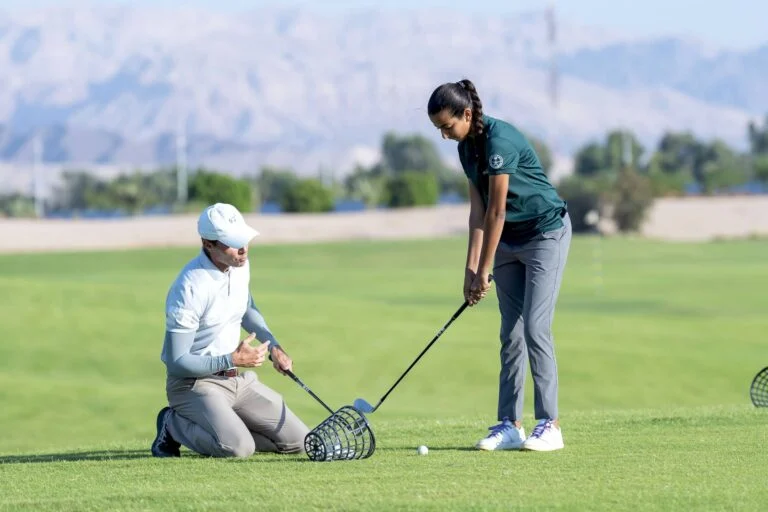
The webinar also argued for the coach as a community anchor rather than simply a dispenser of swing thoughts.
That distinction is sensible. New golfers do not only need technical instruction. They need a reason to feel expected, included and comfortable enough to return. For women and girls entering programmes where they may still be in the minority, the person creating that environment can matter as much as the lesson plan.
Aston Ward, Chief Operating Officer, Confederation of Professional Golf, said: “If golf is going to grow sustainably, we need to create great experiences that attract more women and girls and give them reasons to keep coming back.
The session was excellent and a very interesting chance to find out more about organisations and people working in different markets, understand the challenges they face and take away practical ideas that can be applied locally. We really believe sharing like this can help move our community forward.”
Golf also has a measurement problem
Perhaps the most revealing numbers were not about golfers at all.
Some 44% of attendees said they relied on manual workflows to track and report programme success, while only 5% used a dedicated golf participation dashboard.
That leaves plenty of room for good intentions to outrun evidence. If an organisation cannot easily see who joined, who returned and where people dropped away, improving a participation programme becomes part analysis, part archaeology.
Golf Genius clearly wants technology to form part of the answer through its Digital Series. Yet the broader point does not require a software pitch: sustainable growth is difficult to prove if nobody can reliably measure it.
The next test happens away from the webinar
The Digital Series will continue with reports, workshops and webinars through to The Open Championship at St Andrews in 2027. Its opening international webinar showed there is appetite for sharing ideas between markets.
To register to view to Simulator Golf Market Insights Report, please click here
The useful work begins after everyone closes the laptop.
Golf does not lack strategies for attracting women and girls. It needs more programmes that are welcoming, repeatable, measurable and good enough to become a habit.
A target can sit happily in a strategy document for years. A golfer has to decide to come back next Tuesday.