 Andy Devaney
Golf clubs tend to know their courses rather well. Every bunker, every troublesome stretch of rough and every patch of ground that refuses to drain quite as enthusiastically as anyone would like.
But understanding how that same land supports wildlife, stores carbon or responds to environmental pressures is another matter entirely.
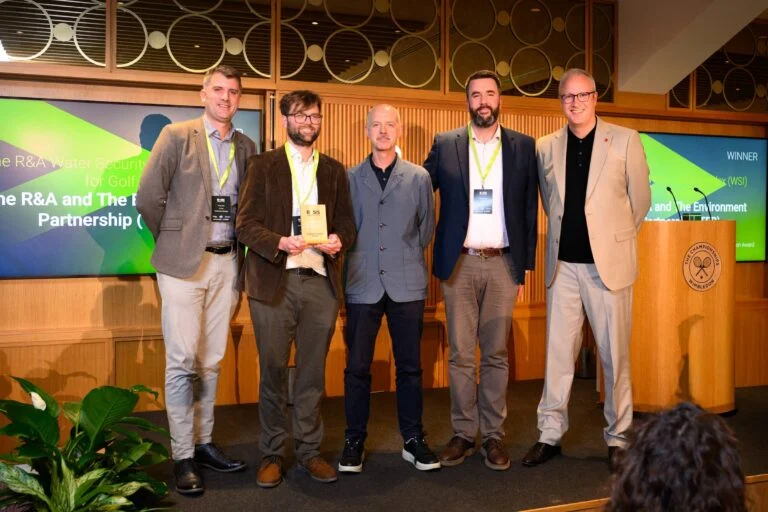
England Golf is attempting to close that knowledge gap with a digital Sustainability Platform that has now won the Innovation category at the 2026 BASIS Sustainable Sport Awards.
And while an award is always welcome, particularly when there is a trophy involved, the more interesting development is what the technology could mean for the people responsible for looking after England’s golf courses.
Putting 1,650 Golf Courses Under the Environmental Microscope
Developed alongside The Environment Partnership (TEP), with support from YourPact, the platform brings together national habitat mapping, environmental analytics and digital assessment tools.
Launched earlier in 2026, it now provides environmental information covering more than 1,650 England Golf-affiliated courses.
According to England Golf, this represents the first nationally consistent environmental evidence base for golf in England.
Rather than leaving individual clubs to navigate environmental questions with limited information, the system is designed to give them a clearer picture of their own land and where action might be most useful.
That includes understanding biodiversity, carbon capture, water management, potential flooding and resilience to changing climatic conditions.
For clubs balancing course maintenance, long-term investment and environmental responsibilities, having that information in one place could make planning considerably more straightforward.
What Does the Sustainability Platform Actually Do?
The system combines four elements: a national habitat baseline, a sustainability prioritisation framework, an online mapping application and tools for collecting information directly from courses.
Together, they are intended to help clubs understand their environmental characteristics and identify areas where changes to management or investment might make a difference.
A club considering its approach to habitat management, for example, could use course-specific information to understand where attention might be best directed. The same principle applies to water-related risks and longer-term environmental planning.
England Golf can also use the information nationally, identifying common priorities and deciding where its sustainability team can offer the most useful support.
Kirstin McEvoy, England Golf’s Head of Sustainability, explained why that matters.
“What makes the platform unique is its ability to transform complex environmental information into clear, actionable insights. It helps clubs understand where they can make the biggest difference, while enabling England Golf to target its support where it can have the greatest impact.”
It is a sensible approach. Environmental ambitions are one thing; knowing precisely where to concentrate limited resources is another.
From Environmental Data to Changes on the Course
There is, of course, an important distinction between identifying an environmental opportunity and delivering a measurable improvement.
Mapping habitats does not automatically improve biodiversity. Understanding flood risk does not, by itself, prevent flooding.
What the platform offers is a common evidence base from which those decisions can be made.
That is particularly relevant to England Golf’s relatively small sustainability team, which says the technology is already helping it prioritise work nationally and at individual club level.
The BASIS recognition acknowledges the innovation behind the system, although the information released so far does not establish how many clubs have acted on its findings or what measurable environmental improvements have followed.
Those outcomes will ultimately provide a more meaningful indication of its long-term value.
For now, England Golf has taken a substantial step towards making environmental information more accessible across its affiliated courses.
The award recognises the technology. The real measure of success will be what happens out on the course.
For more information, visit England Golf’s sustainability programme.