 Andy Devaney
There’s nothing quite like finding a premium golf driver at a price that suggests somebody has either made a terrible mistake or is feeling unusually generous.
For golfers, the temptation is obvious. For partners, parents and relatives attempting to buy a Christmas present for the golfer in their lives, it can look like a golden opportunity.
Unfortunately, that gleaming TaylorMade or PING driver advertised online might not be quite what it appears.
Counterfeit golf clubs have become increasingly sophisticated, with some copies now resembling the genuine article closely enough to fool buyers who know their way around a golf bag.
And the problem isn’t confined to the occasional questionable listing buried in the darker corners of the internet.
According to golfclubs4cash, which describes itself as Europe’s largest retailer of second-hand golf equipment, approximately 1,000 counterfeit clubs are encountered by the business every year. More than 20 suspected fakes arrive across its four locations each week.
Those are the retailer’s own figures, rather than an estimate of counterfeiting across the wider golf industry. Even so, they’re a reminder that buying used equipment requires more than recognising a familiar logo.
To understand how counterfeit clubs are finding their way into the market, why some are so difficult to identify and what happens when an unsuspecting golfer puts one into play, Andy Devaney spoke with Martin Lambert, Founder and Director of golfclubs4cash.
His advice is particularly relevant as the Christmas shopping season gathers pace.
Why Christmas Is an Opportunity for Counterfeit Golf Club Sellers
The problem with buying golf equipment for somebody else is that knowing their favourite manufacturer doesn’t necessarily mean you know what you’re buying.
A driver that looks convincing in a photograph might have very little in common with the genuine club beyond its appearance. And when there’s a sizeable discount involved, it’s easy to overlook the warning signs.
Do Black Friday and Christmas create greater opportunities for counterfeit sellers, particularly when people buying golf gifts don’t play themselves?
“Black Friday and Christmas provide a perfect opportunity for counterfeit club sellers to increase the number of products they sell. These seasonal periods allow sellers to target non-golfers looking to purchase affordable golf clubs for a relative or friend. These people are likely to be more susceptible to purchasing counterfeits as they lack the technical knowledge to spot the difference between genuine and counterfeit clubs. ”
It’s a particularly awkward situation for well-meaning gift buyers. They may know that a particular model is desirable without understanding what separates a genuine example from a counterfeit.
And judging authenticity from a handful of photographs is becoming increasingly difficult.
What’s the most convincing counterfeit equipment you’ve encountered? Are there particular modern models that have proved especially difficult to distinguish from genuine clubs?
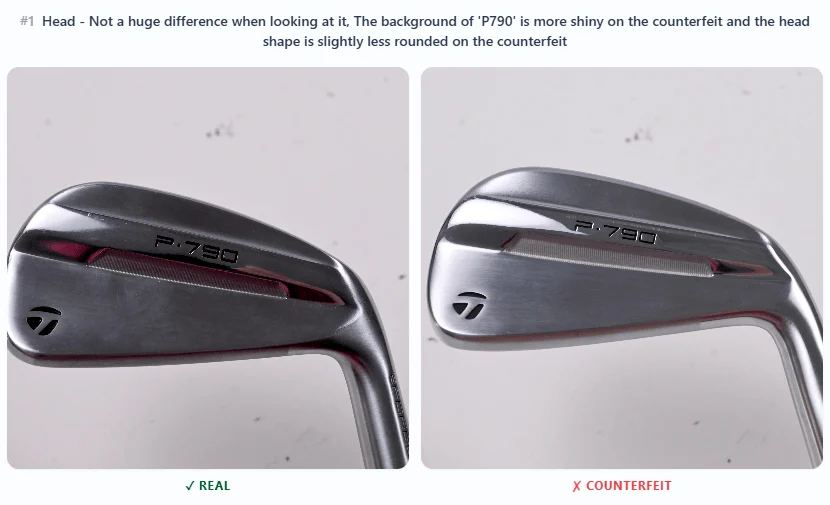
“The most convincing fake clubs have been more modern models, such as TaylorMade Qi10 and PING G440 clubs. At first glance, they can look remarkably close to the real thing. It’s only when you inspect the finer details that the inconsistencies become apparent, which shows why buying from a trusted source is so important.”
That should give anybody shopping for a relatively recent premium driver something to think about.
Counterfeiters aren’t necessarily producing crude imitations with obviously incorrect graphics or suspiciously misspelt branding. According to Lambert, some are getting close enough visually that identifying the differences requires a much more experienced eye.
And for anyone buying a Christmas present, the difficulty is compounded by not necessarily knowing what the genuine equipment should look or feel like in the first place.
Are non-golfers buying Christmas presents particularly vulnerable, and how can they buy confidently without understanding all the technical details?
“Sellers of counterfeit golf clubs often target people who may lack technical knowledge, most commonly when people are buying equipment as a gift for a family member or friend who plays the sport.
“This means people buying clubs as gifts often buy the equipment they think is the best value for money, often meaning cheaper options from private sellers on open online marketplaces.
“Purchasing from a trusted retailer is a more reliable option. This is because specialists have verified that each club is genuine before they go on sale, protecting against counterfeiters. Retailers such as golfclubs4cash, who have physical locations also have experts on hand to offer advice for people unsure about specific technical details.”
The distinction matters. Second-hand equipment can offer considerable value, but the seller’s reputation and inspection standards are important parts of that purchase.
Could a Fake Driver Be Costing You Distance and Accuracy?
Golfers are rather good at finding reasons for a poor drive.
The grip was wrong. The timing was off. The wind picked up just as the ball left the face. Occasionally, the explanation is simply that golf remains a magnificently frustrating game.
But what if the club itself isn’t performing as it should?
Lambert believes counterfeit equipment can introduce problems that a golfer might wrongly attribute to their swing.
What performance differences would you expect between a counterfeit driver and its genuine equivalent? Could somebody unknowingly using a fake end up blaming their technique?
“Genuine drivers are highly engineered, with precise construction and variable thickness to optimise how they perform. Counterfeit drivers are manufactured to mimic the appearance of a genuine club lacking the specialist materials and detailing which severely impacts how they perform on the course.
“Distance and ball speed are drastically reduced, as the poor quality metal of counterfeit driver heads is unable to transfer energy to the same degree as titanium genuine drivers.
“The face of a genuine driver is designed to compensate when the ball is hit off-centre, counterfeits lack this engineering meaning the driver is unpredictable and likely to send the ball widely offline, impacting consistency and accuracy.
“The poor design of counterfeit driver faces means almost twice the amount of backspin is produced compared to a genuine driver, causing the ball flight to sometimes mimic a balloon.
“This often results in golfers that are unknowingly using counterfeit clubs, attributing inconsistent performance in their game to their skill level rather than substandard equipment.”
These are Lambert’s technical assessments. Comparative testing data wasn’t supplied to independently establish the differences in ball speed, distance, accuracy or the claimed increase in backspin.
Nevertheless, the concern is understandable. The engineering that goes into a modern driver isn’t merely decorative. Materials, face construction and the way a club behaves when impact moves away from the centre all influence the intended playing characteristics.
A counterfeit may resemble the original while lacking that same construction.
For somebody struggling with an unfamiliar driver, it introduces another possibility worth considering before assuming every poor result is down to technique.
How Golf Club Specialists Identify a Counterfeit
For an experienced equipment retailer, authentication involves more than checking whether the logo looks right.
A club can have apparently convincing branding yet still contain small inconsistencies in its finish, graphics or components.
Those differences might mean very little to a casual buyer, but someone who regularly handles genuine examples of the same model is more likely to recognise when something isn’t right.
What checks does your team carry out when authenticating second-hand golf clubs, and what details do ordinary buyers tend to overlook?
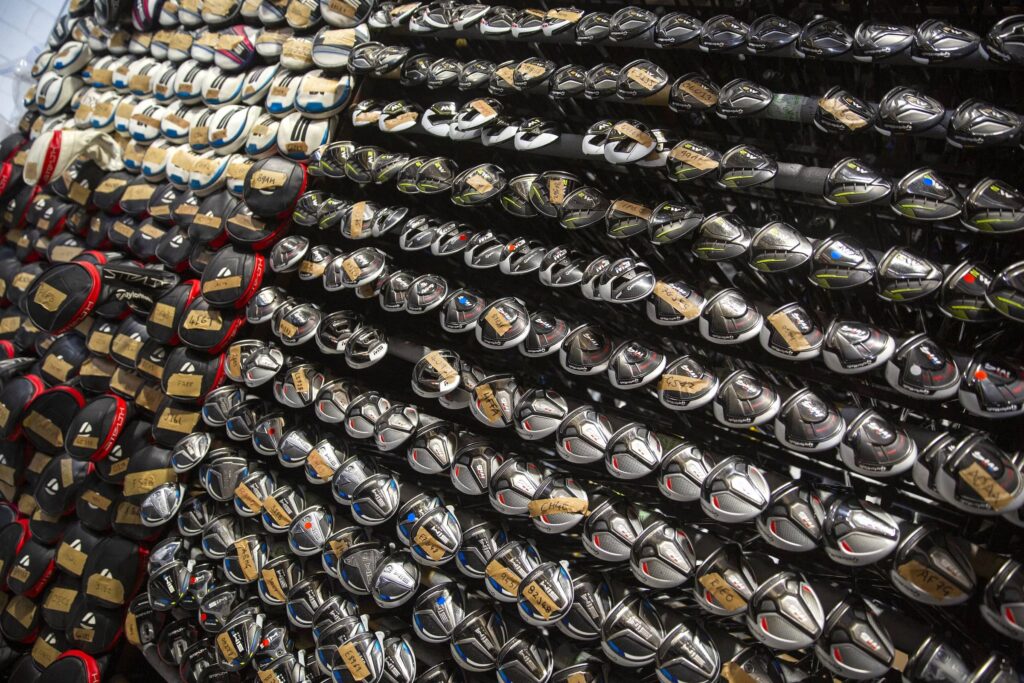
“Our checks involve focusing on details most golfers would understandably overlook. We examine the paint finish, the size and font of lettering, and the positioning and quality of graphics. We also assess whether the shaft’s flex feels consistent with its advertised specification.
“No single detail tells the whole story. A shaft can have the right branding but behave differently from what you would expect. Handling genuine equipment every day gives our team a valuable reference point for spotting those inconsistencies.”
It’s an important point because there is no single visual check that guarantees authenticity.
A convincing headcover, correctly positioned logo or apparently genuine shaft label shouldn’t be treated as conclusive evidence that the club itself is legitimate.
And while photographs can help identify obvious problems, they’re no substitute for inspecting the actual item.
The Hidden Cost of Buying a Counterfeit Golf Club
A suspiciously cheap driver might initially appear to save a golfer hundreds of pounds. But the financial consequences don’t necessarily become obvious until they decide to upgrade.
Part of the attraction of buying genuine pre-owned golf equipment is the opportunity to trade it in or sell it on when something newer catches your eye.
That doesn’t work quite so well when the equipment turns out to be counterfeit.
What happens when somebody tries to trade in or resell a counterfeit driver? How much could that supposed bargain cost them in the longer term?
“The long-term financial consequences of purchasing a counterfeit driver are significant. When the person decides they want to trade-in or sell their driver for another model, reputable retailers and golfers will likely refuse to accept buying the fake club. This means that unfortunately, the original cost of the counterfeit driver can not be recovered in any way.”
Lambert’s warning concerns the loss of legitimate resale or trade-in opportunities. That shouldn’t be confused with a buyer’s separate ability to seek a refund or pursue a payment dispute with the original seller.
Still, the potential financial disadvantage is clear. Instead of owning a genuine club with some prospect of residual value, the buyer may be left with an imitation that reputable second-hand equipment specialists won’t accept.
And that’s before considering whether the club performs as expected.
The Sustainability Problem With Fake Golf Equipment
The second-hand golf equipment market has an appeal that goes beyond saving money.
A genuine driver doesn’t suddenly become useless because a manufacturer releases a newer model. Plenty of clubs can remain playable for years, passing between owners as golfers upgrade or change their equipment.
Counterfeits complicate that picture.
When equipment can’t be trusted, safely reused or legitimately resold, the prospect of keeping it in circulation becomes considerably more difficult.
What happens to counterfeit equipment that cannot be resold or safely reused? Does it undermine the sustainability benefits of buying pre-owned golf clubs?
“Counterfeit clubs create avoidable waste. Materials, energy, packaging and transport have all gone into making something that may quickly become unusable and end up in the bin.
“A genuine club can have a long playing life and pass through several owners. A counterfeit undermines that second-hand cycle because its quality and construction cannot be relied upon.
“Keeping genuine equipment in use for longer, through second-hand purchase, is a much better outcome for golfers and the environment.
“Where a counterfeit cannot be resold or safely reused, responsible disposal, with material recovery where possible, is the best remaining option.”
It’s another reason to look beyond the initial price.
Buying genuine pre-owned equipment can extend a club’s useful playing life. Counterfeits potentially undermine that process by introducing products whose construction and reliability are uncertain.
The precise environmental impact hasn’t been quantified in the information supplied, but Lambert’s concern about avoidable waste adds another dimension to a problem normally discussed in terms of price and performance.
Are Counterfeit Golf Clubs Getting Harder to Spot?
Counterfeit equipment isn’t a new problem, but the opportunities for sellers to reach potential customers have changed.
Online marketplaces and social media have made buying and selling golf equipment easier. They have also created opportunities for counterfeiters to advertise products directly to people who may struggle to establish whether a listing is genuine.
Lambert believes education is becoming increasingly important alongside efforts to tackle counterfeit sellers themselves.
How has the counterfeit market changed since you started golfclubs4cash, and what more needs to be done to protect golfers?
“The manufacturing of fake clubs has become a much more widespread and sophisticated operation over recent years. Counterfeiters have used the increasing number of online marketplaces and social media platforms to their advantage to promote and sell their substandard counterfeit products to unsuspecting buyers.
“Enforcement is clearly incredibly important in targeting sellers of counterfeit clubs directly, and a lot of good work is being done partnering with authorities in this regard.
“However, we feel that education is equally as important. Helping amateur golfers know what to spot when it comes to counterfeit clubs is crucial for protecting the golfing community from being exploited by these fake club sellers. Letting people know the major impact using counterfeit clubs can have on their game is also crucial in reducing the demand for fake clubs.”
That educational element is particularly relevant as more buying decisions take place online, where customers cannot physically inspect equipment before committing to a purchase.
A seller’s photographs, description and apparent credibility may be all they have to work with.
Which makes a little caution considerably more useful than an impressive discount.
Three Insider Tips for Avoiding Fake Golf Clubs This Christmas
For anyone considering a second-hand driver, fairway wood or set of irons over Black Friday or Christmas, the most useful advice is also some of the simplest.
Check who’s selling the equipment, understand what you’re being offered and resist the temptation to judge authenticity solely by appearance.
What are the three most important things golfers and Christmas gift buyers should remember before purchasing equipment?
“Check the seller, not just the website. A familiar marketplace name does not authenticate every listing. For new equipment, use an authorised retailer; for second-hand clubs, choose an established specialist with a clear inspection process and returns policy.”
“Don’t mistake convincing photographs for proof. Images may show a genuine club rather than the one you will receive. Ask for photographs of the actual item, including close-ups of the head, sole, shaft labels and markings. Photographs alone cannot guarantee authenticity, but an evasive seller is a good reason to walk away.”
“Choose genuine second-hand quality over an unbelievable ‘brand-new’ bargain. Compare the asking price with established retailers. A current premium model offered dramatically below its normal price deserves scrutiny. A genuine previous-generation club from a trusted seller can offer excellent value and greater peace of mind.”
It’s sound advice for golfers upgrading their own equipment and equally relevant to anyone trying to find a decent Christmas present without paying full retail price.
There’s nothing wrong with hunting down a bargain. Indeed, finding a genuine previous-generation driver for a sensible price can be one of the more satisfying aspects of shopping for golf equipment.
But there’s a considerable difference between buying a discounted premium club and buying an imitation of one.
The former might leave you with enough money for a few extra rounds. The latter could leave you questioning your swing, regretting the purchase and discovering that your supposed bargain has very little value when it’s time to move it on.
And golf already provides quite enough disappointment without having to manufacture any more.