 Andy Devaney
There’s a particular moment in golf when a putter can look beautifully lined up behind the ball, only for the stroke to have other ideas. Most of us are familiar with it. Odyssey’s answer is the TRTL, a new family of mallet putters built around easier alignment, greater resistance to twisting and, in the larger model, less face rotation.
The range has a retail launch date of 6 November 2026, with two main designs. The standard TRTL is priced at $350, while the bigger, zero-torque TRTL Max is $400. Those are prices supplied in US dollars; UK pricing has not been confirmed.
Two Heads, Two Approaches
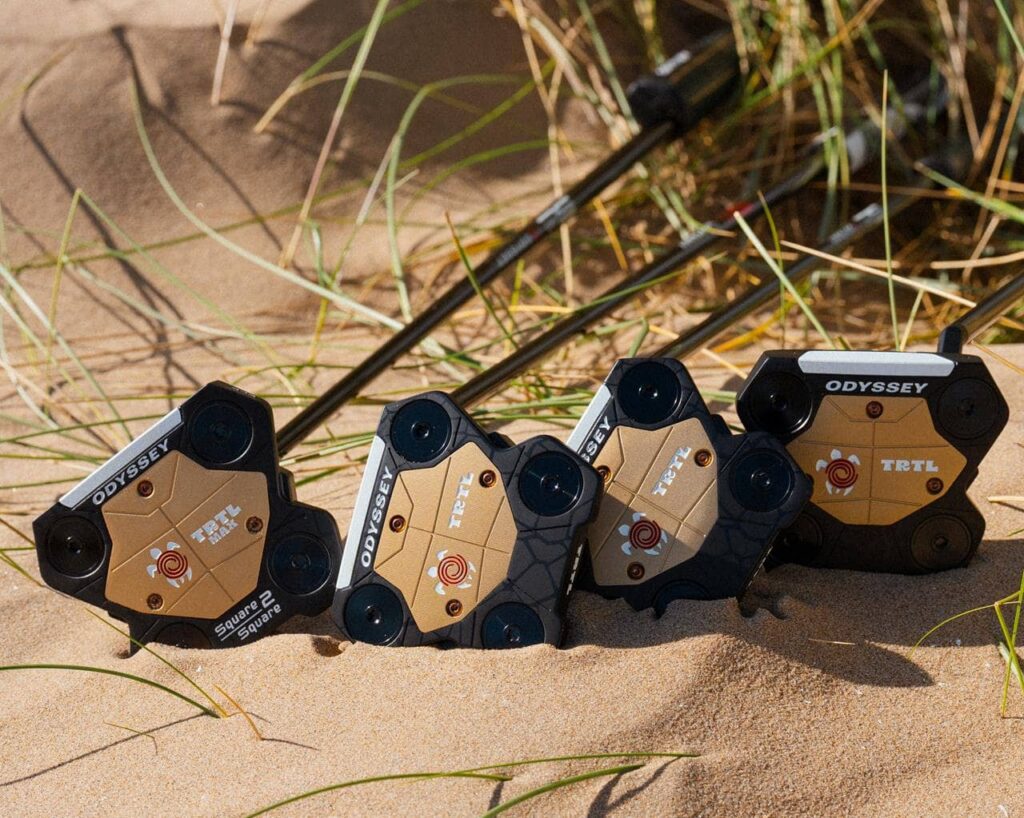
The standard TRTL is a mid-mallet offered with crank hosel, double bend and S-neck configurations. That’s a meaningful choice rather than a catalogue flourish: the way the shaft connects to the head affects the putter’s balance and how it behaves through the stroke.
The TRTL Max goes down the zero-torque route, a design Odyssey says is intended to minimise face rotation. It also puts particular emphasis on moment of inertia (MOI), a measure of how strongly a putter head resists twisting when the ball is struck away from the centre.
Neither approach removes the need to read a green or make a decent stroke. But stability and a clearer aim are reasonable things to look for if your putting feels less predictable than you’d like.
A Longer Line to the Hole
Both designs feature what Odyssey calls Twin Track: long, uninterrupted alignment lines extending towards the face. Instead of relying on a small mark behind the ball, the golfer gets a more substantial visual guide when setting up.
The sole has been reshaped, too. Odyssey says its revised rake and camber are intended to help the putter settle naturally square on the turf. It is a small design detail with a practical purpose, particularly for anyone who finds themselves repeatedly adjusting the head before a stroke.
There is a fair bit happening beneath the finish. The main body is steel, the shell lightweight ABS, and the sole or belly aerospace-grade aluminium. Odyssey says this lets it distribute more weight around the perimeter to increase stability and forgiveness on off-centre contact.
The company also describes four weights at the corners of the head, which can move the centre of gravity forwards, backwards, towards the heel or towards the toe, and alter toe hang. The supplied details do not explain how retail buyers will access that adjustability.
The Insert Doing the Quieter Work
The new Ai-Star face insert has two layers: aluminium on the inside and a firmer urethane surface facing the ball. Odyssey says this combination is designed to make ball speed more consistent across the face while retaining a responsive feel.
A revised Forward Roll Design groove pattern has a stated 19-degree slope. Its purpose, according to Odyssey, is to promote forward roll even when contact is slightly high or low on the face.
These are engineering claims rather than independently verified performance results. They make the TRTL worth a closer look, but the real test is whether the face and weighting deliver the consistency a particular golfer needs.
Tour Interest Is One Thing. Fit Is Another.
Odyssey says it first introduced the TRTL range in Japan earlier in 2026, where it claims its four models have occupied the four top-selling positions since launch. It has also pointed to Tour interest involving Min Woo Lee and Yuna Nishimura. Independent sales figures and comparative putting data were not supplied.
For golfers choosing between the two, the distinction is fairly clear. The standard TRTL offers more hosel options; the Max is built around minimising face rotation. Which is more suitable depends on the player’s stroke, preferred balance and how each putter looks at address.
Pre-orders are open ahead of the 6 November retail launch. At $350 and $400, these are considered purchases, and an actual fitting or practice-green session will be more useful than assuming the highest-MOI option must be the right one.
More information about Callaway and Odyssey can be found at: eu.callawaygolf.com