 Andy Devaney
The KBS Tour V-X shaft arrives with a fairly unfashionable promise: less unwanted movement.
There are no claims of miracle distance or mysterious speed gains, just a steel iron shaft built around greater stability, tighter dispersion and the sort of predictable delivery that becomes increasingly attractive once a golfer has discovered how expensive sideways can be.
The interesting number is not the weight
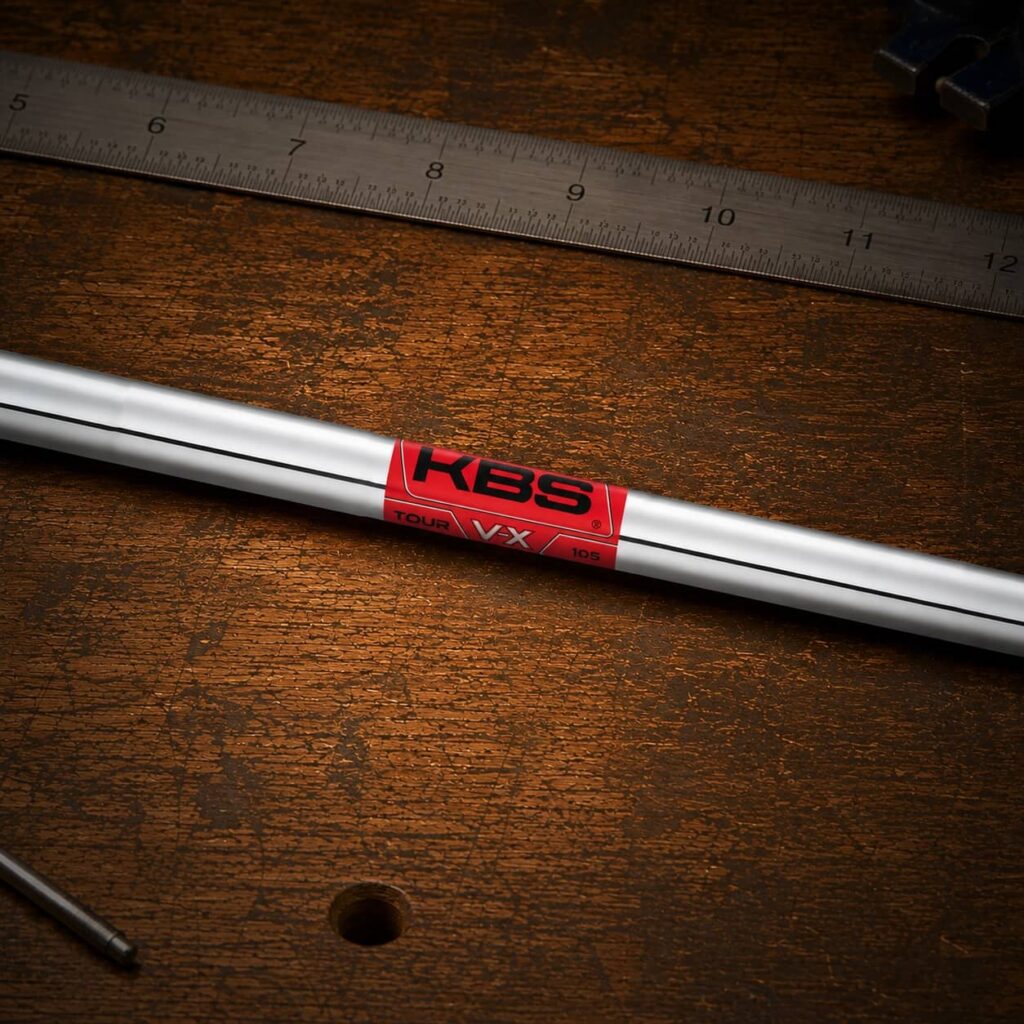
The headline engineering claim is a weight-to-strength ratio nearly 20% higher than any previous KBS iron shaft design.
That distinction matters. KBS is not merely adding mass and congratulating itself on having produced a sturdier piece of metal. The idea is to increase strength relative to weight, reducing shaft distortion during the swing and particularly through impact.
For the golfer, the intended benefit is simple enough. If the shaft bends and moves more predictably, the clubhead should be easier to deliver consistently. KBS is consequently targeting a truer ball flight, more reliable trajectory and tighter dispersion.
That is the theory. Shaft performance remains stubbornly dependent on the person swinging it, and no engineering claim can tell you precisely how a particular profile will behave in your hands. Steel shafts are irritatingly democratic in that respect.
A flex profile built around control
The TOUR V-X combines a firm butt section with a responsive mid-section and stable tip.
That configuration is designed to keep the shaft controlled without making it feel lifeless. There is a balancing act involved. Too much movement in an unsuitable part of the profile can make timing harder to repeat; too little can leave a player feeling as though the club has been assembled around a scaffolding pole.
KBS has organised the design around three priorities: stability, feel and playability.
“Golfers should not have to choose between stability and feel,” said Kim Braly, Director of R&D and Master Shaft Maker at KBS. “With the TOUR V-X, we have engineered a shaft that feels unmistakably KBS but offers an exceptional level of control through impact. It is a next-generation design created for players who want to swing with confidence and see more predictable results.”
“Feels unmistakably KBS” will naturally mean more to somebody who already plays the company’s shafts. Without a proper fitting, feel remains impossible to judge with any seriousness. The more useful detail is that KBS has not treated increased stability as an excuse to make the entire profile uniformly stout.
Six weights make fitting the real story
The TOUR V-X comes in six weights spanning 105g to 130g, while the flex range covers R, R+, S, S+, X and TX.
That breadth may ultimately prove more important than the engineering headline.
A shaft can possess admirable structural properties and still be completely wrong for the golfer attached to it. Weight can affect tempo, strike and how clearly a player senses the club during the swing. Flex and bend profile then influence how that load behaves as the club approaches impact.
Offering six weights gives fitters considerably more room to chase consistency without automatically pushing every stronger player towards the heaviest option or every smoother swinger into something markedly softer.
Golfers have traditionally been rather fond of reducing shaft fitting to a speed chart. The TOUR V-X range is a useful reminder that human swings have declined to become quite that tidy.
Where TOUR V-X sits in the KBS range
The new shaft joins the lighter TOUR V-X LITE within the V-X family.
That gives KBS a wider spread of steel options for golfers who suit the broader V-X concept but require different weights or loading characteristics.
There is some straightforward commercial logic here too. Modern iron fitting has become increasingly granular, and a family covering multiple weights gives a fitter more opportunities to retain the same basic design philosophy while changing the build around an individual golfer.
That is more useful than simply adding another shaft name to an already crowded fitting-cart drawer.
Who should pay attention?
The TOUR V-X appears most relevant to golfers who prioritise dispersion, trajectory control and predictable impact delivery rather than chasing another claim of effortless speed.
Existing KBS players looking for greater stability are an obvious audience. So are golfers whose fitting results suggest that excess shaft movement is making delivery inconsistent.
The caveat deserves equal billing. Tighter dispersion is not something a manufacturer can bolt universally into an iron set. It only matters if the shaft suits the swing in front of it.
The extensive weight and flex range should improve the chances of finding that match. It also makes a proper fitting more important rather than less.
On paper, the TOUR V-X earns attention because KBS has focused on a decidedly unglamorous problem and attached a measurable engineering claim to it. A weight-to-strength ratio nearly 20% higher than any previous KBS iron shaft design is specific enough to be interesting.
Whether that produces better golf for an individual player still requires a launch monitor, a competent fitter and rather more than three heroic swings.
Golf equipment is forever promising to give players something extra. The TOUR V-X is trying to take something away: uncertainty. For an iron shaft, that may be the more useful trick.