 Andy Devaney
Shane Lowry’s emphatic Irish Open victory put his clubs under the microscope. FST chairman David Chuang explains why the KBS Tour 130 X in Lowry’s scoring clubs is rather more interesting than simply being very heavy and very stiff.
An 11-shot victory tends to make equipment detectives of us all.
Lowry finished the Irish Open at 23 under, first in Strokes Gained: Total and second in scrambling, which is the sort of week that invites close inspection of practically everything short of his shoelaces.
Yet one of the more revealing details in Lowry’s set-up was not a shiny new clubhead. It was the steel running through his irons and wedges.
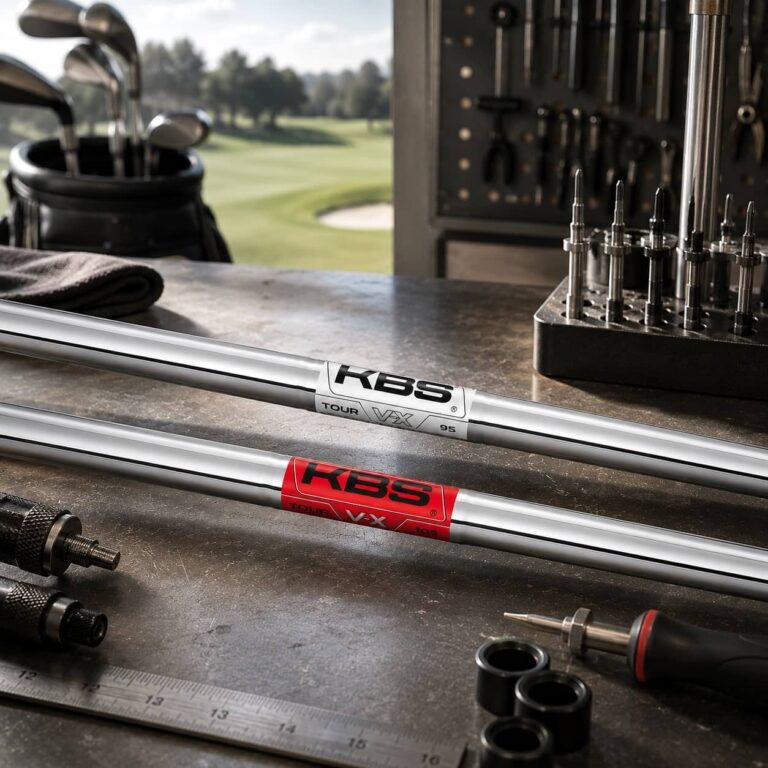
Lowry used KBS Tour 130 X shafts in the scoring end of his bag, a heavyweight X-flex option built around stability and control. More intriguingly, he did not simply use the same shaft specification from one end of the iron set to the other.
And that, according to David Chuang, Chairman and Chief Executive Officer of FST Corp, is where the useful lesson begins.
Why the KBS Tour 130 X works for Lowry

A 130-gram X-flex shaft is not an especially subtle piece of equipment. Nor is it intended to be.
For a player producing Tour-level speed and force, its attraction lies in creating a predictable relationship between swing and clubhead — particularly when controlling trajectory and distance matters more than squeezing out another few yards.
“The KBS Tour 130 X is really about stability, control and giving a player the ability to produce the flight they want consistently,” Chuang says.
“At that level, players are generating a tremendous amount of speed and force, so they need a shaft that can stand up to that while still giving them the feel and responsiveness they are looking for.”
The KBS Tour is designed to produce a mid-flight trajectory with strong energy transfer. For Lowry, whose iron and wedge game relies heavily upon controlling flight and distance, Chuang believes that combination is particularly relevant.
“For a player like Shane, who relies so much on controlling trajectory and distance with his irons and wedges, those characteristics can be extremely valuable.”
There is an important distinction here. The 130 X is not interesting because it is somehow a more serious golfer’s shaft. It is interesting because its properties fit the way Lowry delivers the club.
Those are two very different things.
Why Lowry changes shafts through his iron set

Perhaps the more instructive element of Lowry’s equipment is that the KBS Tour 130 X does not simply run unquestioned through every iron.
He uses a lighter set-up in his longer irons before moving into the heavier KBS Tour 130 X as the clubs become more concerned with scoring.
That is Tour fitting in miniature.
“Every club in the bag has a slightly different job, and players at this level can be incredibly precise about what they want from each one,” says Chuang.
“In the longer irons, a player may be looking for certain launch and speed characteristics, while the scoring clubs are often much more about trajectory, distance control and consistency.”
For years, the conventional idea of an iron set encouraged golfers to think of eight or nine clubs as a single family. At Tour level, the thinking can be far more forensic. A long iron and a wedge may share a badge on the back of the head, but they are being asked to perform quite different tasks.
“That can lead a fitter and player toward different weights or profiles as they move through the set,” Chuang says.
“What I think is interesting for the average golfer is that it shows how individualized fitting has become and how much opportunity there is to build a set around what a player is actually trying to accomplish with each club.”
That is considerably more useful than simply discovering what Lowry plays and ordering the same thing.
The shaft is doing more than most golfers realise
Clubheads receive most of the attention because clubheads are visible, photogenic and generally covered in words suggesting that physics has recently been renegotiated.
Shafts are less theatrical.
They are also fundamental to how a golfer delivers the club.
“The shaft is a critical part of how the golf club performs because it is the connection between the golfer and the clubhead throughout the swing,” Chuang says.
“Weight, flex and the overall profile of the shaft can influence how a golfer delivers the club, which in turn affects launch, spin, dispersion and consistency.”
Lowry’s second-place ranking in scrambling is a useful backdrop. Around the scoring end of the bag, fractions matter: trajectory, strike, distance control and the ability to produce the expected shot under pressure.
Feel belongs in that discussion too.
“Feel is important as well because golfers tend to make their best swings when the club responds in a way that feels natural to them,” Chuang says. “We always encourage golfers to look at the club as a complete system and to give the shaft the same consideration they give the head.”
That is a less glamorous sales pitch than promising another seven yards.
It is also rather more believable.
Swing speed is only the beginning
One of golf fitting’s persistent shortcuts is the assumption that clubhead speed should dictate shaft flex.
It is useful information. Chuang argues that it is nowhere near enough.
“We want to understand the golfer’s tempo, how they transition into the downswing, how they load the shaft and what is happening at impact,” he says.
“We also look at the resulting ball flight and data, including launch, spin and dispersion, because ultimately we are trying to find the combination that produces the most repeatable performance.”
Two golfers with apparently similar speeds can therefore end up with completely different shafts.
One may change direction smoothly. Another may attack the downswing as though it owes him money. The number on the launch monitor might look similar at impact; how each player got there can be anything but.
“One golfer may have a very smooth transition and another may load the club much more aggressively, even though their clubhead speeds are almost identical,” Chuang says.
“Their preferred ball flight and the way they respond to different weights can also lead you in different directions.”
And again, feel matters because the golfer has to live with the thing.
“When a golfer feels comfortable with how the shaft loads and releases, it becomes much easier for them to make their normal swing.”
The danger in copying a Tour player
There is a certain inevitability to what happens after a golfer wins by 11.
His clubs are photographed. Specifications circulate. Somebody, somewhere, concludes that the missing ingredient in their own game is 130 grams of X-flex steel.
Chuang sees the problem.
“One of the biggest things we see is golfers choosing a shaft based on a flex designation or what somebody else is playing instead of looking at their own swing,” he says.
“There is a lot more to a shaft than the letter printed on the label.”
Weight, profile and loading characteristics can all matter independently of the familiar R, S or X designation. The purpose of fitting is not to establish which label sounds most impressive. It is to discover what allows a particular golfer to deliver the club repeatedly.
“A fitting gives the golfer a chance to compare those variables with real performance data and find something that complements the swing they already have.”
That may be the most transferable equipment lesson from Lowry’s week.
Not that recreational golfers need his shafts. Quite possibly they do not.
It is that Lowry’s bag has been built around what individual clubs need to do — and around the way one particular golfer swings them.
How Tour feedback reaches the wider market
FST has manufactured golf shafts for more than three decades and produces the proprietary KBS line while also working as an OEM and ODM manufacturer for leading golf equipment brands.
At Tour level, feedback becomes part testing laboratory, part interrogation.
“Tour players are extremely sensitive to changes in feel, trajectory and performance, so that environment gives us an extraordinary amount of information about how a shaft behaves at the highest level,” Chuang says.
That information is fed back into research and development alongside feedback gathered from everyday golfers through fitting operations and other channels.
“We combine those insights with what we learn from everyday golfers through our fitting operations and other customer feedback, and that helps us continue developing products for a very broad range of players.”
Lowry’s Irish Open victory will inevitably send golfers searching for the precise contents of his bag.
The more useful question is not, “What shaft does Shane Lowry play?”
It is why he plays it — and why he does not necessarily play the same thing in every iron.