 Andy Devaney
As Europe’s fairways start thinking about frost, Shura Links is pitching the Red Sea as a warmer, sharper and rather more spectacular winter golf alternative.
The winter golf habit has always had a fairly reliable compass: point south, hope the Mediterranean behaves, and pack a jumper anyway. Shura Links in the Red Sea is asking golfers to look further down the map.
Set on Shura Island at the centre of The Red Sea destination, the Brian Curley-designed course is not being sold as a quick resort add-on, and nor should it be judged like one. This is a par-72 championship layout wrapped into a larger island proposition of ultra-luxury hotels, reef-fringed water, mangrove corridors and desert edges. Subtle, it is not. But winter golf has rarely suffered from too much sunshine and scenery.
For travelling golfers, the pitch is clean enough: when northern Europe starts serving up plugged lies, cold hands and the sort of damp that gets into your soul, Shura Links offers coastal golf with warmth, theatre and a serious hospitality machine built around it.
A Red Sea answer to winter golf
The Mediterranean has long owned the shoulder-season golf escape. Spain, Portugal, Cyprus and Turkey have fed generations of British and European golfers through the colder months, and they are hardly about to disappear from the flight-search box.
Shura Links is not trying to be another version of that. Its point of difference is geographical as much as architectural. The course sits along island shorelines in the Red Sea, with the surrounding destination designed as a complete resort collective rather than a single-course getaway with a hotel bolted on like an afterthought.
That matters because winter golf travel is rarely just about the scorecard. It is about the whole small act of defiance: leaving behind a calendar of temporary greens and thermal base layers, then stepping onto turf where the ball runs, the hands work, and the post-round conversation does not begin with a complaint about the wind chill.
Shura Links leans hard into that seasonal contrast. The useful question is not whether it can replace the Mediterranean. It is whether it gives golfers another winter direction entirely.
Brian Curley lets the coastline talk
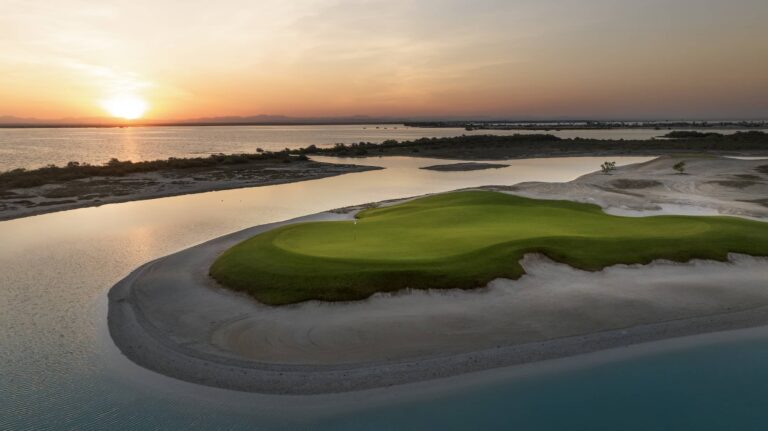
The course has been designed by Brian Curley, whose work here makes the most of the site’s natural theatre rather than pretending the landscape is merely a backdrop. Thirteen of the 18 holes play directly alongside mangrove corridors and sweeping white sand dunes, with the Red Sea doing what good coastal water does best: looking beautiful while quietly complicating your club selection.
Sea breeze is not decoration. On a course routed through open coastal terrain, it becomes part of the architecture. One day’s sensible line can become tomorrow’s minor act of optimism. The best resort golf understands that. It gives holiday players their views, certainly, but it also gives proper golfers something to solve.
That is where Shura Links has its strongest sporting argument. The visual appeal is obvious — turquoise water, white dunes, mangroves, island edges — but the more interesting detail is how much of the round appears to be shaped by those same ingredients. This is not manicured golf dropped beside a nice view. The setting is part of the test.
The course has already been placed 39th in Golf World’s Top 100 X-Factor Courses in the World ranking, which tells you the obvious part: it photographs well. The more meaningful measure, once golfers start building trips around it, will be how strongly the routing, wind and coastal ground hold up after the first gasp has passed.
Island golf, with the hotels to match
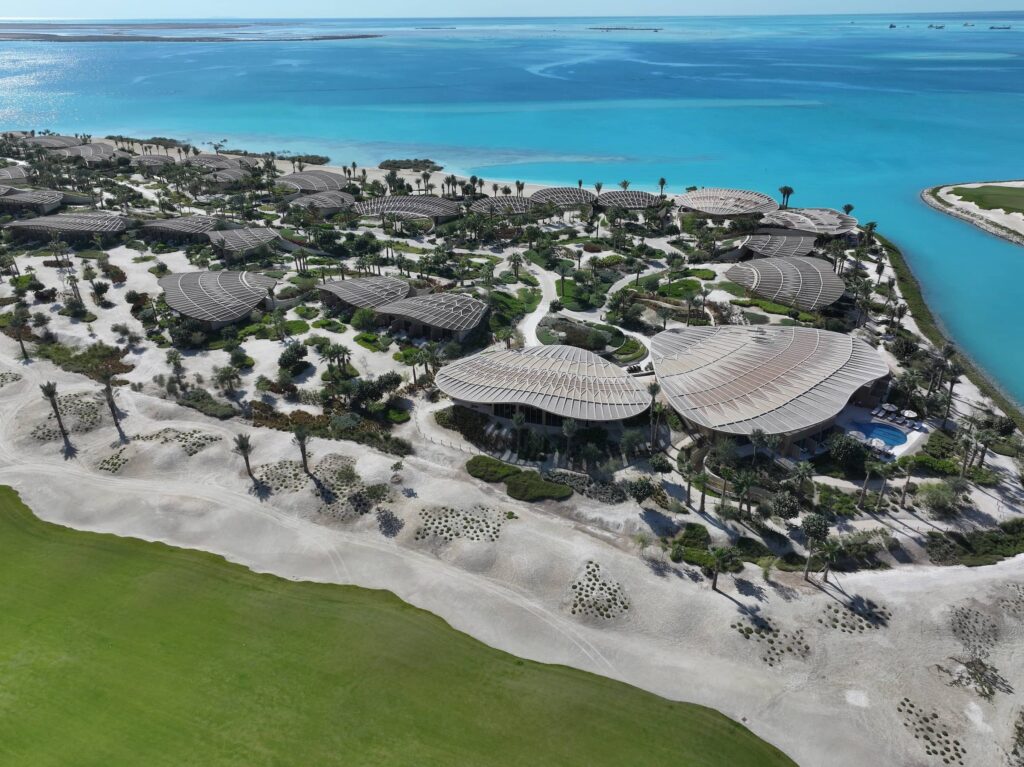
Shura Island is being built as an enclave of 11 ultra-luxury resorts, with names including The Red Sea EDITION, SLS The Red Sea and InterContinental the Red Sea Resort by IHG, alongside properties from Four Seasons, Faena, Miraval, Rosewood and Raffles.
That line-up is not incidental. It tells you exactly where the destination is positioning itself: premium winter golf, high-service hospitality, and a guest who wants the 19th hole to involve rather more than a damp towel and a lukewarm sandwich.
There is also a practical benefit to that concentration of hotels. Golf travel becomes easier when the course, accommodation and wider resort life feel like one coherent setting. Nobody wants to spend a premium trip shuttling about as though they are completing an airport transfer challenge on a hidden-camera show.
Access is becoming part of the story too. Red Sea International Airport is expanding European connectivity through BeOnd, with direct links via London, Paris, Munich, Zurich and Milan, alongside routes from Malé. For European golfers, that turns the Red Sea from a vague luxury concept into a more realistic winter itinerary.
The round does not have to end at the 18th
The Red Sea proposition stretches beyond golf, which is useful because even the most committed player occasionally has to pretend to be balanced.
Adventure operators WAMA and Galaxea bring the water into play, with diving and snorkelling among barrier reefs, foiling and kitesurfing across lagoons, and kayaking through mangrove channels. Inland, the offer shifts towards guided desert hikes, gravel biking and stargazing under clear night skies.
That wider setting helps Shura Links avoid the familiar resort-golf weakness: a fine course in a place where the non-golfer quietly starts calculating the emotional cost of day three. Here, the landscape is not simply scenery for the golfer. It is the destination’s real currency.
The broader Red Sea footprint adds still more choice, with outer island properties including The St. Regis Red Sea Resort, Nujuma, a Ritz-Carlton Reserve, and Shebara, while Six Senses Southern Dunes and Desert Rock extend the experience into desert terrain.
For golfers travelling as couples, groups or families, that matters. A winter golf trip is much easier to sell when the argument includes reefs, lagoons, dunes and proper hotels rather than only “I’ll be finished by lunch”.
A winter pivot with championship intent
Jon Brook, General Manager of Shura Links, frames the idea as a change in season rather than merely a change in scenery.
“Med to Red is about changing the rhythm of the golf calendar,” said Jon Brook, General Manager of Shura Links. “When northern courses go dormant, Shura Island comes alive. You have Brian Curley’s routing weaving through coastal dunes in the morning, pristine waters right off the edge of the fairway, and world-class hospitality waiting at the 19th hole. You get absolute championship quality without the cold-weather compromises.”
There is a lot packed into that, but the important phrase is “without the cold-weather compromises”. Every golfer in northern Europe knows those compromises. The mitts. The mud. The heroic claim that winter golf builds character, usually delivered by someone whose trolley battery has just died in horizontal rain.
Shura Links is not offering character-building. It is offering escape with a proper golf spine: a championship course, a recognised designer, a distinctive landscape and enough luxury infrastructure to make the trip feel deliberate rather than experimental.
Whether it becomes a fixture in the winter golf calendar will depend on the usual grown-up matters: service, conditioning, access, pricing, and whether the course plays with as much substance as it promises in photographs. But as a statement of intent, Shura Links has chosen its lane clearly.
The Med has the history. The Red Sea now has a winter argument with sand under its feet and mangroves down the fairway.