 Andy Devaney
Titleist has decided that performance, apparently, no longer needs to arrive dressed like a bank manager. The company’s new limited-edition Oil Can finish brings a rich copper look to its T-Series irons, giving one of the most played iron families in elite golf a little more swagger without fiddling with the engineering that made it so popular in the first place.
This is not some decorative afterthought hastily sprayed on to catch the eye under shop lighting. The Oil Can treatment, first seen on a limited-edition Vokey wedge, is applied through a PVD process designed to enhance durability and reduce glare. So yes, it looks handsome, but it also has a job to do. In golf, that already puts it ahead of half the gimmicks on the market.
Available in T100, T150, T250 and T350 models, and offered in both right- and left-hand builds, the new finish runs consistently through the range. That matters. One iron can look special on its own; a full set that hangs together visually is another thing entirely. Add in custom copper-coloured Titleist Golf Pride Z-Grip Full Cord grips and True Temper Onyx shafts, and the whole thing has the air of a set assembled by someone who knows exactly where the teaspoons are kept.
A new finish, same familiar Titleist performance brief
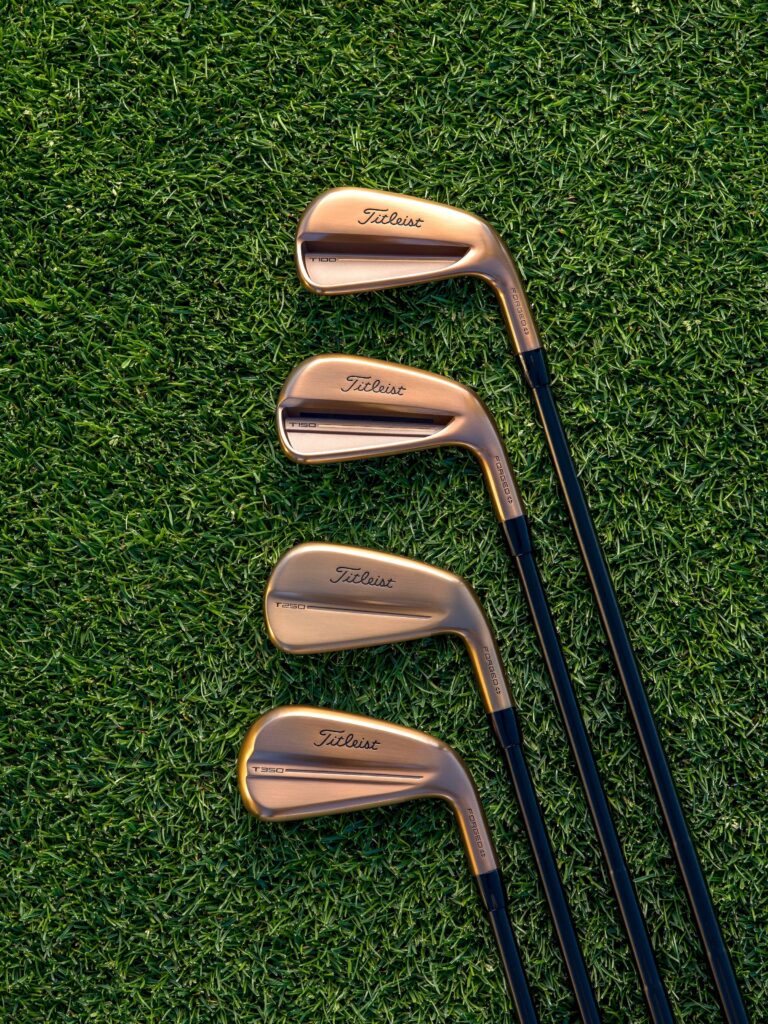
The important point is that the finish may be new, but the T-Series framework remains unchanged. These irons are still built around clearly defined player types, launch windows and forgiveness profiles. In other words, this is a visual refresh laid over a performance family that already has a strong following from tour players to decent club golfers and those still conducting an uneasy truce with their 7-iron.
Titleist says the T-Series Oil Can irons are available for pre-sale now and will land in golf shops worldwide on Thursday, March 26.
First impressions: sharp, restrained and properly premium
There are golf clubs that try too hard to look expensive, and then there are clubs that simply do. These fall into the second camp. The copper tone gives the heads a more distinctive personality than the standard finish, but it stops well short of looking loud or novelty-driven. That is a difficult line to walk and Titleist, to its credit, usually knows where the rope is.
For golfers who like clean shapes and traditional profiles, the finish adds character without compromising seriousness. The reduced reflectivity should also appeal to players who do not enjoy a clubhead flashing at them in full sun like a distress signal.
From a shelf-appeal standpoint, these irons will do very nicely. From a bag-appeal standpoint, they might be even better.
Breaking down the models
T100: the tour iron for precise players
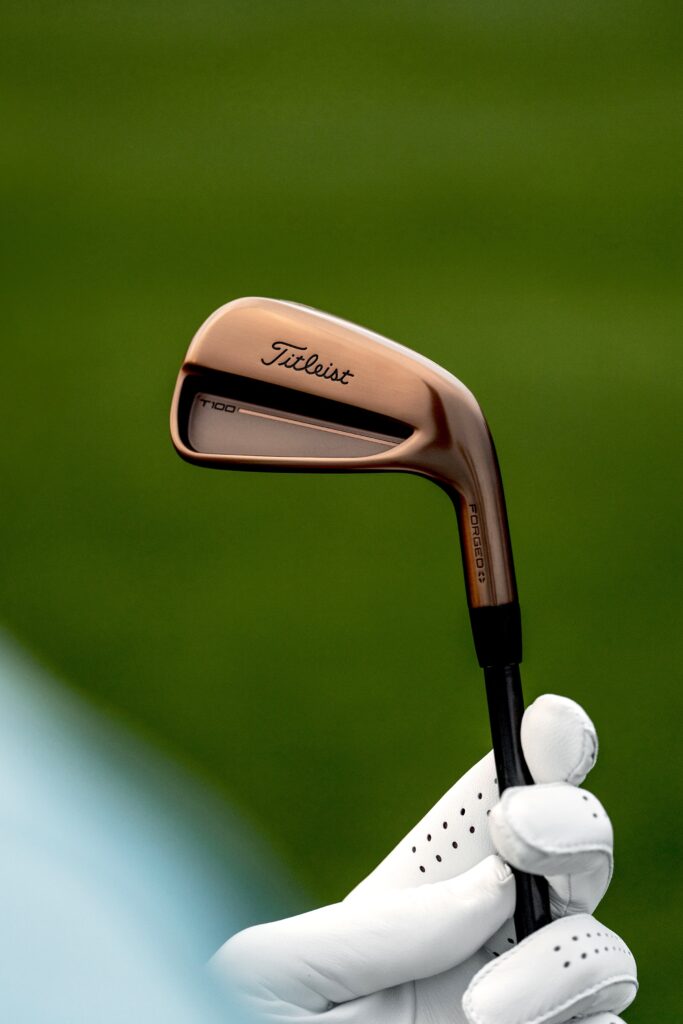
The T100 remains the purist’s choice in the lineup. It sits in a fully forged head with a compact profile, thin topline and minimal offset, which is another way of saying it does not arrive with training wheels. This is the model for the accomplished ball-striker who wants control, consistency and the sort of feedback that tells you exactly where you made contact, even if you would rather not know.
Titleist notes that T100 has been the most played iron model on the PGA TOUR since the platform launched in 2019. That speaks to trust, not fashion.
Best for: low handicappers, competitive golfers, strong ball-strikers
Strengths: precision, feel, workability, compact look
Potential weakness: less help on off-centre strikes than the larger models
T150: the quicker, more forgiving player’s iron
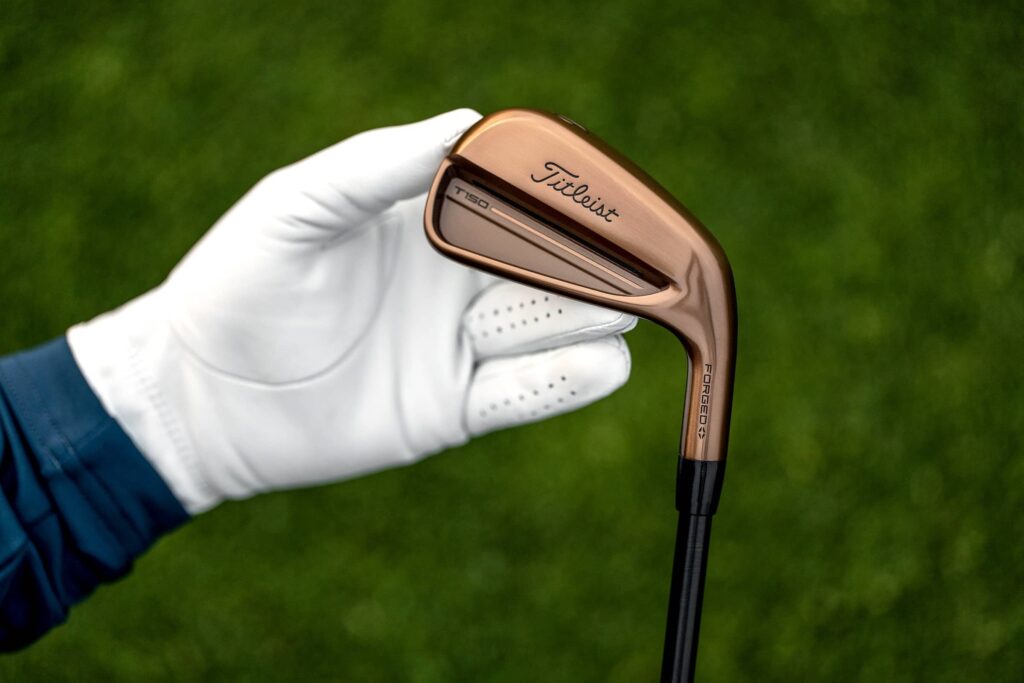
The T150 is the sensible middle child who ended up being rather successful. It offers more speed and launch than T100 while retaining much of the compact, player-friendly look better golfers prefer. The profile is slightly larger, which gives a little more confidence at address, and the brief here is clear: keep the feel and control, then make life fractionally less demanding.
For many single-figure golfers, and a fair few good mid-handicappers, this may be the sweet spot of the whole range.
Best for: low- to mid-handicappers wanting control with added help
Strengths: blend of feel, stability, launch and speed
Potential weakness: not quite as compact as T100, not quite as forgiving as T250
T250: distance iron without the usual clumsiness
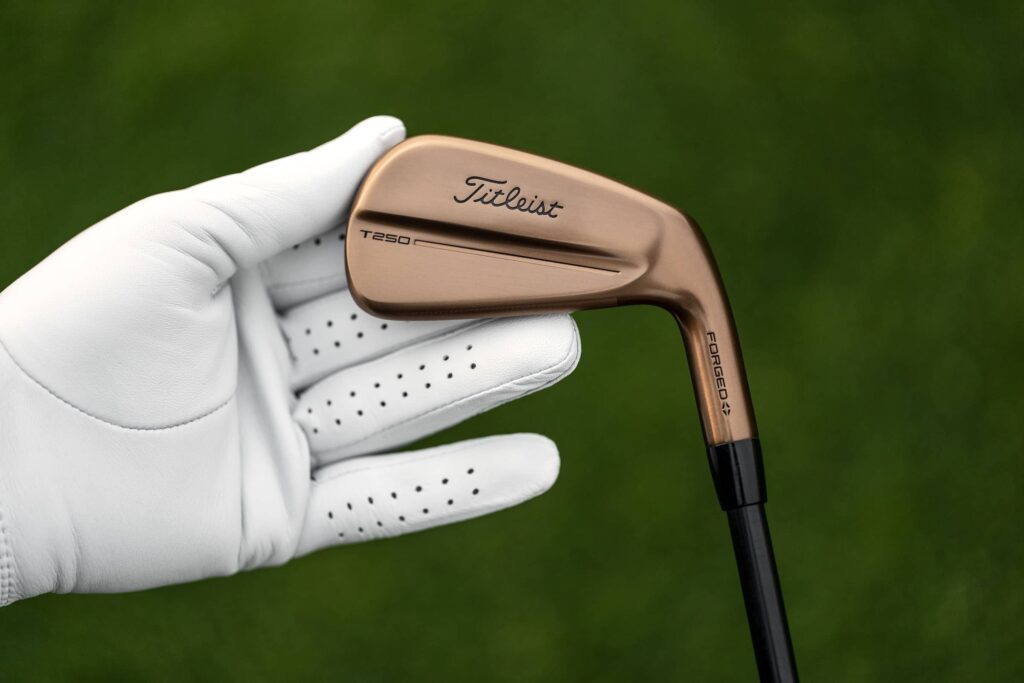
The T250 is pitched as the player’s distance iron, and that category can sometimes produce clubs that promise elegance and deliver something closer to a kitchen appliance. This one, on paper at least, seems to avoid that trap.
With a thicker topline and wider sole than T100 and T150, T250 is built to provide more launch, more speed and more forgiveness while maintaining a cleaner, sharper profile than many irons in this category. For golfers who want stronger distance performance but still prefer a traditional Titleist look, this could be the most interesting head in the bunch.
Best for: mid-handicappers, improving players, golfers seeking speed and launch
Strengths: distance, forgiveness, confidence at address
Potential weakness: less compact and less workable than T100 or T150
T350: maximum help, minimum drama
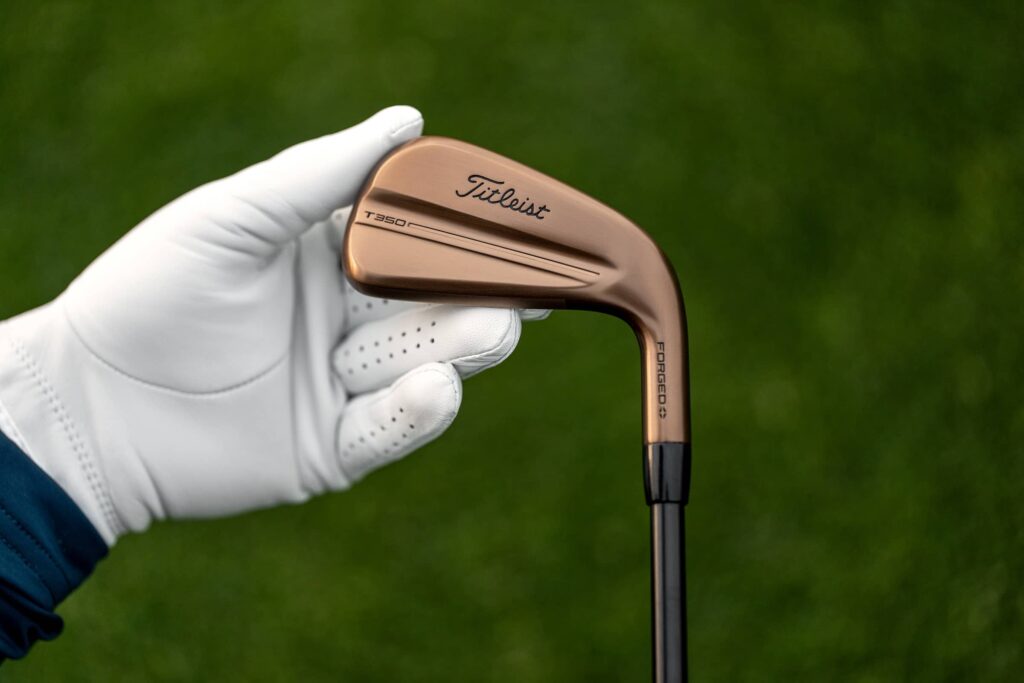
The T350 is the game-improvement option, which is often code for “please rescue me from myself.” It delivers the highest levels of distance, forgiveness and launch in the T-Series family, and it does so within an all-steel construction that helps the model sit more neatly alongside the rest of the range.
That all-steel design matters for golfers considering blended sets, because it avoids the visual disjointedness that can occur when long irons and short irons look like they belong to entirely different species.
Best for: mid- to high-handicappers, slower swing speeds, golfers prioritising launch and forgiveness
Strengths: easy launch, stability, long-hitting performance, forgiveness
Potential weakness: less compact feel and less shot-shaping precision than the smaller models
What the Oil Can finish means in real terms
The finish itself does not make the ball go any farther, any straighter or any softer into a breeze. It is not meant to. What it does is add durability, cut down reflectivity and give a proven iron lineup a distinct visual identity.
That may sound cosmetic, but golfers are not robots. Confidence matters. Familiarity matters. Liking what sits behind the ball matters. A club that looks right to the player can often free up a better swing than one that merely tests well in a fitting bay.
So while the PVD Oil Can treatment is not a performance technology in the launch-monitor sense, it can still influence performance in the real, untidy world where human beings stand over golf shots with opinions.
Blended sets remain the smartest part of the story
One of the more interesting elements in the release is not the finish at all, but the emphasis on blended set fitting. Titleist says around 80% of its brand ambassadors currently playing on the PGA TOUR and DP World Tour use a mix of at least two Titleist iron models.
That tells you two things. First, even elite players do not expect one iron model to do every job equally well. Second, ordinary golfers would probably benefit from a little less tribal loyalty to the idea of a “full matching set” and a little more honesty about what actually helps them score.
The fitting goals are sensible enough: proper ball speed gapping, consistent peak height and descent angles in long irons that still allow the ball to hold a green. That is the kind of boring, useful detail that saves strokes while flashier marketing is busy admiring itself in a mirror.
Stock build details and custom fitting options
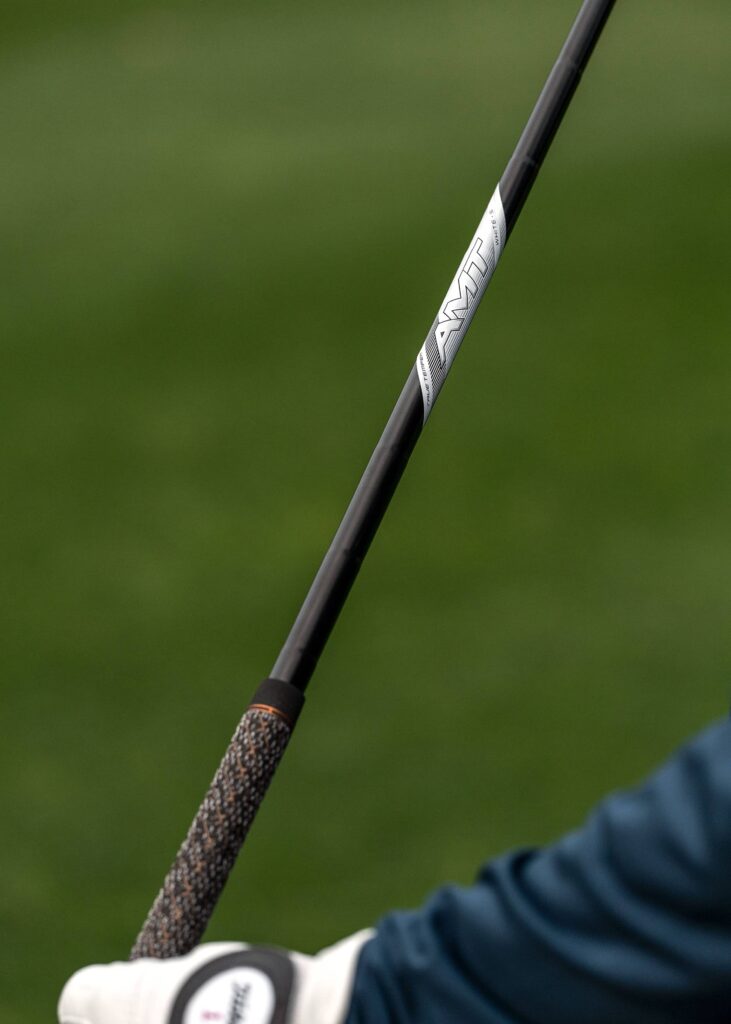
The stock shaft pairings are split by model:
- T100: True Temper AMT Tour White Onyx
- T150: True Temper AMT Tour Silver Onyx
- T250: True Temper AMT Tour Black Onyx
- T350: True Temper AMT Tour Red Onyx
- Grip: Titleist Golf Pride Z-Grip Full Cord (custom)
Custom order options are extensive, which is exactly what you would expect from Titleist. Loft and lie can be adjusted at least 2 degrees either way, while club length can be built up to 2 inches over standard or 4 inches under, in quarter-inch increments. That gives fitters and golfers plenty of room to create something more useful than a generic off-the-rack compromise.
How Titleist compares in this category
Against competitors in the players’ iron and players’ distance space, Titleist continues to lean on clean shaping, tour credibility and fitting depth. Where some rival brands push harder on outright launch-monitor fireworks or heavily stylised cosmetics, Titleist tends to take the more tailored route: precise categories, understated looks and strong custom integration across the set.
That will suit golfers who value control, consistency and bag composition over raw marketing noise. It may not be the cheapest route into premium irons, but it is often one of the most coherent.
Strengths and weaknesses
What stands out
The obvious strength is that Titleist has not tried to reinvent an already successful iron family. The Oil Can finish adds visual distinction and reduced glare, while the four-head structure still offers a clear ladder from tour precision to full-blooded game improvement.
The second strength is the blended-set potential. This is where Titleist has long been cleverer than many brands, and the uniform finish only improves that proposition.
What may divide opinion
Price will be a consideration. The suggested retail price is £250 per club in steel and £265 per club in graphite, which places these firmly in premium territory. Limited-edition finish or not, that is still real money.
The other point is simple: golfers who prefer a bright chrome look or who want radical visual differentiation may not fall for the copper-toned styling. Taste, unlike loft, cannot be adjusted in one-degree increments.
Verdict: stylish without becoming silly
The smartest thing about these limited-edition Titleist T-Series Oil Can irons is that they do not mistake novelty for progress. The finish is striking, yes, but the substance remains in the fitting architecture, the model separation and the clarity of purpose across the lineup.
T100 will appeal to the exacting player. T150 looks like the all-rounder. T250 should tempt the golfer chasing speed without sacrificing shape. T350 remains the safety net for those who would prefer their irons to be helpful rather than judgmental.
As limited-edition releases go, this feels considered rather than contrived. It gives a proven iron family a fresh face, keeps the performance story intact and adds just enough theatre to make golfers stop, stare and begin mentally rearranging their bags.
For a brand that trades on trust as much as glamour, that is probably the point. And, annoyingly for the rest of the market, Titleist has pulled it off rather well.
Find a fitting near you: https://www.titleist.co.uk/fitting
Experience the online Titleist iron selector tool: https://www.titleist.com/golf-clubs/irons-selector