 Robert Theodorson
The U.S. Open wasted no time reminding everyone of its job description on Thursday: arrive looking stern, remove all comfort, and make very wealthy golfers question most of their recent life choices.
An early fog delay gave the opening round a suitably eerie beginning, as though Shinnecock itself wanted a little extra time to sharpen the furniture. Once play finally settled into its rhythm, the message was clear enough. This was not going to be a birdie exhibition. This was going to be a negotiation, and the course had brought lawyers.
Only a select few managed to emerge under par. Everyone else spent the day discovering that a U.S. Open scorecard can become accusatory very quickly when the wind gets up, patience thins out and the margins begin behaving like a tax audit.
Shinnecock Makes The First Move
There are difficult golf courses, and then there are courses that appear to take things personally. Shinnecock was firmly in the latter category.
The day had the feel of a long major championship slog from the start, beginning around 6am and stretching into the sort of hours where caddies start walking like men carrying bad news. The fog delay did not soften the place. If anything, it merely added atmosphere to the ambush.
For most of the field, par was not a target so much as a polite fantasy. The scoring suggested a familiar U.S. Open truth: perfection is not encouraged, it is demanded, and even then it may be returned unopened.
If Friday follows the same script, the cut line looks likely to sit somewhere over par, which is hardly unusual in this championship. Still, there is a difference between tough and suffocating. Shinnecock leaned towards the latter with a straight face.
McIlroy Looks Sharp, Then Finds The Sting
Among the early starters, Rory McIlroy looked as composed as anyone. For much of the day, he carried the air of a man who had read the room properly while others were still looking for the door.
At three under, McIlroy had one of the finest scores on the course and, for a decent stretch, the best number in the field. His game looked tidy, his tempo persuasive and his control good enough to suggest he might be about to steal a march while the rest of the leaderboard was still coughing up sand.
Then came the late sting. Two closing bogeys erased the shine and left him walking off with the familiar irritation of a player who had done most of the hard work and then dropped the tray near the kitchen.
It was not a disaster. Far from it. But at a U.S. Open, late bogeys have a way of feeling less like dropped shots and more like personal insults delivered in public.
Scheffler Shows Why He Is Never Really Out Of It
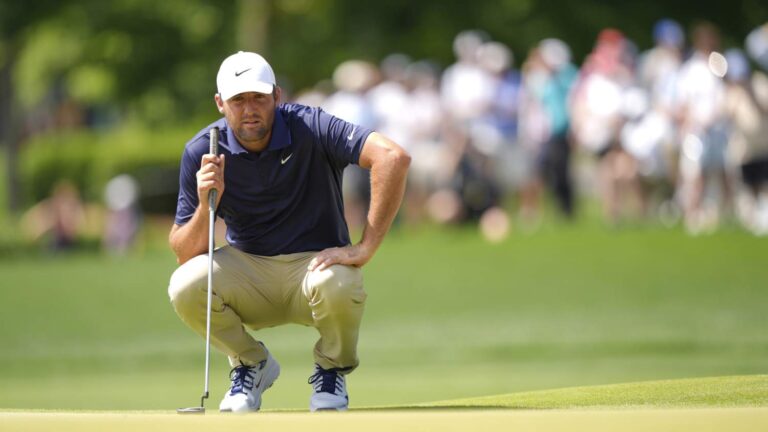
Scottie Scheffler’s opening round was not exactly elegant. It was, however, very Scottie Scheffler.
His front nine was a scrambled composition of two bogeys, a double and a lone birdie, leaving the world’s number one golfer in the sort of position where lesser players start doing mental arithmetic and staring into hedges. Scheffler, naturally, did not appear especially interested in panic.
Playing into the gusts on the back nine, he fought his way back with three scoring holes, offset by two more bogeys, and eventually signed for a two-over round. On paper, that is not the dream start expected of the presumed favourite for the 2026 U.S. Open. In practice, it was a useful piece of damage limitation.
Scheffler has made a habit of hanging around long enough to become everyone else’s problem. If he reaches Saturday evening within touching distance of the leaderboard, the rest of the field will know he is not there for the sandwiches.
Big Names Already Under Pressure
The U.S. Open does not wait politely for reputations to catch up. Several notable names now face a Friday that looks less like a second round and more like a rescue mission.
Cam Smith and Chris Gotterup both sit at five over, which is unpleasant but not terminal if something extraordinary arrives quickly. Si Woo Kim and reigning U.S. Open champion J.J. Spaun are at seven over, where the mathematics become rather more unforgiving.
Spaun has already proved that late surges are not impossible. But based on Thursday’s evidence, asking Shinnecock for a round several shots under par is rather like asking a crocodile to pass the butter. It may technically hear you. It is unlikely to oblige.
The bigger issue for those near the bottom is not simply the number. It is the nature of the place. Shinnecock did not look like a course waiting to be solved. It looked like one patiently collecting evidence.
A Championship Already Doing Its Job
This is exactly the version of the U.S. Open many traditionalists claim to enjoy, usually from the safety of a sofa and with no obligation to hit a four-iron from a hanging lie.
The first round delivered pressure, discomfort and a leaderboard that already has a few expensive dents in it. McIlroy showed enough to remain a genuine threat. Scheffler showed enough to remind everyone why he cannot be dismissed. Others, including Smith, Gotterup, Kim and Spaun, now have little choice but to attack a course that seems to regard attacking golf as poor manners.
Friday will decide who survives the weekend and who spends it wondering where the wheels first began to wobble. At Shinnecock, that answer may be simple enough: somewhere between the first tee and the car park.