 Andy Devaney
For decades, much of golf’s coaching philosophy, biomechanical research and performance analysis has been built around the male body. Yet female golfers bring different anatomical and physiological considerations to the course, from pelvic structure and joint mobility to breast health, hormonal changes and iron levels.
Movements that make perfect sense for a woman’s body can be labelled technical faults, while underlying health problems risk being mistaken for a loss of form.
It’s a gap the Ladies European Tour (LET) is working to address, with research that looks beyond clubhead speed and swing positions to understand the athlete behind the performance.
And golf may be particularly well placed to lead that change. With its wealth of swing data, performance statistics and health monitoring, the sport has an opportunity to connect the dots between biomechanics, physiology and injury prevention in ways that could benefit female athletes far beyond the fairways.
I spoke with Dr Danny Glover, Chief Medical Officer of the Ladies European Tour and Director of the LET Performance Institute, about the limitations of male-derived sports science, the research reshaping our understanding of women’s golf, and why everything from breast support to a routine blood test could prove as important as another session on the driving range.
The Problem With the ‘Ideal’ Golf Swing
Is a woman’s golf swing being judged against the wrong definition of “normal”?
In many ways, yes. Most of the biomechanical models, coaching cues and “ideal” positions in golf were built from male players. Women differ in pelvic width, hip structure, joint laxity, the distribution of muscle mass and, of course, breast tissue.
If you take a male template and measure a woman against it, normal female movement can start to look like a fault. I’m not saying there’s no such thing as poor technique in women. I’m saying we need female reference data before deciding what’s an error and what’s simply how a female body organises the swing.
How much of lower-back, neck and wrist pain is swing mechanics versus strength, recovery, workload or health?
Mechanics matter, but a change in mechanics often matters more. A player who has swung a certain way for years has usually adapted to it, so I’m far more interested when something shifts. That might be a swing change, new equipment, a compensation for a niggle elsewhere, or a sudden jump in practice volume.
As in any sport, injuries in golf are multi-factorial, and it’s rarely one single factor. When I see a back, neck or wrist problem, I’m looking at how much the player has been hitting, travel, sleep, strength and conditioning, recovery and her general health, as much as at the swing itself.
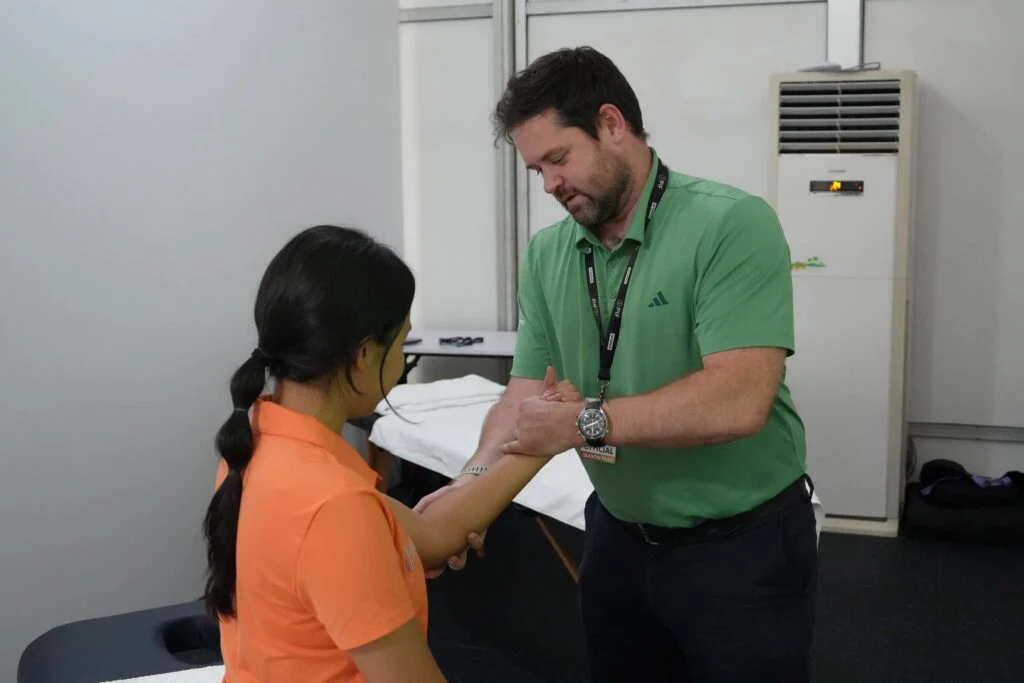
The key thing we can influence is tissue tolerance. If a player builds her capacity through well-structured training and proper recovery, her body can cope with the load the swing puts through it. Injury tends to happen when the load outstrips that capacity. So the swing is often where the injury shows up, but not always where it starts.
Could we have spent years coaching women out of movements that suit their anatomy?
I think it’s very likely in some cases. Hip and pelvic rotation patterns, how a player creates width, and how she uses ground force can all legitimately differ in women.
If a coach works to “fix” a movement that was actually a sensible adaptation, the player can lose speed or shift load somewhere less able to cope with it, often the lumbar spine or the lead wrist. The honest answer is that we don’t yet have enough female data to say exactly where that line is. That’s precisely the gap we’re trying to close.
The Overlooked Health Questions in Women’s Golf
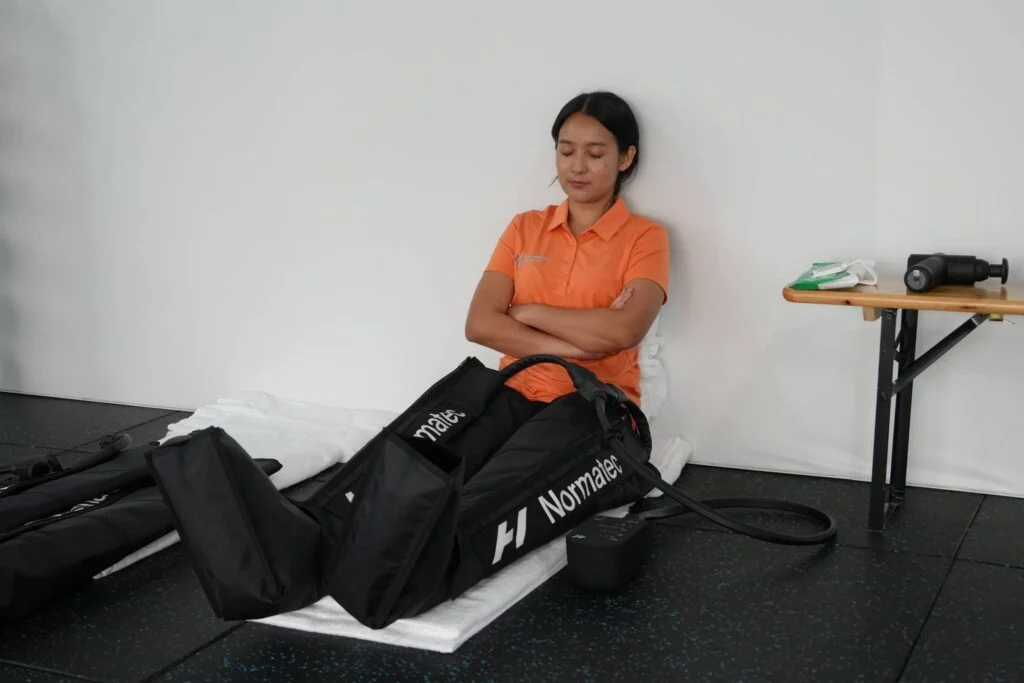
How much can menstrual health affect training, recovery, injury and performance, and what should golfers track?
For some women, very little. For others, a great deal, and that variation between individuals is the most important point.
There is currently no good evidence to support a blanket approach where every player trains, recovers or competes differently according to the phase of her cycle. The best research so far, including large reviews pooling dozens of studies, suggests any average effect of cycle phase on performance is small and inconsistent.
The differences between individual women are far bigger than the differences between phases. Telling a whole squad to back off in one phase or push hard in another isn’t supported by the science, and it risks making women feel their bodies are a limitation.
What does matter is how the cycle affects that player. Symptoms such as pain, heavy bleeding, fatigue, poor sleep, gut upset and mood changes can clearly affect training quality and recovery. Heavy bleeding is also a major driver of iron loss.
So rather than a phase-based plan for everyone, I’d encourage players to track:
- cycle length and regularity
- bleeding heaviness
- symptoms and how severe they are
- sleep and energy
- how training and competition felt
Over a few months, patterns appear, and then you can individualise. A missing or irregular period is not a performance badge. It’s a medical signal and should be investigated.
What has the LET research taught you about breast support?
Mainly that it’s been completely overlooked. Through the LET Performance Institute, we’ve worked with the Research Group in Breast Health at the University of Portsmouth, Professor Joanna Wakefield-Scurr and Lewis Clarke from the PGA.
Fewer than one in five players had ever received formal guidance on breast support for sport. Many didn’t wear a sports bra at all because they didn’t see golf as demanding enough. Yet nearly half said breast-related discomfort or distraction had affected them during a round. Players who were screened felt the breast and bra influenced their technique and performance, particularly at set-up and in the backswing.
Golf looks gentle, but the swing involves fast rotation, acceleration and deceleration through the torso. The breast has very little supporting structure, so without adequate support it moves substantially in all directions.
I’d be careful not to claim we’ve proven a performance gain yet. That’s the next phase: looking at how breast movement and support influence spinal loading, torso movement and swing mechanics. But on comfort and confidence, the message from players has been very clear.
How does a golfer know her sports bra is genuinely suitable for golf, not just comfortable?
Comfortable standing still is not the test. The test is how it performs through a full-speed swing, repeatedly, over four or five hours. Practical checks:
- Does the band sit level and firm without riding up when you rotate?
- Do the cups fully contain the breast without spilling or gaping?
- Do the straps stay put without digging in?
- Is there any movement, rubbing or discomfort at the top of the backswing or through the finish?
- Does it stay comfortable in heat, when wet and late in the round?
Make a few full swings in it before buying, and ideally get professionally fitted. Size and shape change with weight, training, the cycle, pregnancy and age, so it’s worth re-checking regularly.
When the Swing Isn’t the Problem
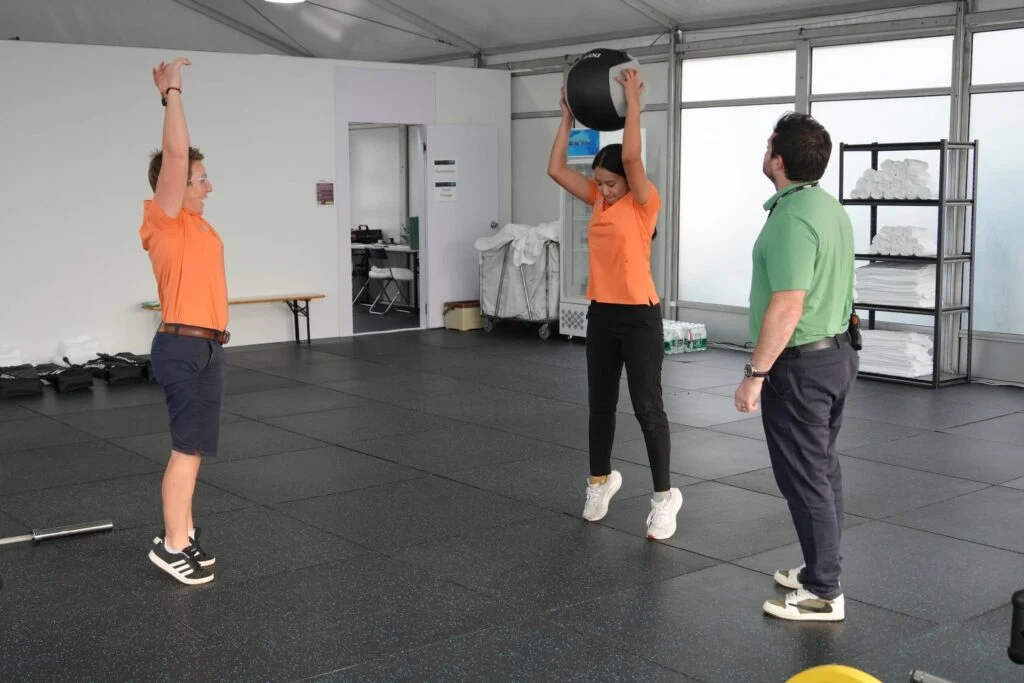
When an athlete loses speed or gets injured, how often is it treated as biomechanical when it’s physiological?
More often than it should be. As I said earlier, injury and changes in performance are usually multi-factorial. A drop in clubhead speed could be biomechanical, but it could equally be related to a number of other things:
- fatigue, or accumulated training and travel load
- poor sleep or inadequate recovery
- low energy availability or under-fuelling
- iron deficiency
- illness or a recent infection
- thyroid or other hormonal changes
- an emerging injury or a compensation for pain elsewhere
- loss of strength or conditioning
- stress or mental fatigue
- equipment changes
The natural reaction is to look at the swing or the equipment first, because that’s what’s most visible. But sometimes the best swing intervention is a blood test.
Personally, I’d like to see the medical and performance teams working much more closely together. In golf, that doesn’t happen as naturally as you might think. Through the LET Performance Institute, we’ve made real progress in bringing the medical and performance sides together as a genuine multidisciplinary team. Doctors, physios, S&C and sports science staff now share information and look at the player as a whole.
The missing piece is the coach. Coaches are usually employed privately by the player, so we’ve had little to no exposure to them, and they’re often the person who sees the swing change first. Bringing coaches into that conversation is the next step. That way, an unexplained drop in performance becomes a question everyone asks together: has something changed in this athlete’s health, not just in her swing?
Could swing data eventually detect health problems before the athlete notices?
That would absolutely be the goal. Golf is an incredibly data-rich sport, across both performance and health. Players have launch monitor and swing data, strokes-gained statistics, wearables, sleep tracking, training load and medical information.
The problem is that much of this data is siloed. It sits with different people, on different platforms, and rarely talks to each other. We can already use individual metrics well. Heart rate variability, for example, gives us a useful window into recovery. But we don’t yet have the algorithms and technology to bring it all together and show how a change in health shows up in the swing, or the other way round.
That’s exactly what ORB for Sport is working on through its Athlete Health Passport, which players are already using. It brings a player’s health and performance information together in one place that she owns and controls. The aim is to spot meaningful changes against her own baseline earlier, so the medical and performance team can have the right conversation before a small problem becomes an injury or a lost season.
Whatever we build, the athlete’s consent and ownership of her data have to be at its core. The goal is earlier conversations, not surveillance.
What do we know about iron deficiency in female golfers, and should women who menstruate be checked routinely?
Honestly, golf-specific data is limited, which is itself part of the problem. Across sport, iron deficiency is reported in around 15–35% of female athletes, compared with 3–11% of male athletes.
Golfers aren’t immune. Long days, travel, variable diet and heavy periods all add risk. You can also be iron-deficient without being anaemic, so a normal haemoglobin doesn’t rule it out.
My view is that any woman training and competing seriously who menstruates should have ferritin checked as part of routine screening. Some sports science guidance suggests screening women twice a year or quarterly, depending on their history. What I’d caution against is self-prescribing iron without testing, because too much is also harmful.
Rethinking Sports Medicine Around the Female Athlete
What would female-specific sports medicine look like if designed from scratch around women?
It would start with the female athlete as the default, not the adjustment. That means:
- menstrual, pelvic, breast and bone health as part of routine screening, not niche add-ons
- reference data, kit and equipment built on female bodies
- care across every life stage: adolescence, pregnancy, return to play after childbirth, and perimenopause
- staff who are comfortable having these conversations
- research designed around women from the outset
That’s the thinking behind the SWING study, the Survey of Women in Golf, led by Professor Margo Mountjoy. It looks specifically at pelvic, endocrine and reproductive health. Golf is the first sport, and the design is intended to be repeated across others. Women’s golf has an opportunity to lead here rather than follow.
What emerges from Dr Glover’s answers is not an argument for treating every female golfer differently simply because she’s a woman. It’s a case for understanding the individual athlete rather than measuring her against a template that was never designed for her in the first place.
There’s still plenty the research cannot tell us. The relationship between breast support and swing performance remains under investigation, golf-specific evidence on iron deficiency is limited, and the technology needed to connect changes in health with changes in performance is still developing.
But the direction is clear. Through the LET Performance Institute and initiatives such as the SWING study, women’s golf has an opportunity to build a more complete picture of female athlete health, with medical teams, performance specialists and eventually coaches working from the same information.
The real breakthrough may not be discovering a better way for women to swing a golf club. It may be recognising when the swing was never the problem to begin with.