
 Andy Devaney
A round of golf is not where most people expect to confront cardiac arrest, which is precisely why cardiac arrest on golf courses deserves more than a polite nod towards “safety”.
Around 400 golfers in the UK suffer a cardiac arrest each year. During Air Ambulance Week this September, England Golf and Air Ambulances UK are asking clubs to look again at CPR awareness, access to defibrillators and the emergency plans that suddenly matter when the scorecard does not.
Thirteen shocks on the way to hospital
Paul, a golfer from Cookham in Berkshire, was playing in Milton Keynes when he suffered a catastrophic cardiac arrest. Thames Valley Air Ambulance was dispatched from RAF Benson, more than 30 miles away, and reached the golf course in 16 minutes.
Doctor Chloe Spence and Critical Care Paramedic Jo Meadham arrived to deliver advanced cardiac care. Paul’s heart repeatedly stopped and restarted. During the journey to hospital, the crew administered 13 defibrillator shocks as they fought to keep him alive.
“It was the toughest cardiac incident both Jo and I have ever attended. Paul was critically ill. His heart was in and out of life-threatening rhythms, stopping and starting, requiring advanced intervention to get it to restart all the way to hospital. He was as critical as one can be, but Paul was a fighter and he battled to stay alive,” Dr Spence said.
There is no tasteful way to make 13 shocks sound routine. That is rather the point.
The striking number is not only 16 minutes
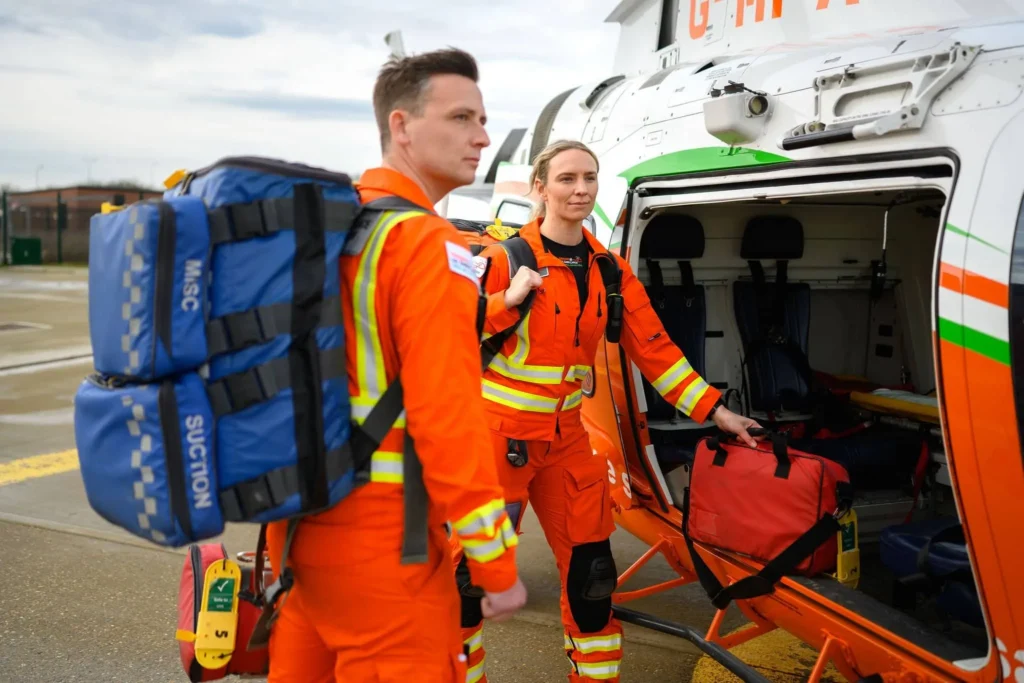
The speed of the response is extraordinary, but the more useful detail for golf clubs is what arrived with it. The air ambulance brought a doctor and critical care paramedic capable of providing advanced treatment on the course and continuing that care on the way to hospital.
Air ambulance charities collectively attend around 137 lifesaving missions every day across the UK, taking critical care directly to people with life-threatening illness or injury.
Paul’s case gives that statistic a face. Emergency response is not an abstract box for a club committee to tick once a year; on the wrong afternoon, it becomes the difference between having help in place and discovering what the gaps are under pressure.
A defibrillator only helps if the club is prepared
England Golf’s support for Air Ambulance Week is aimed squarely at preparedness. Clubs are being encouraged to review emergency arrangements, ensure access to defibrillators and improve awareness of the work carried out by local air ambulance charities.
Early CPR and access to a defibrillator can significantly improve survival rates after cardiac arrest. That makes the practical question fairly simple: does the club know how it would respond?
This is not an argument for turning every fourball into a roaming medical unit. It is an argument for removing avoidable uncertainty. A defibrillator somewhere on site is useful; a club that has actually thought through an emergency is better placed to make that equipment count.
Around 400 golfers a year makes this a golf issue
The figure that should hold the attention of club managers and golfers alike is around 400 cardiac arrests among UK golfers each year. That is roughly one golfer a day.
Golf is usually discussed in the language of pace of play, handicaps, course conditioning and the occasional argument about dress codes. Cardiac arrest sits less comfortably in the conversation, but discomfort is not a reason to ignore a recurring risk.
Mark Heaven, Head of Corporate Fundraising at Air Ambulances UK, said: “Paul’s story demonstrates why rapid access to emergency care, CPR and defibrillation can make such a difference when every minute counts.”
That is the practical centre of the campaign. The point is not to make golfers anxious about stepping onto the first tee. It is to make clubs less likely to be caught improvising when somebody suddenly needs urgent care.
Paul’s recovery is the part worth remembering
After emergency treatment in hospital to remove a blood clot blocking his heart, Paul made a remarkable recovery and has returned to work full-time.
“I am so grateful to Thames Valley Air Ambulance for reaching me so quickly, acting so calmly in a chaotic situation and to everyone that battled to save my life. It was a terrifying ordeal and I feel incredibly lucky to be alive. I am under no illusion that without the incredible skill and emergency treatment I received, I would not be alive today,” he said.
For Air Ambulance Week, England Golf and Air Ambulances UK want clubs to use cases such as Paul’s as a prompt rather than a scare story: check the emergency plan, think seriously about CPR and make sure defibrillator access is not merely assumed.
Golf has rules for almost every awkward situation a player can manufacture. Cardiac arrest is one occasion when the important preparation needs to happen before anyone asks what the ruling is.